China, Eliminated in Qualifiers, Shows Great Interest in Qatar World Cup
Many Chinese Companies Involved from Official Ball and Souvenirs Production to Stadium Construction
Online, Mixed Feelings of Envy and Anger Over No-Mask World Cup
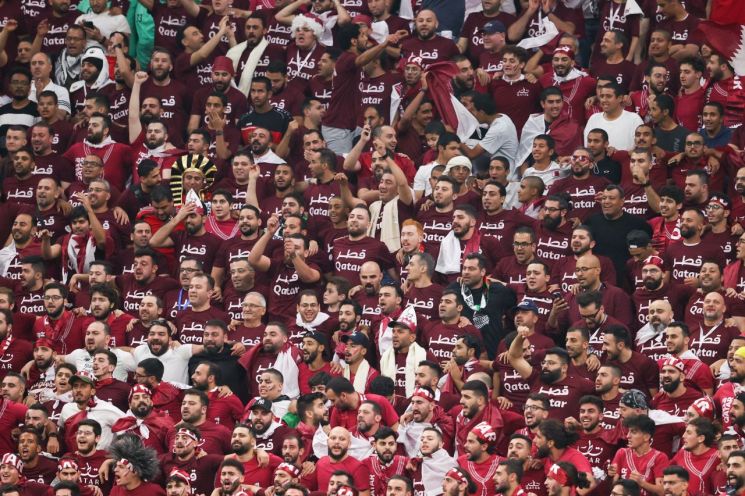 On the 20th (local time), football fans at Al Bayt Stadium in Al Khor, Qatar, cheered the Group A first match of the 2022 FIFA Qatar World Cup opening game between Qatar and Ecuador without wearing masks. Photo by TASS Yonhap News
[Asia Economy Reporter Hwang Sumi] China is showing interest in the 2022 FIFA Qatar World Cup comparable to that of the qualified teams. Many Chinese express envy at the sight of global football fans enjoying the tournament without masks. They criticize the government's stringent 'Zero COVID' policy and voice frustration, feeling as if they are living in a different world despite being in the same era.
The Chinese national football team is absent from the 2022 Qatar World Cup. They failed to secure a spot in the finals after a poor performance in the Asian qualifiers, winning only one match. At that time, the Chinese team suffered a heavy defeat to Vietnam, considered the weakest team, shocking domestic football fans.
Nevertheless, China is showing great interest in this World Cup. According to Yonhap News, advertisements related to the World Cup have been displayed in subway stations and roads in the capital Beijing, as well as on various internet sites, and major state-run media are covering World Cup news as top stories.
Many Chinese are traveling to Qatar to watch the matches. Citing data from the online travel agency Ctrip, the state-run Global Times reported that as of the 11th, flight bookings from China to Qatar have increased more than 28 times compared to last year. It is also known that thousands of Chinese have purchased World Cup tickets.
One reason behind this is the hidden influence of Chinese companies in this World Cup. According to Zhongxin Network, many Chinese companies supplied various materials and participated in infrastructure construction in Qatar, which lacks a manufacturing base.
About 70% of miscellaneous items used in this World Cup, such as official balls, whistles, souvenirs, and participating countries' flags, were produced in Yiwu, Zhejiang Province, China. The Lusail Stadium, the main stadium of the Qatar World Cup, was also built by a Chinese company. With a capacity of around 80,000 spectators, Lusail Stadium is the largest among the eight stadiums hosting matches in this World Cup. It was the venue where Saudi Arabia caused an upset by defeating Argentina 2-1 in the first match of Group C on the 22nd (local time). China Railway Construction Corporation was awarded the contract to build this stadium in November 2016. Chinese companies also participated extensively as partners in constructing other stadiums such as the 974 Stadium and various social infrastructure facilities.
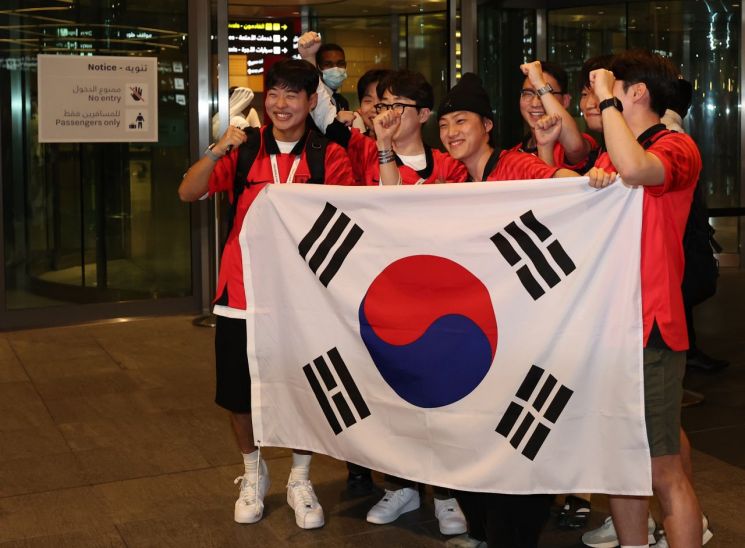 On the 16th (local time), Korean soccer fans are posing with the Taegeukgi flag unfolded at Hamad International Airport in Doha, Qatar. Photo by Yonhap News
In China, the sight of global football fans enjoying the World Cup without masks is drawing attention. The Qatari government relaxed COVID-19 prevention policies ahead of the World Cup, allowing spectators to enjoy the tournament without masks.
This contrasts sharply with the situation in China. Recently, as COVID-19 has rapidly spread, China has tightened its prevention measures again. According to data released by Chinese epidemic prevention authorities on the 23rd, the cumulative number of new COVID-19 infections in China from the 1st of this month to the previous day reached approximately 280,000.
Especially in major cities such as the capital Beijing and Guangzhou, known as a manufacturing hub, the spread is severe. Chinese epidemic prevention authorities have assessed the situation as the most serious and complex in three years. Hu Xiang, a level 2 inspector at the Chinese Center for Disease Control and Prevention, expressed at a recent briefing, "The outbreak is concentrated in large cities with high population mobility, the spread is wide, and due to the strong transmissibility of the Omicron variant, complex infection routes, and shortages of prevention personnel and resources, prevention and control are difficult."
As a result, some regions have already entered lockdown-style epidemic control. The COVID-19 Prevention and Control Center in Shenyang, Liaoning Province, announced that until the 28th, strict control measures limiting unnecessary population movement will be implemented in nine urban districts. All residents must undergo daily polymerase chain reaction (PCR) testing, and violations may be punished according to regulations. Indoor business facilities such as theaters, gyms, bathhouses, and karaoke rooms, as well as indoor public facilities like night markets and cultural centers, have been completely closed. Events involving large gatherings such as meetings and assemblies are also prohibited.
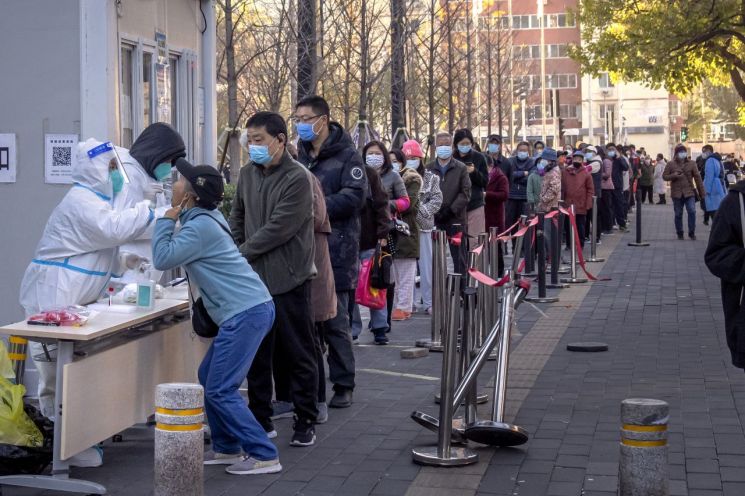 On the 15th, citizens lined up to receive COVID-19 polymerase chain reaction (PCR) tests at a screening clinic in Beijing, China. Photo by Yonhap News Agency
As prevention measures have not eased but instead intensified, Chinese netizens are voicing anger. Analysts note that the World Cup has prompted an increase in people questioning the government's Zero COVID policy. Seeing spectators cheer for players without masks at the Qatar World Cup broadcast daily, Chinese people feel both envy and anger toward the government's strict prevention measures.
According to AFP, a resident of Guangdong Province lamented on Weibo (China's version of Twitter), "Some people watch the World Cup matches in person without masks, while others are confined at home for a month without being able to step outside." He added, "Who stole my life? I will not say." Another netizen from Shanxi Province expressed disappointment with the authorities, saying, "The World Cup has shown many Chinese the real situation abroad."
One netizen asked on WeChat, "Why is China controlling and pressuring so much when other parts of the world are enjoying the World Cup as before the pandemic?" According to Bloomberg, he directly questioned, "Spectators at the Qatar World Cup did not wear masks or need PCR tests. Are they really living on the same planet as the Chinese?" This post rapidly spread, garnering 100,000 views, but was soon deleted. WeChat blocked the account citing 'violation of related regulations.' Bloomberg reported that the prevailing analysis is that this was not WeChat's decision alone but the invisible hand of Chinese authorities at work.
© The Asia Business Daily(www.asiae.co.kr). All rights reserved.



















