Leaders of Six Economic Organizations Gather to Announce Joint Statement
"South Korea the Only Country Implementing Safety Freight Rates
Opposition Also from European Shippers' Council"
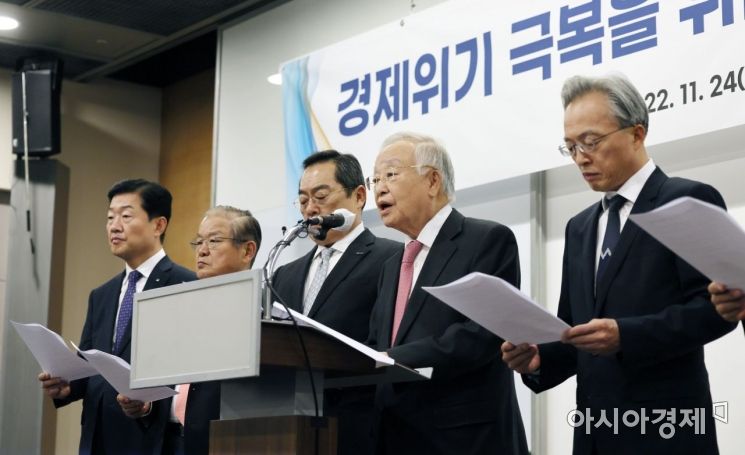 Son Kyung-sik, Chairman of the Korea Employers Federation, holds a press conference on the 24th at the Korea Chamber of Commerce and Industry in Jung-gu, Seoul, to announce the position of six economic organizations for overcoming the economic crisis. Attending the press conference were Son Kyung-sik, Chairman of the Korea Employers Federation; Koo Ja-yeol, Chairman of the Korea International Trade Association; Choi Jin-sik, Chairman of the Korea Federation of SMEs; Woo Tae-hee, Executive Vice President of the Korea Chamber of Commerce and Industry; and Kwon Tae-shin, Executive Vice President of the Federation of Korean Industries. Photo by Yoon Dong-joo doso7@
[Asia Economy Reporter Choi Seoyoon] "Australia was the only country in the world to implement the Safe Freight Rate System, but it has now been abolished at the national level and is only being implemented in one state. Since there are no 'penalty fines' even there, it should be considered that no country is effectively enforcing this system."
Jung Manki, Executive Vice Chairman of the Korea International Trade Association, said this on the 24th at an emergency press conference held by six economic organizations at the Korea Chamber of Commerce and Industry building in Jung-gu, Seoul, regarding the Safe Freight Rate System, which sparked the Cargo Solidarity general strike. He said it is "the only system still alive in Korea." The Safe Freight Rate System legally guarantees a minimum freight rate that truck owners receive. Freight owners who violate this must pay a penalty fine of 5 million KRW.
"Safe Freight Rate System Triggers Massive Costs, Regulatory Overlaps, and Work Disruptions"
According to the business community, Australia introduced the Road Safe Freight Rate System on April 7, 2016, but abolished it after a short period until April 21 of the same month for three main reasons: economic costs at the national level, regulatory overlaps, and work disruptions for owner-operators.
Vice Chairman Jung said, "According to the PWC review report, the Australian government had to invest about 2.3 billion AUD (approximately 3 trillion KRW) over 15 years to build road GPS systems for the implementation of the Safe Freight Rate System," adding, "There were already regulations aimed at preventing speeding and driver fatigue, so there was an issue of regulatory overlap." He continued, "The Safe Freight Rate did not apply to employed drivers, which caused work leakage."
He mentioned, "Although it is still being implemented in a place called New South Wales, the penalty fines introduced domestically have been abolished." Under Korean law, if a freight owner pays less than the Safe Freight Rate set by the Ministry of Land, Infrastructure and Transport, a penalty fine of up to 10 million KRW can be imposed.
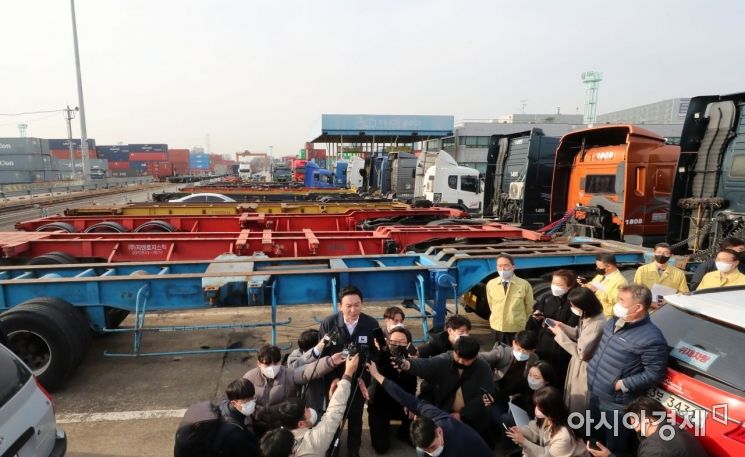 On the 24th, when the Cargo Solidarity Union began an indefinite general strike, Won Hee-ryong, Minister of Land, Infrastructure and Transport, visited the Uiwang Inland Container Terminal in Gyeonggi Province and held a briefing after an emergency situation meeting. Photo by Yoon Dong-joo doso7@
Vice Chairman Jung explained, "The freight owner is actually the person requesting the delivery of goods, so imposing fines or some kind of disadvantage on them is unreasonable. That is why even in New South Wales, penalty fines have been abolished."
He added, "The European Shippers' Council (ESC) and the Global Shippers' Alliance (GSA) have also requested active opposition, saying that if Korea implements an economically adverse system, it could negatively affect other countries as well."
Kwon Taeshin, Executive Vice Chairman of the Federation of Korean Industries, also said, "The term 'Safe Freight Rate System' itself is wrong," and pointed out, "According to traffic statistics, the number of traffic accidents involving tow-type freight trucks subject to the Safe Freight Rate System actually increased by 8% last year compared to the previous year."
However, according to the Korean Public Service and Transport Workers' Union (KPTU), Australian senators and transport unions from 65 countries worldwide expressed support for the Cargo Solidarity general strike on the 22nd. Tony Sheldon, Australian Senator for New South Wales, wrote in a letter to Jung Jin-seok, Emergency Committee Chairman of the People Power Party, that "The Safe Freight Rate System has been implemented in New South Wales for a long time and is scheduled to be implemented in Queensland starting next year," and added, "If Korea permanently implements the Safe Freight Rate System and expands its application to more items on this occasion, more lives can be saved."
"Stop Amendments to the Labor Union Act That Encourage Illegal Strikes"
The business community also stated that they cannot accept the amendments to Articles 2 and 3 of the Labor Union Act (the Yellow Envelope Act), which limit claims for damages and provisional seizures related to illegal strikes, from the perspective of protecting property rights. Lee Donggeun, Vice Chairman of the Korea Employers Federation, said, "It is natural to claim damages from the perspective of protecting property rights against illegal acts," and added, "The current law exempts constitutional disputes from civil and criminal liability for damages."
Vice Chairman Lee said regarding Article 2 of the Labor Union Act, which allows subcontracted workers to demand collective bargaining with the primary contractor, "In a capitalist society, collective bargaining is conducted between subcontracted unions and subcontracted companies with employment contracts, not with the primary contractor, which does not align with capitalist logic," and added, "There is a system that punishes unfair labor practices if the primary contractor refuses collective bargaining."
He emphasized, "Currently, legal disputes can be made over dismissal, wages, working conditions, and approval of working conditions, but if unique management decisions such as investment, hiring decisions, overseas expansion, and overseas factory construction become subjects of collective bargaining, companies will not be able to manage properly."
Joint Statement by Six Economic Organizations 'To Overcome the Economic Crisis'
On the same day, six economic organizations including the Korea Chamber of Commerce and Industry, Korea Employers Federation, Federation of Korean Industries, Korea International Trade Association, Korea Federation of Small and Medium Business, and Korea Federation of Medium-sized Enterprises issued a statement titled 'Joint Statement to Overcome the Economic Crisis' before the emergency press conference. The main points of the statement were ▲ cessation of the Cargo Solidarity transport refusal ▲ halt of amendments to the Labor Union Act ▲ relief of corporate tax and rising tax burdens.
In the statement, the business community said, "Recently, our economy is facing a complex crisis of high inflation, high exchange rates, and high interest rates, causing great difficulties," and claimed, "The unilateral transport refusal that worsens export competitiveness must be immediately withdrawn, and the Safe Freight Rate System must be abolished."
They also said, "Amendments to the Labor Union Act that encourage illegal strikes and escalate labor-management conflicts and increase uncertainty in the business environment must be stopped," and added, "The unit for calculating extended working hours should be expanded from weekly to monthly or yearly, and the sunset clause for the additional 8-hour extended working hours system applied to small businesses with fewer than 30 employees until the end of this year should be abolished."
© The Asia Business Daily(www.asiae.co.kr). All rights reserved.


















