Proactive Response Based on June Strike Experience
"Prolonged Strike Will Inevitably Disrupt Production"
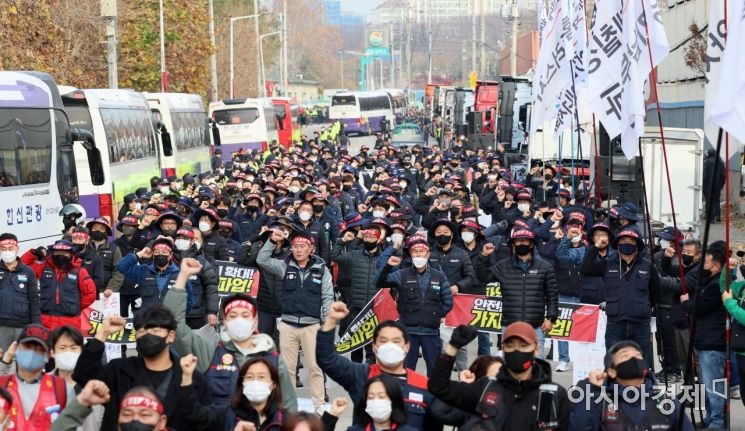 On the 24th, when the Cargo Solidarity Union began an indefinite general strike, members of the Cargo Solidarity Union held a send-off ceremony near the Uiwang Inland Container Terminal in Gyeonggi-do. Photo by Dongju Yoon doso7@
[Asia Economy Reporter Seong Gi-ho] The Cargo Solidarity Headquarters of the National Public Transport Workers' Union under the Korean Confederation of Trade Unions is pressing ahead with another strike, putting the tire industry on high alert. Having previously experienced strikes by the Cargo Solidarity, the tire industry is busy preparing countermeasures, but as logistics disruptions continue, damages are mounting. There are concerns that, in the worst case, factory shutdowns could follow.
According to the industry on the 26th, major domestic tire companies are struggling to prepare countermeasures in anticipation that the indefinite strike by the Cargo Solidarity, which began at midnight on the 24th, will continue for a considerable period.
During the Cargo Solidarity strike in June, the tire industry experienced production disruptions due to transportation failures. Hankook Tire and Kumho Tire ship up to 180,000 tires per day. However, during the strike period, daily shipments dropped to only 50,000 tires, less than 30% of normal volume. As a result, during the eight-day strike, the tire industry was affected in shipping approximately 640,000 tires (about 57 billion KRW).
In the case of Hankook Tire & Technology, product shipments were not carried out on the first day of the strike at the Daejeon and Daesan factories. Hankook Tire is focusing on securing empty containers before and after the Cargo Solidarity strike. Transportation is being carried out mainly by non-union members and union members not participating in the strike, but without securing containers, even this is impossible. This is a preemptive response based on the experience of the June strike.
Kumho Tire is taking measures such as maintaining inventory levels above appropriate stock at each logistics center before and after the strike. Additionally, they are preparing a yard space sufficient for five days' worth of stock.
The problem is that even if each company makes maximum efforts to respond, damage is inevitable if transportation itself stops. Even if production occurs at the factory, getting products out of the factory is the first issue. Also, even if shipments are made from the factory and loaded into designated storage spaces, if exports through ports do not proceed, unlimited storage is impossible due to space limitations.
The industry expects the Cargo Solidarity to escalate their level of struggle compared to before, as the Safe Freight Rate System is scheduled to be abolished on December 31.
In fact, the Cargo Solidarity instructed its members to maintain the strike formation after participating in the general strike rally of each regional headquarters the previous day and to act in a coordinated manner according to the instructions of the struggle headquarters until further notice. The tire industry is concerned that, although the Cargo Solidarity has not yet made a move, they may engage in base struggles in front of factories as they did in the previous strike.
A tire industry official said, "We are doing our best to prepare, but it is true that damage caused by the strike is not easy to overcome," adding, "If the strike prolongs, producing volume will be meaningless, so in the worst case, production stoppages may occur."
© The Asia Business Daily(www.asiae.co.kr). All rights reserved.

















