[Asia Economy Reporter Choi Seok-jin, Legal Affairs Specialist] The Supreme Court has ruled that even transgender individuals with minor children can correct their gender on the family relationship registry if they are not currently married.
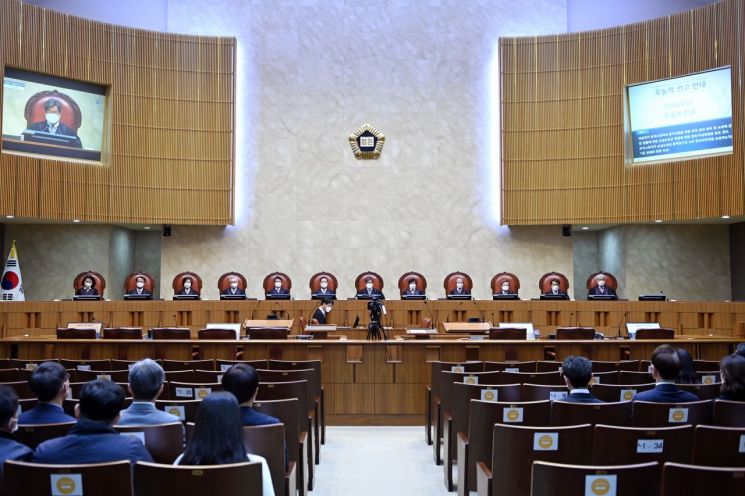
The Supreme Court en banc (Presiding Justice Park Jeong-hwa) on the 24th overturned the lower court's dismissal of A's appeal in the retrial of the gender correction case, where A had transitioned from male to female, and remanded the case to the Seoul Family Court.
The court stated, "The lower court, citing the 2011 Supreme Court en banc decision, regarded having minor children as an independent negative condition for gender correction of transgender individuals. It failed to make a substantive judgment by specifically examining various circumstances in the case records and simply denied the application on the grounds that the applicant had minor children." It added, "This judgment misinterpreted constitutional fundamental rights under Article 10, which guarantees all citizens dignity and worth as human beings and the right to pursue happiness, and Article 11, Paragraph 1, which guarantees equality before the law, as well as the legal standards for permitting gender correction for transgender individuals. It also failed to conduct necessary investigations, affecting the trial. The applicant's reasons for retrial pointing this out are valid," explaining the reason for reversal and remand.
Furthermore, the court added, "Therefore, the 2011 Supreme Court en banc decision, which holds that gender correction on the family relationship registry is not permitted for transgender individuals with minor children, along with similar decisions, shall be changed to the extent that they conflict with this ruling."
Previously, the Supreme Court's 2011 en banc decision stated that gender correction for transgender individuals would not be permitted if they were currently married or had minor children.
This case involved a transgender individual with minor children who was not married.
Until now, the Supreme Court allowed gender correction on the family relationship registry for transgender individuals but maintained that if the transgender individual had minor children, gender correction would not be permitted considering the significant negative impact on the welfare of those children.
However, this ruling changed the stance, stating that at least for transgender individuals who are not married, gender correction should not be unconditionally denied solely because they have minor children.
The court stated, "Every human being has the right to form their personality and live their life according to their gender identity. Transgender individuals should also be able to realize their personality and individuality based on their gender identity and live pursuing happiness as equal members of our society alongside others." It added, "To fully exercise these rights, transgender individuals have the right to have their gender legally recognized as their true gender."
It further noted, "This is a fundamental right derived from human dignity and worth, constituting the essence of the right to pursue happiness, and should be guaranteed to the maximum extent."
The court also pointed out, "Meanwhile, transgender individuals with minor children have the duty as parents to protect, nurture, and exercise parental authority prioritizing the welfare of their children. Therefore, when deciding whether to permit gender correction for transgender individuals with minor children, a comprehensive consideration of various factors balancing the protection of the transgender individual's fundamental rights and the protection and welfare of the minor children must be made in a substantive manner."
It continued, "Therefore, gender correction should not be denied solely on the ground that the transgender individual has minor children without substantive consideration of the above factors."
The court also stated, "Gender correction merely reflects the transgender individual's actual situation in the official registry and does not cause significant changes in the legal relationship with the children." It added, "It is incorrect to conclude that permitting a parent's gender correction exposes minor children to social prejudice and discrimination."
On the other hand, Justice Lee Dong-won dissented, stating, "Denying gender correction to transgender individuals with minor children is a reasonable decision that aligns with our legal system, the welfare of the minor children, and general social norms."
A was born male but was diagnosed with 'gender identity disorder (transsexualism)' at a hospital in 2013. After continuous hormone therapy, A underwent gender reassignment surgery at a plastic surgery clinic in Thailand in 2018.
A married in 2012 and had two children but divorced in 2018. The children were being raised by the ex-spouse and were unaware of their father's gender reassignment surgery, believing A to be their aunt rather than their father.
After legally changing their name and living as a woman with court permission in 2018, A applied to the family court in 2019 to correct the gender on the family relationship registry to female. However, the application was dismissed due to having minor children. After appealing and being dismissed again, A appealed to the Supreme Court.
A Supreme Court official stated, "This decision changes previous precedents by ruling that denying gender correction solely because a transgender individual has minor children violates the transgender individual's constitutional fundamental rights such as human dignity, the right to pursue happiness, and equality. Furthermore, it establishes that the approval of a parent's gender correction must be decided after substantive consideration of whether it concretely and practically aligns with the welfare of the minor children, confirming the transgender individual's right to have their gender legally recognized."
© The Asia Business Daily(www.asiae.co.kr). All rights reserved.
![User Who Sold Erroneously Deposited Bitcoins to Repay Debt and Fund Entertainment... What Did the Supreme Court Decide in 2021? [Legal Issue Check]](https://cwcontent.asiae.co.kr/asiaresize/183/2026020910431234020_1770601391.png)
















