Public Golf Courses Should Be 34,000 Won Cheaper Than Metropolitan Membership Non-Member Fees
Fairness Controversy Over 'Metropolitan Area·Peak Season' Price Standards... Industry Says "Government Overreach"
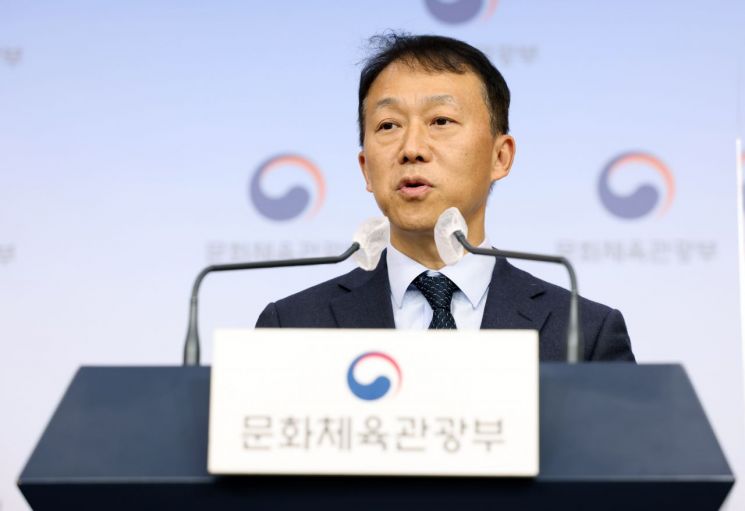 Choi Bogeun, Director of the Sports Bureau at the Ministry of Culture, Sports and Tourism, is explaining the contents of the "Notice on the Designation of Public Golf Courses" at the Government Seoul Office on the 9th. Photo by Ministry of Culture, Sports and Tourism
[Asia Economy Reporter Lee Seohee] As the government announced a new classification system for golf courses, the public golf course 'usage fee (green fee)' has become a hot issue. Golf course users, who were dissatisfied with the skyrocketing fees, are hopeful that the prices will ease. However, voices pointing out the rationality and fairness of the government’s policy are also significant among frontline golf courses and experts.
Uniform Application of Metropolitan Area Fees Violates Fairness... “Regional Application Needed”
The Ministry of Culture, Sports and Tourism recently announced the contents of the ‘Notice on Designation of Public Golf Courses’ as part of the revised enforcement decree of the ‘Act on Installation and Use of Sports Facilities’ (hereinafter referred to as the Sports Facilities Act).
The core of the notice is that from now on, existing public golf courses must set their fees at least 34,000 KRW lower than the non-member green fee of metropolitan area membership golf courses in order to be designated as 'public golf courses' that maintain tax benefits. The standard for the 'non-member green fee of membership golf courses' is the average green fee during the peak season (May and October), when fees are highest.
For now, users are optimistic about the green fee reduction effect due to government intervention. According to a survey conducted by the domestic golf reservation platform ‘XGOLF’ targeting 1,413 golfers regarding the revised Sports Facilities Act, 69.7% of respondents expressed support. The most common reason for support was that ‘the appropriate green fee should return to pre-COVID levels.’
However, experts and frontline golf courses have raised concerns about the fairness of the standard setting. Using metropolitan area membership golf courses as the benchmark could rather encourage price increases in local golf courses, as local golf courses generally have lower green fees compared to metropolitan ones.
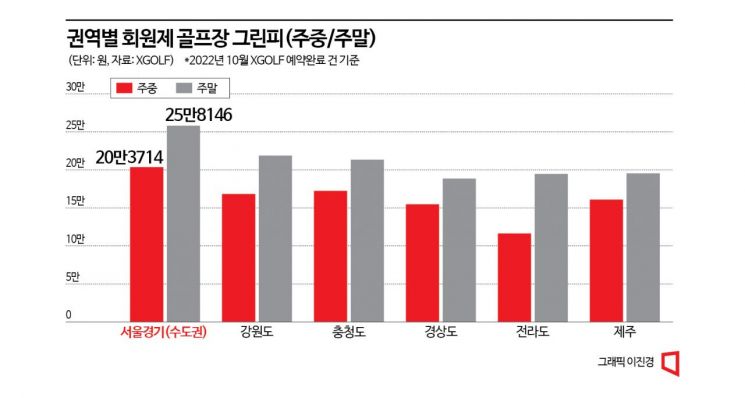
According to XGOLF’s survey of golf course green fees in October this year, the weekend average green fee of metropolitan area (Seoul and Gyeonggi) golf courses was about 55,000 KRW higher than other regions (Gangwon, Chungcheong, Gyeongsang, Jeolla, Jeju). The weekday average green fee was also about 49,000 KRW higher.
Seo Cheonbeom, director of the Korea Leisure Industry Research Institute, explained, “There is a significant difference between the green fees of metropolitan and local golf courses, so using the same fee as a standard violates fairness. It is reasonable to calculate the average fees by region such as metropolitan, Chungcheong, and Gangwon, and apply the standard accordingly.”
Peak Season Green Fees in May and October Often Inflated
There are also many concerns about the policy to calculate the usage fee based on the peak season (May and October), when golf course users increase by about 5% compared to usual.
During May and October, when reservations are highly competitive due to increased users, golf courses raise green fees to enjoy a ‘temporary boom.’ In some golf courses, the difference between peak and off-season fees is large enough that peak season fees are about 1.5 times higher than off-season fees. If the usage fee is based on peak season fees rather than the actual usage fee over the past year, golfers end up paying higher green fees.
Additionally, there is criticism that government fee regulations only apply to green fees, leaving golf courses considerable leeway. Public golf courses could lower green fees but compensate by raising cart fees and food prices, which cannot be controlled.
In fact, cart fees, which were mostly 80,000 KRW before COVID-19, have now risen to around 90,000 KRW.
Director Seo pointed out, “There are about five or six golf courses that charge 200,000 KRW for green fees in the off-season and raise them to 350,000 KRW in the peak season. Yet, it is hard to understand why the fee is based on the most expensive period.” He added, “Since cart fees and caddy fees are also expenses borne by golfers, the total amount of green fees, caddy fees, and cart fees should be applied as the per-person usage fee.”
Industry: “Government Regulation Excessive and Unjustified”
The frontline golf course industry is also unanimously opposing the government’s policy. They argue that direct regulation of golf course fees, which are not essential daily goods, contradicts market logic and lacks justification.
A representative of the Korea Public Golf Course Association said, “It is true that green fees temporarily increased after COVID-19, but this issue will naturally resolve according to market principles once the golf population returns to pre-COVID levels. For the government to regulate the fees of all golf courses is not only against market logic but also lacks justification.”
© The Asia Business Daily(www.asiae.co.kr). All rights reserved.
![User Who Sold Erroneously Deposited Bitcoins to Repay Debt and Fund Entertainment... What Did the Supreme Court Decide in 2021? [Legal Issue Check]](https://cwcontent.asiae.co.kr/asiaresize/183/2026020910431234020_1770601391.png)