Visited the Factory Producing Eco-Friendly Packaging Films
Exploring Negopack Factory Located in Hwaseong, Gyeonggi-do Report
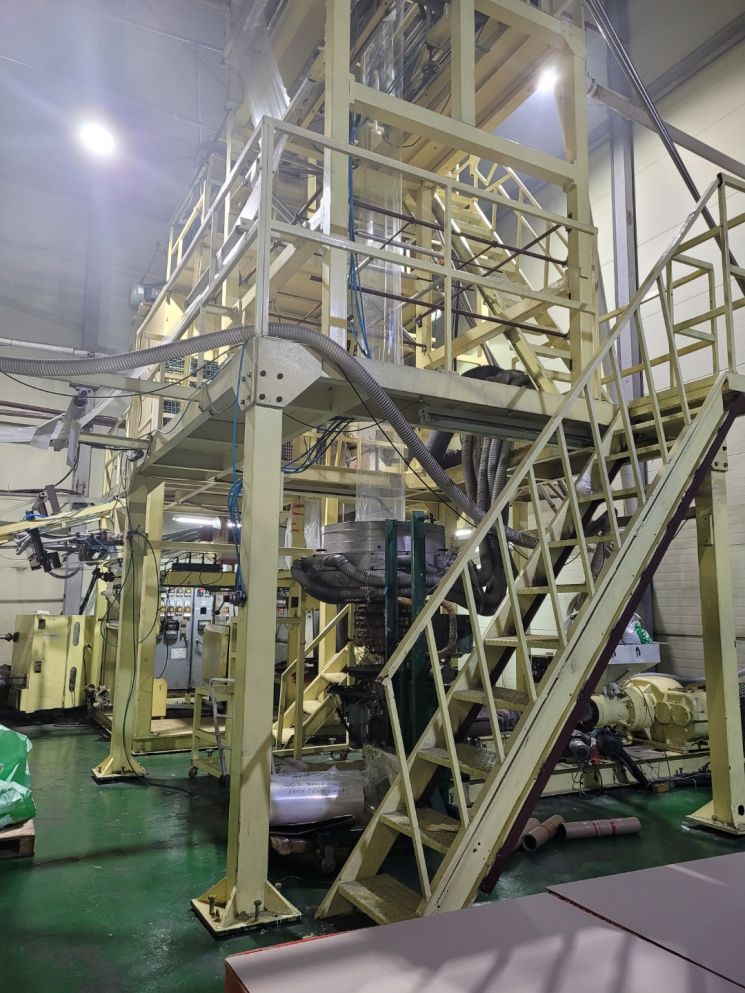
The Negopack factory in Paltan-myeon, Hwaseong-si, Gyeonggi-do, occupies a production facility of 2,700㎡ on a site of about 7,000㎡ (2,000 pyeong). This site operates as a one-stop location from the development to mass production of eco-friendly packaging films. On one side of the factory, a powder grinder that finely crushes biomass is running, and an extruder producing eco-friendly plastic films using this raw material is operating nonstop. CEO Lee Boyoung of Negopack is confident about the machines running in this factory, saying, "This will not just be Negopack but the food source of the Republic of Korea," reflecting her confidence in the technology amid the growing importance of ESG (Environmental, Social, and Governance). On the 22nd, we visited the site where proprietary technology is embedding 'eco-friendliness' into packaging films we frequently encounter in daily life.
CEO Lee said, "Among ESG management, the most important environmental aspect is ultimately reducing carbon dioxide," adding, "Negopack produces carbon-reducing materials and products." Established in 1999, Negopack has steadily built its technological capabilities through continuous research and development in the 'white bio' industry, which utilizes renewable resources. The core of Negopack's technology is finely grinding biomass?eco-friendly raw materials made from recyclable plants or microorganisms?and incorporating it to produce bioplastics. CEO Lee explained that since biomass replaces petroleum-based raw materials, it can achieve carbon emission reduction effects. She said, "Petroleum-based plastics generate carbon dioxide during production and disposal. For example, if agricultural by-products like corn husks are ground and included so that biomass accounts for 25%, it contributes to carbon reduction accordingly."
Recently, Negopack completed technology to grind biomass even more finely through in-house design, laying the foundation for mass production of biomass plastics. They also plan to replace production equipment. The carbon reduction method that Negopack focuses on is closely connected to our daily lives. A representative example is the 'freshness film,' which will be their future main product. This film uses the principle of transmitting protons and anions in biomass plastic as wave energy to maintain the freshness of fruits and vegetables. CEO Lee said, "With the freshness film pack, fruits and vegetables can be stored for a long time. In the case of onions, even if peeled and stored, they do not change until the entire net is consumed," adding, "Reducing food waste can naturally lead to a reduction in carbon dioxide emissions." The freshness film is scheduled to be launched after customer testing within this year.
They are also preparing for mass production of sealing machines using eco-friendly packaging materials. Sealing machines are packaging equipment used for beverages or jjajangmyeon (black bean noodles). Applying white bio to the containers and packaging films used here can be an alternative to the increasing plastic usage problem caused by the recent rise in delivery orders. Negopack utilized various policy supports during the preparation and design process for ESG. In particular, they received assistance for new business item development and commercialization through business transformation and structural improvement policy funds from the Small and Medium Business Corporation. Participating in this year's carbon neutrality level diagnosis allowed them to analyze energy usage status by process and equipment and derive energy reduction measures, which strengthened their confidence in advancing the business.
Having established a full-scale mass production system, Negopack plans to embark on a rapid growth path starting next year. If the ongoing investment discussions materialize, they are preparing to expand production facilities in Gunsan. They also have plans to enter 10 countries, including establishing a joint venture factory in Saudi Arabia. With confidence in their technology, their goals are ambitious. CEO Lee emphasized, "Sales of about 5.3 billion KRW this year are expected to increase to 25 billion KRW next year and 75 billion KRW the year after. The site is prepared to achieve sales of up to 150 billion KRW. Our goal is to go public in 2026."
© The Asia Business Daily(www.asiae.co.kr). All rights reserved.

















