Train staff blocked open door with their bodies, operated through 4 stations
Citizens worry "One wrong step and they could have fallen"
Experts say "Control system and manual response both inadequate"
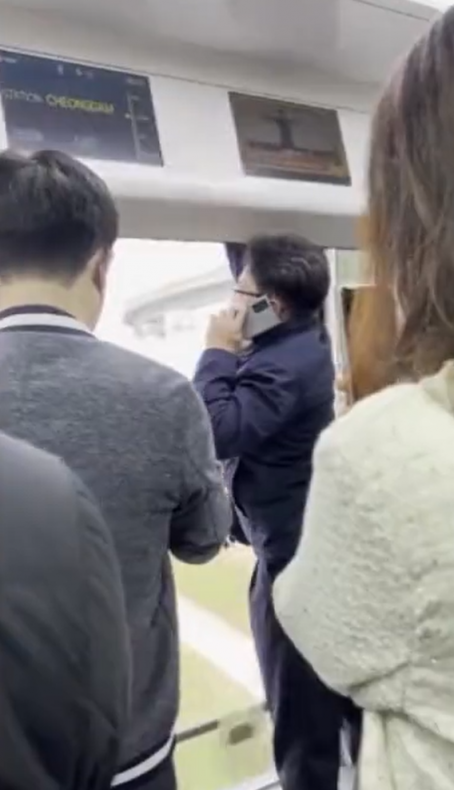 On the morning of the 23rd, a Seoul Subway Line 7 train was operating with its door open due to a malfunction. An employee is standing dangerously in front of the door, blocking the way. Photo by SBS
[Asia Economy Reporter Kang Juhee] A Seoul Subway Line 7 train operated with its doors open for four stations, crossing the Han River in a dangerously risky situation. There were no passenger movements or disembarkations, and staff continued the operation while physically blocking the open doors. Although there were no casualties, concerns have been raised that this could have led to a major accident.
On the 23rd, according to Seoul Metro Corporation (the Corporation), at around 7:44 a.m., a train bound for Onsu stopped at Junggok Station on Line 7 experienced a problem where one of its doors failed to close.
The Corporation attempted to repair the door but could not fix it immediately. Two staff members boarded the train and temporarily installed a banner covering about half of the door before resuming operation. The train departed Junggok Station in this condition and traveled through Gunja, Children’s Grand Park, Konkuk University Entrance, and Ttukseom Resort Station. During the passage of these four stations, the two staff members blocked the open door entrances. No measures were taken to have passengers disembark or move to other cars.
When the train stopped at Ttukseom Resort Station, maintenance staff from the Corporation’s mobile inspection office boarded to perform repairs. However, the train moved to the next station, Cheongdam Station, without completing the repairs, and the door remained open. The door finally closed just as the train arrived at Cheongdam Station. The section between Ttukseom Resort Station and Cheongdam Station crosses the Han River via Cheongdam Bridge.
According to footage inside the train released by SBS, during the Ttukseom Resort to Cheongdam Station segment, there was not even a protective barrier. The staff member who boarded for repairs was precariously standing, holding a mobile phone in one hand while supporting themselves against the train wall with the other. Although the train was not crowded, passengers standing in that car were only about 2 to 3 steps away from the staff blocking the door. If the train had passed a curve or if someone had fallen, there was a high risk of a serious accident. Citizens who viewed the video reacted with comments such as, "How can a train operate in such a condition?" and "It feels like you could fall just by slipping a foot."
According to Article 328 of the Corporation’s Train Operation Regulations (In case of train door malfunction), operating a train with doors open is a violation of regulations. If the malfunctioning door can be manually closed and locked, the train may depart with a safety barrier installed and under staff supervision. However, if the door remains open, operation is prohibited. The regulation states, "If the malfunctioning door is manually closed but does not close properly, or if interlocking operation or locking is impossible, the operation control must be notified and, following instructions, the train must be returned to the depot."
Regarding this, a Corporation official said, "According to the manual, the door should have been manually closed, a protective barrier installed, and staff assigned, but some parts of this procedure were not followed. We will investigate where the errors occurred and strengthen staff training to ensure manuals are followed for passenger safety in the future."
Professor Yoo Jeong-hoon of Ajou University’s Department of Transportation Systems Engineering stated, "It is unacceptable for any mode of transportation to operate with doors not closed. Even in buses, departing with doors open can result in penalties. This is not merely a matter of correcting mistakes."
Professor Yoo added, "In aviation and railways, doors are automatically controlled, and in this case, it appears there was a system error such as a sensor malfunction. While mechanical issues were involved, the response according to the manual was also insufficient. There should be controls in place to prevent departure if doors are open."
© The Asia Business Daily(www.asiae.co.kr). All rights reserved.
![Clutching a Stolen Dior Bag, Saying "I Hate Being Poor but Real"... The Grotesque Con of a "Human Knockoff" [Slate]](https://cwcontent.asiae.co.kr/asiaresize/183/2026021902243444107_1771435474.jpg)
















