Professor Jeong Seong-hoon's Team Analyzes South Korea's Birth Rate Trends
Predicts 180,000 Total Births in 2060
Declining Births but Increasing Newborns Requiring Care
"Perinatal Medical System Must Be Firmly Established"
 Professor Seonghoon Jeong, Department of Pediatrics and Adolescents, Gangdong Kyung Hee University Hospital.
 [Photo by Gangdong Kyung Hee University Hospital]
[Asia Economy Reporter Lee Gwan-joo] Amid an unprecedentedly rapid decline in birth rates and aging population worldwide due to a severe low birthrate, it is projected that population decline will begin in earnest from 2035, with South Korea's population decreasing to around 42.8 million by 2060, and the total number of newborns dropping to just 200,000.
A research team consisting of Professors Jung Sung-hoon, Kim Chae-young, and Choi Yong-sung from Kyung Hee University College of Medicine, along with Professors Bae Jong-woo, Yoon Jung-ha, and Son Se-hyung from CHA University, analyzed population data from Statistics Korea and released these findings in the report "Trends and Prospects of South Korea's Fertility Rate" on the 24th. This paper was published in the November issue of the Journal of Korean Medical Science.
The research team analyzed changes in South Korea's population, number of births, and birth rates from 1925 to 2020 and projected trends through 2060. According to the study, the number of births and birth rates showed little change from the Japanese colonial period to the liberation period, then declined during the Korean War. Afterward, they increased significantly until the early 1970s, then shifted to a declining trend in the 1980s due to birth control policies. The relaxation of birth control policies in the 1990s led to a temporary increase, but the 1997 IMF financial crisis caused a rapid decline.
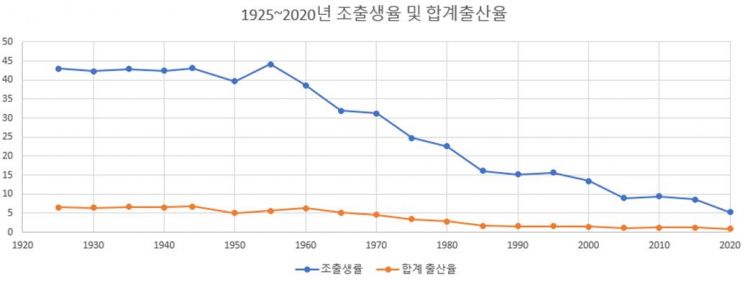
From the 2000s onward, a severe ultra-low birthrate era began in earnest. In 2020, the total number of newborns dropped below 300,000 for the first time, reaching 272,400, and last year, the total number of births was 260,562, a 4.5% decrease from the previous year. Last year's crude birth rate and total fertility rate also continued to decline, standing at 5.3 and 0.84 respectively.
The research team forecasted that the population will start to decrease from 51,199,019 in 2030 to 50,868,691 in 2035, eventually falling to 42,617,053 by 2060. The total number of newborns is estimated to increase from 272,337 in 2020 to 323,000 in 2030, then gradually decline to 181,000 by 2060.
Professor Jung Sung-hoon stated, "South Korea's fertility rate is the lowest among OECD countries, and we have entered an era of population decline, which will lead to serious demographic and socio-economic problems in the future. The government needs to prepare multifaceted measures and make efforts to overcome this challenge."
He added, "Although the number of newborns has decreased, the proportion of newborns requiring perinatal care, such as premature, low birth weight, and multiple births, is increasing. It is necessary to explore ways to reduce the maternal age and the proportion of elderly mothers, and to strengthen the perinatal medical system, including expanding neonatal intensive care unit facilities to manage premature and low birth weight infants."
© The Asia Business Daily(www.asiae.co.kr). All rights reserved.


















