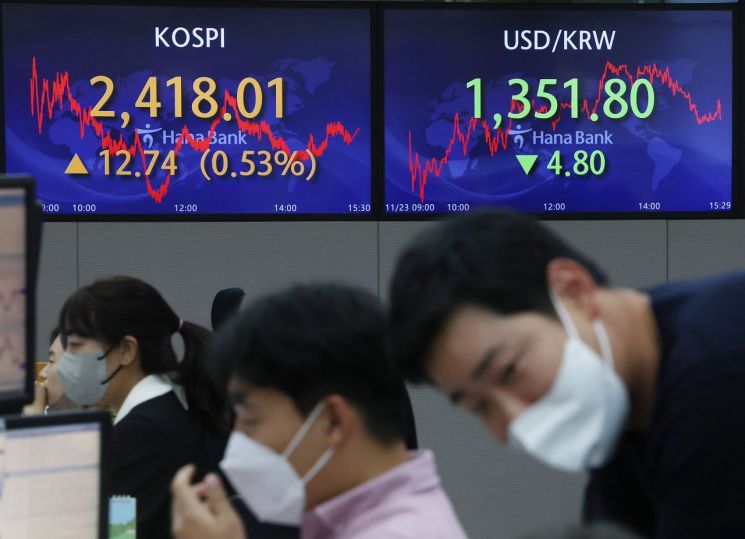
[Asia Economy Reporter Lee Seon-ae] The Korean stock market showed signs of relief following the positive close of the U.S. stock market, which eased concerns over the Federal Reserve's (Fed) tightening. The Bank of Korea's Monetary Policy Committee's decision to implement a 'baby step' (a 25 basis point increase) also contributed to the domestic market's reassurance. The KOSPI has maintained the 2430 level after opening higher.
As of 10:42 a.m. on the 24th, the KOSPI was up 0.58% at 2431.01. The KOSDAQ was trading at 734.16, up 1.18%. Positive expectations for a slowdown in the pace of U.S. interest rate hikes have had a favorable impact. Seo Sang-young, a researcher at Mirae Asset Securities, noted, "The rise in the U.S. stock market, supported by a weaker dollar and falling government bond yields, along with the forecast that the Fed's terminal rate will be 5%, is expected to positively influence the Korean stock market."
The Bank of Korea's adjustment in the base interest rate pace has also injected upward momentum into the stock market. At the last Monetary Policy Committee meeting of the year, a baby step was decided, raising the base rate to 3.25%. This is the highest level in 10 years and 4 months since July 2012 (3.25%). The Bank of Korea's MPC stated, "It was decided to raise the base rate by 0.25 percentage points from the current 3% to 3.25%." Accordingly, the base rate will be maintained at around 3% until the next decision.
The MPC has raised the base rate by a total of 2.75 percentage points since starting from 0.5% in August last year to 3.25% as of this meeting. The market had already anticipated a baby step. Han Ji-young, a researcher at Kiwoom Securities, commented, "Since a 25 basis point hike was expected, the domestic stock market will now focus more on changes in the economic outlook and monetary policy direction as key points to watch."
With the MPC's rate hike, the gap with the U.S. has narrowed to 0.75 percentage points for now, but the key issue is the Fed's decision in December. If the Fed takes a big step (a 50 basis point hike) next month, the U.S. rate will rise to 4.25?4.5%, widening the gap again to 1.25 percentage points. An expanded interest rate inversion between Korea and the U.S. could lead to foreign capital outflows. This may also intensify the won's depreciation, pushing up import prices and potentially triggering a vicious cycle of rising domestic consumer prices. Therefore, a conservative investment strategy is recommended.
The researcher added, "The fact that the Fed's tightening stance has somewhat softened compared to before is welcome news for market participants, but since much of this has already been priced in since October, the positive impact of the pace adjustment on the stock market may not last long."
He continued, "What the market should focus on going forward is the fact mentioned in the recent Federal Open Market Committee (FOMC) minutes that the terminal rate needed to achieve the Fed's goals may be higher than previously thought (the median terminal rate in the September FOMC dot plot was 4.7% for 2023)." He emphasized, "The key factor influencing the stock market's direction is not the pace adjustment but the terminal rate level and its duration, and this existing forecast remains valid."
Accordingly, considering that the market can intuitively gauge the terminal rate level from the dot plot presented at the December FOMC, it is advisable to prepare for a period of unclear stock market direction until that meeting.
© The Asia Business Daily(www.asiae.co.kr). All rights reserved.

















