Incheon Bridge Installs 1,500 Drums Worth 40 Million Won After Consecutive Jumping Incidents
Cars Can Stop on Shoulder, but Drums Raise Concerns of Secondary Accidents
Fall Prevention Nets Costing 5 to 7 Billion Won Emerge as Alternative
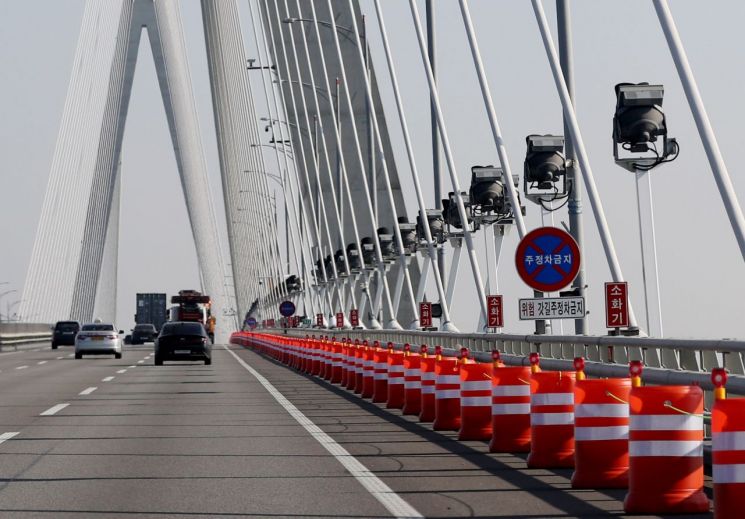 A drum barrel installed to prevent parking on the shoulder of Incheon Bridge in Jung-gu, Incheon. Photo by Yonhap News
[Asia Economy Culture Young Intern Reporter] As a series of suicide attempts occurred on Incheon Bridge, the longest bridge in South Korea, the Incheon Bridge authorities installed thousands of plastic drums to prevent parking on the shoulder. However, there are voices claiming that this measure actually increases the risk of accidents and lacks effectiveness.
The Incheon Bridge authorities spent 40 million KRW to install 1,500 plastic drums on the shoulder between the cable-stayed bridge and the connecting bridge, where suicide attempts are statistically frequent. The drums, placed at 5-meter intervals over a 3 km section in both directions of the total 21.4 km span, are all tied together with ropes, making parking in that section difficult.
The drums were installed with the intention of preventing drivers from parking in safe zones or wide shoulders, thereby deterring extreme choices such as jumping into the sea. LED safety lights were attached to ensure visibility even in the dark night.
However, some question whether the drums installed only in certain sections will effectively prevent suicide attempts. Since suicide attempts on the bridge typically occur after parking on the shoulder, the purpose is to prevent parking itself. Yet, vehicles can easily park on the adjacent shoulder without drums, and it is possible to approach the bridge railing through the gaps between the drums.
Also, warning signs such as "No Parking on Shoulder" and "CCTV Surveillance in Operation" are installed throughout the bridge, but there is little enforcement even when cars are parked right next to the drums. Local residents express concerns that placing drums on the shoulder for emergency situations could cause secondary safety accidents. On the Yeongjong area community board, comments such as "I have experienced stopping on the Incheon Bridge shoulder due to car trouble; is there any contingency plan?" and "There is space to park, so how can drums prevent suicide?" have been posted.
The Incheon Bridge authorities are currently unable to install additional safety facilities due to concerns about bridge safety and budget constraints. The most likely solution is the installation of fall prevention nets, which would require a budget of 5 to 7 billion KRW. Additionally, wind tunnel tests to check the bridge’s safety against wind-induced vibrations must be conducted.
Democratic Party lawmaker Heo Jong-sik pointed out, "The drums may actually increase the risk of traffic accidents, leading to greater harm," and emphasized the need for fundamental measures such as installing fall prevention facilities. Incheon City Council member Shin Sung-young also criticized during the administrative audit on the 21st, attended by Fire Chief Heo Seok-gon, saying, "The shoulder is a safe zone," and "Blocking the shoulder with drums to prevent parking is more dangerous." In response, Chief Heo said, "When related agencies review the effectiveness, we will propose improvements."
Meanwhile, Seoul’s Mapo Bridge saw a 26.5% decrease in suicide attempts after installing an additional 1-meter-high roller-type railing on top of the existing 1.5-meter-high railing. Similarly, Changwon’s Machang Bridge experienced more than a 50% reduction in suicide attempts after installing fall prevention facilities.
© The Asia Business Daily(www.asiae.co.kr). All rights reserved.
![Clutching a Stolen Dior Bag, Saying "I Hate Being Poor but Real"... The Grotesque Con of a "Human Knockoff" [Slate]](https://cwcontent.asiae.co.kr/asiaresize/183/2026021902243444107_1771435474.jpg)
















