Export Logistics Emergency Response Team Faces Numerous Complaints
Steel Industry Prioritizes Urgent Product Shipments
Yeosu Industrial Complex Prepares Logistics Transport by Item
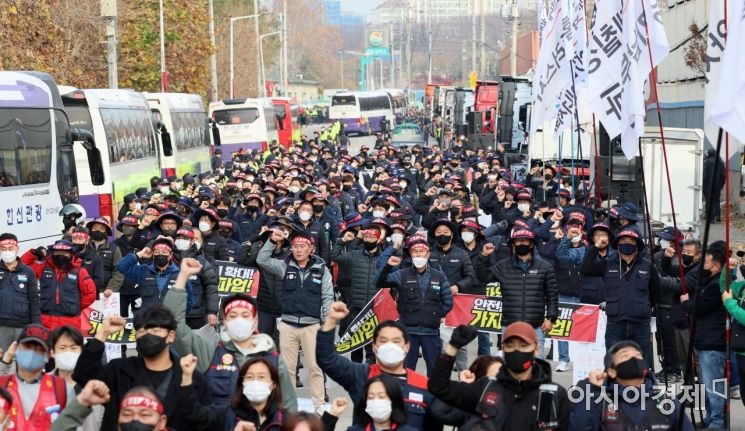 On the 24th, when the Cargo Solidarity Union began an indefinite general strike, members of the Cargo Solidarity Union held a send-off ceremony near the Uiwang Inland Container Terminal in Gyeonggi-do. Photo by Dongju Yoon doso7@
[Asia Economy Reporters Oh Hyung-gil and Choi Dae-yeol] On the 24th, as the Cargo Solidarity Headquarters of the Korean Confederation of Trade Unions (Cargo Solidarity) launched a general strike nationwide, the industrial sector has entered emergency measures to prevent the worst-case 'shutdown' scenario. Companies have prepared countermeasures such as securing parts to the maximum extent and shipping inventory out of factories, but concerns remain that factory operations could halt if the strike prolongs.
In particular, this strike involves a politically charged confrontation with the government, and it is widely expected to far exceed the damage of over 1.6 trillion won caused during the eight-day strike last June. With no easy way out, companies that have already entered austerity management due to deteriorating performance amid the economic downturn are once again being hampered by union risks, facing a harsher winter than ever before.
According to the Korea International Trade Association, the 'Export Logistics Emergency Response Team' activated in response to the Cargo Solidarity strike has been receiving a continuous stream of damage reports and concern calls from the first day. Lee Jun-bong, head of the Logistics Service Office at the Korea International Trade Association, said, "Exporters need their goods to be shipped, but if shipments are blocked at ports, delivery delays can lead to contract penalties and even severed transactions," adding, "We are receiving numerous reports of such difficulties."
Since the strike was anticipated, companies have prepared and implemented emergency measures based on past logistics crisis experiences. In the steel industry, for example, they are responding by closely communicating with customers in shipbuilding and construction sectors and prioritizing the shipment of urgent products.
They have established the principle that timely delivery is crucial because a halt in steel product transportation affects the entire industrial sector. In particular, POSCO, which is currently restoring its Pohang Steelworks from typhoon damage, and Hyundai Steel, which is struggling to operate normally due to guerrilla strikes by its labor union, are facing a compounded crisis with the logistics disruption. During the June strike, Cargo Solidarity union members held a send-off rally near Pohang Steelworks, causing unexpected damage, so they are on high alert for any eventuality.
A POSCO official stated, "From the supply side, there should be no problem as urgent materials for customers are shipped in advance, but if the strike prolongs, vehicle access for restoration materials and waste materials generated during restoration may be blocked, potentially disrupting the planned restoration schedule."
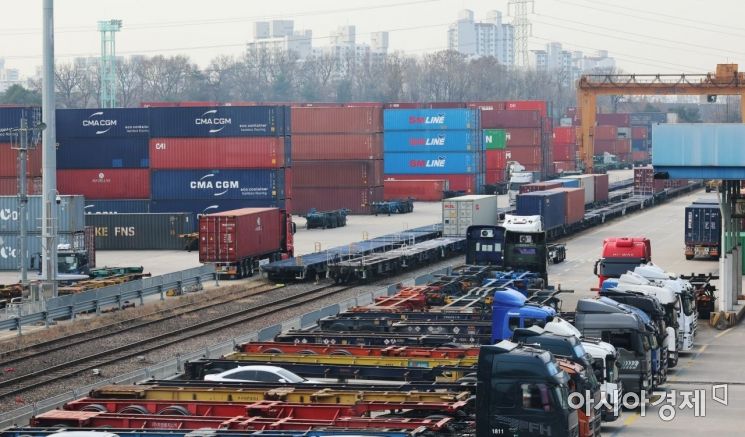 On the 24th, when the Cargo Solidarity Union began an indefinite general strike, containers were piled up behind the freight trucks stopped at the Uiwang Inland Container Terminal in Gyeonggi Province. Photo by Dongju Yoon doso7@
The petrochemical industry, considered a major blockade point, has also prepared in advance by prioritizing the shipment of key products. The Korea Petrochemical Industry Association began operating an emergency response team from this day. The association plans to actively respond if logistics problems arise. The Yeosu and Daesan industrial complexes, which have experienced severe logistics difficulties, are devising countermeasures to ensure no disruption in logistics transportation by product category.
In the finished car industry, anticipating possible transportation disruptions during new car deliveries, alternative personnel and organizations have been assembled. During the June strike, the operating rate of car carriers (vehicles transporting cars) dropped, leading company employees, including those from headquarters, to personally drive vehicles from factories to shipping yards.
Logistics companies also plan to minimize damage by assigning transportation tasks to non-union members or using previously unused routes to resolve the transportation refusal situation. They are also considering operating transportation services on weekends if disruptions occur due to the strike.
The industrial sector is voicing strong demands for the government to take firm action against obstruction of transportation by non-union members during the strike. A logistics industry official emphasized, "If movements to block entrances to container yards at major ports intensify, the damage will inevitably be widespread across the entire domestic industrial sector, not just certain industries," and stressed, "It is necessary to strictly deal with organized issues such as obstruction of transportation by non-union members."
Industry fears that if the logistics crisis prolongs at a time when production volumes increase toward the year-end, the damage will snowball. During the eight-day strike in June, the government estimated damages of 1.15 trillion won in the steel industry, 500 billion won in the petrochemical industry, and 257.1 billion won in the automobile industry, totaling 1.6 trillion won. With high interest rates, high exchange rates, and high prices increasing product unit costs and transportation costs, and with an indefinite strike announced, the scale of damage is expected to grow uncontrollably.
Kim Pyeong-jung, head of the Korea Petrochemical Industry Association, pointed out, "Compared to the June strike, the damage will be greater due to the rise in exchange rates and product prices," adding, "Resolving the strike is the most urgent matter."
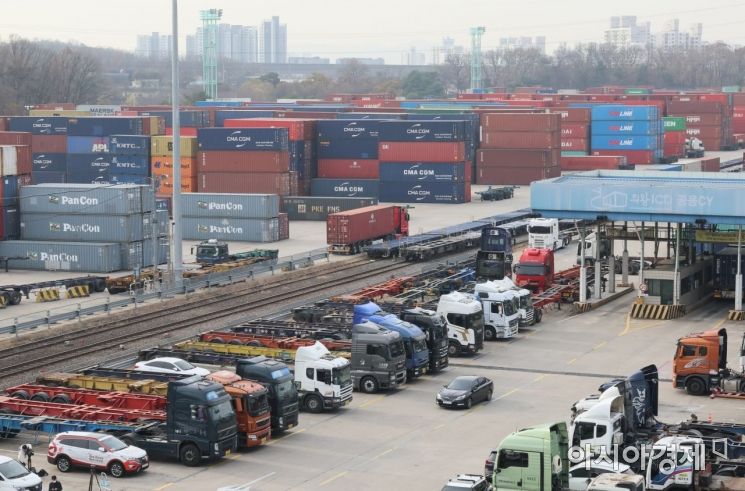 On the 24th, when the Cargo Solidarity Union began an indefinite general strike, containers were stacked behind the freight trucks stopped at the Uiwang Inland Container Terminal in Gyeonggi Province. Photo by Yoon Dong-ju doso7@
© The Asia Business Daily(www.asiae.co.kr). All rights reserved.
![User Who Sold Erroneously Deposited Bitcoins to Repay Debt and Fund Entertainment... What Did the Supreme Court Decide in 2021? [Legal Issue Check]](https://cwcontent.asiae.co.kr/asiaresize/183/2026020910431234020_1770601391.png)


















