Minju "Improvement of Public Broadcasting Governance" VS Gukhim "Desperate Resistance"
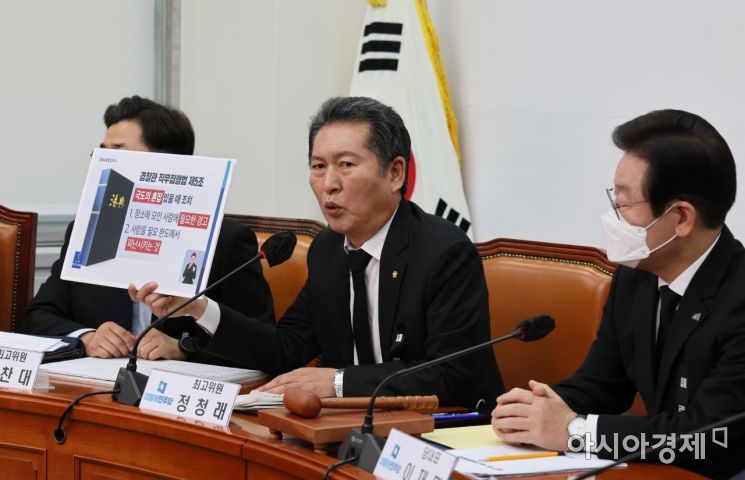 Jeong Cheong-rae, Supreme Council Member of the Democratic Party of Korea, is speaking about the 'Police Officer Duty Execution Act' at the Supreme Council meeting held at the National Assembly on the 2nd. Photo by Yoon Dong-joo doso7@
[Asia Economy Reporter Lim Hye-seon] The National Assembly’s Science, Technology, Information and Broadcasting Communications Committee will discuss legislation related to the improvement of public broadcasting governance on the 24th. The People Power Party, which had been boycotting the committee in protest of the Democratic Party’s unilateral decision on the appointment of the second subcommittee chair, is expected to attend this session to prevent the ruling party from unilaterally passing the Broadcasting Act, setting the stage for a heated exchange between the ruling and opposition parties.
On the same day, the Committee will hold a meeting of the Information and Communications Broadcasting Bill Review Subcommittee to review 25 bills, including the partial amendment bill to the Broadcasting Culture Promotion Act proposed by both ruling and opposition parties. Among these, 16 bills are related to the Broadcasting Act. The committee will examine all the bills concerning the improvement of public broadcasting governance proposed by both sides.
Ten Democratic Party members of the committee issued a statement titled 'Returning Public Broadcasting to the People' on the day. They stated, "We are embarking on institutional reforms to guarantee the independence and neutrality of public broadcasting," adding, "Petitions demanding amendments to the Broadcasting Act have surpassed 50,000 signatures, establishing a national consent petition, and we will boldly move forward toward amending the Broadcasting Act, which is a long-standing wish of the media sector and the public." They continued, "It is time to break away from the past when broadcasting was swayed by the government and open a new chapter of public broadcasting where the people are the owners," emphasizing, "We will stand firm and move forward without yielding to any oppression to fulfill our duty to the people."
In April, the Democratic Party adopted the improvement of public broadcasting governance as its party policy. The partial amendment bill to the Broadcasting Culture Promotion Act, jointly proposed by all Democratic Party members, includes provisions to change the boards of directors of public broadcasters such as KBS, the Broadcasting Culture Promotion Foundation (the major shareholder of MBC), and EBS into operating committees, and to expand the number of committee members to 25. The number of members recommended by the National Assembly is limited to eight (seven from negotiation groups and one from non-negotiation groups), and the maximum number that one party can recommend is set at four. The intention is to move away from a ruling party-centered public broadcasting board structure and guarantee political neutrality.
There are also bills such as the one proposed by Chairman Jeong Cheong-rae, which stipulates that KBS directors and the president be recommended and elected by the public and broadcasting company members, and the bill by Representative Jeong Pil-mo, which calls for the election of public broadcasting directors and presidents by a public committee. Chairman Jeong said, "The public nature, public interest, neutrality, and independence of broadcasting must be preserved," and added, "We will expedite the passage of the bill to improve public broadcasting governance."
The People Power Party interprets this as an attempt by the opposition to secure a majority in the operating committee and take control. Representative Park Seong-jung of the People Power Party proposed a bill to form the public broadcasting board with a 7:6 recommendation ratio between the ruling and opposition parties and to require a two-thirds majority approval of the board when recommending the president. Representative Heo Eun-ah proposed a bill centered on a 'term replacement system,' which replaces one-third of the directors every two years.
Since the National Assembly opened in July, the Science, Technology, Information and Broadcasting Communications Committee has repeatedly experienced 'political strife' and 'disruptions' rather than focusing on 'policy.' The People Power Party has continued to boycott meetings, citing issues with the subcommittee composition and Chairman Jeong Cheong-rae’s unilateral management. A bill prepared to prevent a recurrence of the 'KakaoTalk outage incident' was passed without the participation of the People Power Party. The current public broadcasting governance improvement bill is a key contentious issue, and a fierce power struggle between the ruling and opposition parties is expected.
Within the IT industry, voices are emerging that the National Assembly, which should be setting policy directions amid numerous ICT issues, is only continuing political strife. A public hearing on the bill to prevent free riding on networks, scheduled for the 17th, also fell apart due to disputes between the ruling and opposition parties. The issue of in-app payment fees is being scrutinized more by the Fair Trade Commission than by the relevant ministries. A National Assembly official said, "Although we are belatedly moving to shed the stigma of passing 'zero' bills, the bills needed by the industry are still being neglected," adding, "We expect political strife between the ruling and opposition parties to continue until next year."
© The Asia Business Daily(www.asiae.co.kr). All rights reserved.

















