Liquor Industry Busy Preparing Countermeasures as Shipment Volume Increases
Jeju Samdasoo Increases Stock at Regional Logistics Centers
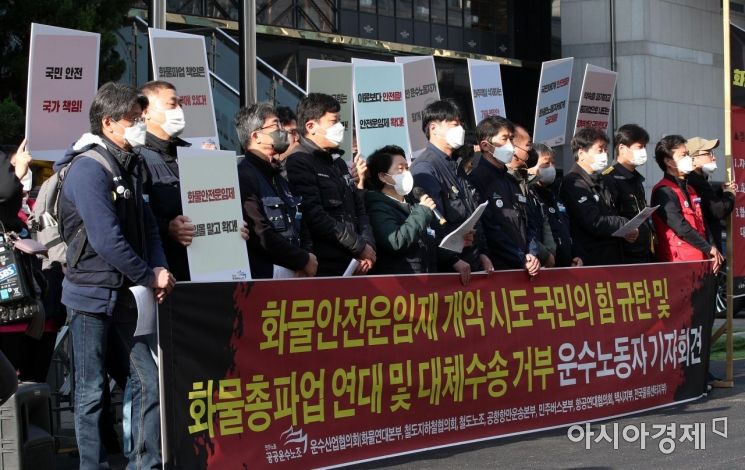 Officials from the Cargo Solidarity Headquarters and the Public Transport Union Transport Industry Council are holding a "Press Conference of Transport Workers Condemning the Government and Ruling Party's Attempt to Deteriorate the Cargo Safety Freight Rate System, Supporting the General Cargo Strike, and Refusing Alternative Transport" on the 23rd in front of the People Power Party headquarters in Yeouido, Yeongdeungpo-gu, Seoul. Photo by Kim Hyun-min kimhyun81@
[Asia Economy Reporter Eunmo Koo] The Cargo Solidarity Union has announced a general strike, demanding the abolition of the sunset clause on the Safe Freight Rate System. The distribution industry, which experienced a logistics crisis due to a strike in June, is concerned about potential logistics disruptions ahead of the World Cup and the year-end peak season.
According to the distribution industry on the 24th, the Cargo Solidarity Headquarters of the Korean Confederation of Trade Unions Public Transport Workers' Union will begin a general strike from this day. This is about five months after the general strike in June.
The reason they have pulled out the general strike card again is that the government’s agreement to continue the Safe Freight Rate System has not been properly implemented. The Safe Freight Rate System guarantees a minimum transportation fee to cargo workers to prevent overwork and speeding, and imposes fines on consignors who pay less than this amount. Introduced in 2020 with a three-year sunset clause, it is set to expire at the end of this year.
The most active sector is the liquor industry, which is facing the World Cup peak season immediately. The day the strike begins is also the day of South Korea’s national team’s first match, when liquor demand is expected to increase. Having experienced a decline in sales due to reduced shipments during the previous strike, the liquor industry is busy preparing countermeasures to prevent logistics disruptions by increasing the volume delivered to each logistics warehouse.
OB Beer has over 70% of its transport drivers affiliated with the Cargo Solidarity Union, so it could be directly affected by the strike. However, since this strike was announced in advance, OB Beer is increasing shipments of products such as beer and moving products to regional logistics centers and wholesalers as much as possible. Even if many workers participate in the strike, product supply is expected to remain stable for the time being. OB Beer is also open to contracting with other logistics companies in case the strike is prolonged.
Hite Jinro is also expected to face no major difficulties during a short-term strike. About 130 truck drivers belonging to Suyang Logistics, which joined the Cargo Solidarity Union in March, will participate in this general strike, but Hite Jinro has signed additional contracts with two other logistics companies besides Suyang Logistics, so there should be no problem with product shipments. Unlike the previous general strike, the scale is expected to be smaller, so the order volume on the first day of the strike will remain unchanged. Hite Jinro, which operates factories in Icheon and Cheongju, Gyeonggi Province, experienced a sharp drop to one-tenth of shipment volume and a temporary production halt when the Cargo Solidarity Union went on strike in September.
Samda, a craft liquor company that suffered logistics difficulties during the Cargo Solidarity strike in June, has also started stockpiling to avoid delivery disruptions. They are increasing cargo volume from Jeju Island to the mainland and maximizing stockpiles at regional logistics centers. Given the possibility of a prolonged strike, they are also preparing alternative transportation options.
However, some express concerns that if the strike is prolonged, companies dealing with fresh foods may suffer more damage than those handling processed foods. While industrial products can tolerate some logistics delays and be managed later in inventory, agricultural, fishery, and livestock products lose their marketability and face immediate losses due to disposal.
Additionally, the e-commerce industry, which is running overseas direct purchase promotions for Black Friday, is anxiously watching for potential disruptions in customs clearance and delivery of overseas direct purchase goods. After the Cargo Solidarity general strike in June, direct purchase shipments piled up all at once, causing customs clearance to take more than two weeks.
© The Asia Business Daily(www.asiae.co.kr). All rights reserved.

















