Need for On-Site Verification Suitable for Industry
Utilization Methods of Voluntary Initiatives Led and Participated by Multinational Corporations
[Asia Economy Reporter Park Sun-mi] As major global countries prepare to enforce mandatory supply chain due diligence, urgent measures are needed to prepare, experts say.
On the 24th, the Federation of Korean Industries (FKI) stated in its report titled "Trends and Best Practices in Major Countries' Supply Chain ESG (Environmental, Social, Governance) Management Policies" that Germany will begin conducting supply chain due diligence focused on human rights protection and environmental impact starting next year. The due diligence obligation includes indirect suppliers, which will affect domestic companies as well. According to Germany's Supply Chain Due Diligence Act, violations of key provisions can result in fines of up to 8 million euros (approximately 11.14 billion KRW) or up to 2% of the company's global annual revenue.
The European Union (EU) also announced a draft guideline for sustainable supply chain due diligence in February this year. Once legislation is finalized, due diligence on potential ESG risks within supply chains will be mandatory for large and medium-sized enterprises both inside and outside the region. The number of target companies is 12,800 within the region and a total of 16,800 including those outside. The impact on domestic companies across the entire supply chain is inevitable.
However, South Korea is evaluated as being poorly prepared. According to consulting firm Gartner's announcement of the top 25 supply chain companies considering ESG factors this year, no Korean companies were included. Among companies excelling in supply chain management, the United States accounted for 14, while China, the United Kingdom, France, and Germany each had two.
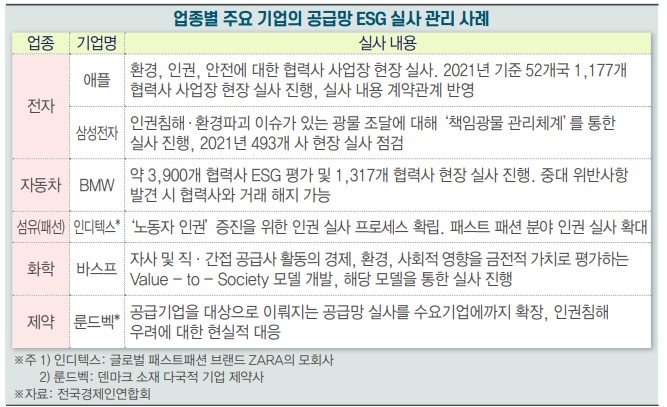
The report introduced global companies' ESG due diligence cases in supply chains and argued that since due diligence issues vary by industry, Korean companies should also prepare due diligence tailored to their sectors. For example, Apple and Microsoft focus on conflict mineral sourcing and environmental impacts within their supply chains as major due diligence issues. Fast fashion companies such as Inditex, the parent company of Zara, and Nike emphasize labor and human rights due diligence, including forced labor and child labor.
It also emphasized that due diligence issues are not matters of national borders but of industries, and responses should include utilizing voluntary initiatives led and participated in by major multinational companies. It argued that policy support and incentives are necessary to enable domestic companies to actively participate in global initiatives by industry.
As countermeasures, the report suggested building infrastructure such as early warning systems that can proactively respond to supply chain ESG risks, along with support measures for medium-sized and small enterprises that currently lack preparedness capabilities. Kim Jun-ho, head of the ESG team at FKI, said, "The recent joint development plan for an early warning mechanism to monitor semiconductor supply chains by the US and EU can serve as a reference case," adding, "Establishing a joint ESG due diligence response system with major countries could act as an efficient measure to prepare for supply chain due diligence."
© The Asia Business Daily(www.asiae.co.kr). All rights reserved.
![Clutching a Stolen Dior Bag, Saying "I Hate Being Poor but Real"... The Grotesque Con of a "Human Knockoff" [Slate]](https://cwcontent.asiae.co.kr/asiaresize/183/2026021902243444107_1771435474.jpg)
















