Physiological Health Assessment of Zelkova Tree Veteran at National Research Institute of Cultural Heritage
Maximum Photosynthetic Rate at 55% of Young Trees... Even Lower in Poor Environments
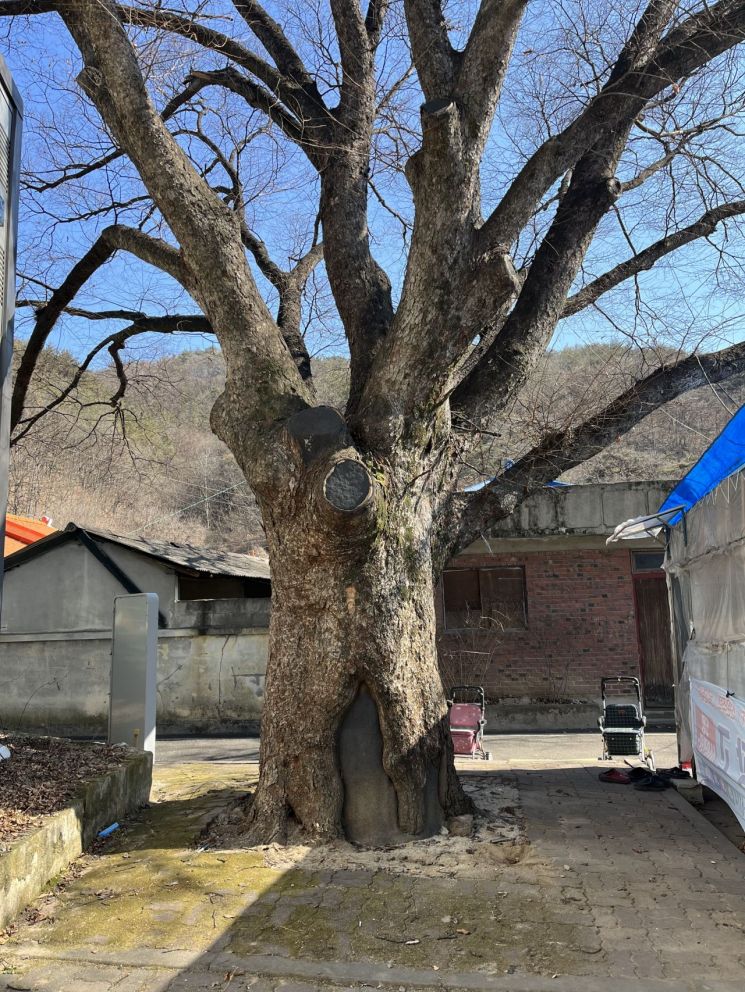
The maximum photosynthetic capacity of old-growth trees was found to be only 55% of that of young trees.
The National Research Institute of Cultural Heritage conducted a physiological health assessment of old-growth Zelkova trees in the Chungcheong region from May to September. To establish protection and management measures for natural heritage suffering complex damage from climate changes such as heavy snowfall and drought, photosynthesis analysis was introduced for the first time in Korea. Photosynthesis refers to the process by which plants use solar energy to produce the energy they need.
The subjects were 25 old-growth Zelkova trees distributed in urban areas of Daejeon Metropolitan City, Gongju City, and Geumsan County. The average age and diameter at breast height (DBH, measured at 1.2 meters above ground) were approximately 262 years and 143.8 cm, respectively. The institute measured monthly changes in physiological characteristics such as photosynthetic rate, water use efficiency (the amount of water used in photosynthesis), and stomatal transpiration rate (the rate at which moisture escapes through pores on the leaf surface) using a photosynthesis meter.
The study found that the season with the highest photosynthetic rate for old-growth trees was summer (4.3 μmol/m-2/s-1), which was 1.3 times the average photosynthetic rate (3.3 μmol/m-2/s-1) during the survey period. The maximum photosynthetic capacity varied with age. Young trees recorded 7.1 μmol/m-2/s-1, whereas old-growth trees reached only 3.9 μmol/m-2/s-1. Moreover, in poor environmental conditions such as soil covering (覆土) that made respiration difficult, the photosynthetic capacity was about 47% lower than that of trees growing under healthy conditions.
Based on these newly discovered facts, the institute is setting directions for improving growth environments. An official stated, "After additional analysis, we plan to publish a paper," adding, "We expect this to provide clues for comparing and analyzing how old trees adapt in the climate crisis situation."
© The Asia Business Daily(www.asiae.co.kr). All rights reserved.
![Clutching a Stolen Dior Bag, Saying "I Hate Being Poor but Real"... The Grotesque Con of a "Human Knockoff" [Slate]](https://cwcontent.asiae.co.kr/asiaresize/183/2026021902243444107_1771435474.jpg)
















