Increase in North Korea-originated Cases but Low Utilization
"Considering Korea-Japan Sentiments, Use TISA for Real-Time Information Exchange Among Korea, US, and Japan"
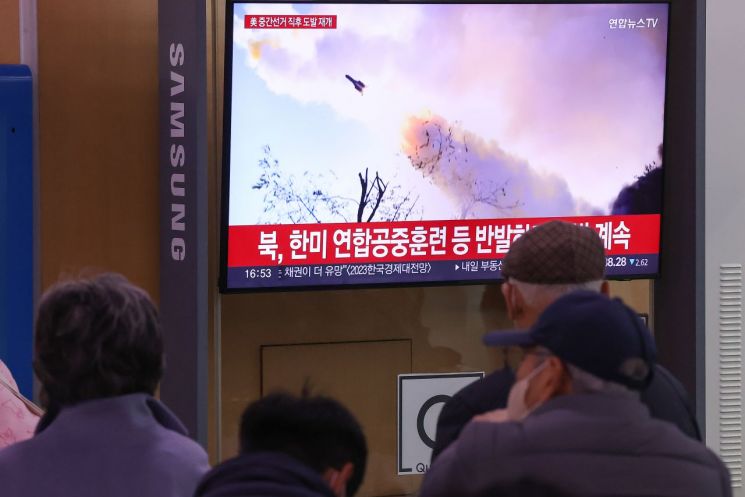
[Asia Economy Yang Nak-gyu, Military Specialist Reporter] There are criticisms that the General Security of Military Information Agreement (GSOMIA) between South Korea and Japan is virtually useless. Despite North Korea carrying out more than 30 provocations this year, information exchange with Japan has been insufficient.
According to the military on the 26th, North Korea's provocations this year have exceeded 30 cases, with more than two-thirds occurring within six months of the Yoon Suk-yeol administration's inauguration. However, since the current administration took office, the number of information exchanges with Japan through GSOMIA has been only 11. Compared to the period from November 2016, when GSOMIA was signed, to October 2019, during which North Korea conducted one nuclear test and launched 25 missiles, and South Korea and Japan shared information 29 times through GSOMIA, the frequency of exchanges has decreased.
GSOMIA is an agreement that allows countries to share military secrets. South Korea and Japan signed GSOMIA on November 23, 2016. The agreement includes 21 articles regulating procedures related to the transmission, storage, destruction, duplication, and disclosure of military information. It allows sharing of all information between the two countries except for top-secret level 1 information, including South Korea's military secret levels 2 and 3, and Japan's Tokutei Gokuhi (Extremely Secret) and HI-level secrets.
The Trilateral Information Sharing Arrangement (TISA) among South Korea, the United States, and Japan, signed in December 2014, shared information 17 times over two years before GSOMIA was signed in November 2016. During the same period, North Korea conducted two nuclear tests and 17 missile tests. This shows that the frequency of information sharing was not significantly different from that under GSOMIA.
For this reason, voices calling for the abolition of GSOMIA have emerged within and outside the military. On the 13th, the leaders of South Korea, the United States, and Japan held a trilateral summit in Phnom Penh, Cambodia, and adopted a joint statement declaring their intention to "share North Korean missile warning information in real time to enhance each country's detection and assessment capabilities against threats posed by North Korean missiles."
Since there is no system for real-time information sharing between South Korea and Japan, options such as expanding the system possessed by the United States are being discussed. The idea is to improve and utilize the operation method of the Trilateral Information Sharing Arrangement (TISA). TISA involves the U.S. Department of Defense acting as an intermediary when exchanging information between South Korea's Ministry of National Defense and Japan's Ministry of Defense, making the "real-time information sharing" mentioned by the three leaders reportedly impossible.
A government official pointed out, "Since issues such as export regulations, GSOMIA, and forced labor with Japan have not been resolved, our government cannot take the initiative to announce (the normalization of GSOMIA) first," emphasizing the need for follow-up measures to support this.
Moon Hong-sik, Deputy Spokesperson of the Ministry of National Defense, said at a recent briefing regarding missile information sharing among the three countries, "The leaders announced a broad agreement, and detailed discussions are the responsibility of the defense authorities of the three countries," adding, "Specific measures will be discussed going forward."
© The Asia Business Daily(www.asiae.co.kr). All rights reserved.

















