Second Strike by Seoul National University Hospital Union Begins on 23rd
Concerns Over Logistics, Transportation, and Care Gaps Due to Strike
Prime Minister Han Duck-soo "Will Respond Firmly to Illegal Acts"
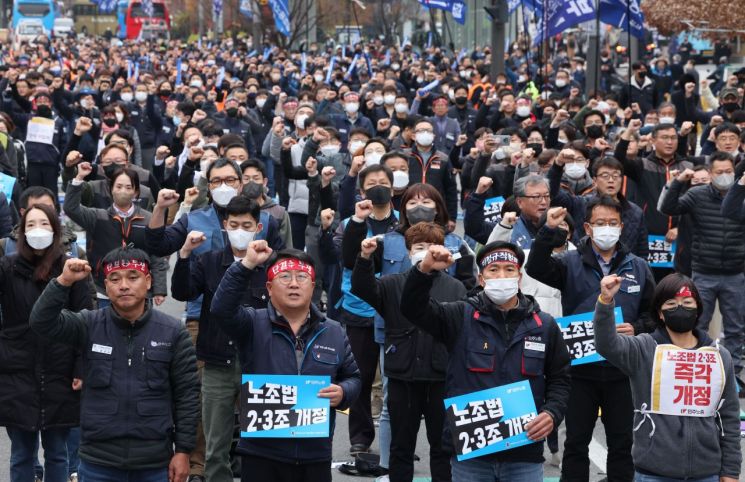 On the afternoon of the 22nd, the Korean Confederation of Trade Unions (KCTU) held a rally in front of the National Assembly in Yeouido, Seoul, to demand the enactment of Articles 2 and 3 of the Trade Union Act. [Image source=Yonhap News]
At the end of this month, the labor sector began clashing with the Yoon Suk-yeol administration by announcing consecutive general strikes. The ruling party and government hinted at a tough response, putting the possibility of deploying public authority to the test.
According to labor groups on the 23rd, the Seoul National University Hospital branch of the Medical Solidarity Headquarters under the Public Transport Union (Seoul National University Hospital Union) will start its second strike on this day. This comes about two weeks after the first strike on the 10th. Around 1,300 members of the Seoul National University Hospital Union held a general strike send-off rally in front of the main building of Seoul National University Hospital at around 10:30 a.m., and in the afternoon, they plan to march from Marronnier Park in Jongno-gu, Seoul, to Jongno 3-ga, demanding increased staffing and improved working conditions.
The nationwide strike was initiated by the Korean Confederation of Trade Unions (KCTU). The day before, KCTU held a press conference in front of the National Assembly, announcing a general strike and all-out struggle. They demanded the enactment of a special construction safety law, abolition of the sunset clause on the cargo safety freight system and expansion of applicable industries, suspension of privatization and strengthening of publicness under the Yoon Suk-yeol administration, and amendments to Articles 2 and 3 of the Trade Union Act (Yellow Envelope Act).
From this day, unions under the Public Transport Union will participate massively in the strike. In addition to the aforementioned Seoul National University Hospital Union, the National Health Insurance Customer Center Branch (November 23), Cargo Solidarity Headquarters (November 24), Seoul Transportation Corporation Union (November 30), and National Railway Union (December 2) will also join the general strike. The Incheon Airport Regional Branch under the Public Transport Union may also participate in the strike on the 28th depending on labor-management negotiations.
The public sector irregular workers' union will strike on the 25th. Approximately 200,000 irregular workers affiliated with elementary, middle, and high school educational institutions, central government ministries, public institutions, and local governments plan to gather in Seoul to resolve to strike. Additionally, the 'Coupang Eats Joint Negotiation Team,' composed of the Rider Union and the KCTU Service Federation's delivery platform unions, announced a strike scheduled for the day after the first World Cup match.
As the winter struggle, known as 'Dongtu' (冬鬪), intensifies, disruptions in logistics, transportation, and caregiving are inevitable. Six major economic organizations?the Korea International Trade Association, Korea Chamber of Commerce and Industry, Federation of Korean Industries, Korea Federation of Small and Medium Business, Korea Employers Federation, and Korea Federation of Medium-sized Enterprises?issued a joint statement demanding the withdrawal of the Cargo Solidarity Headquarters' indefinite collective transport refusal declaration. Local governments such as Gyeonggi Province and Pohang City have prepared emergency transportation measures in anticipation of cargo disruptions caused by the Cargo Solidarity Headquarters' strike. The Ministry of Education expressed concern over educational gaps caused by the public sector irregular workers' strike and urged a return to the workplace.
Ruling Party and Government Signal Tough Response... Attention on Deployment of Public Authority
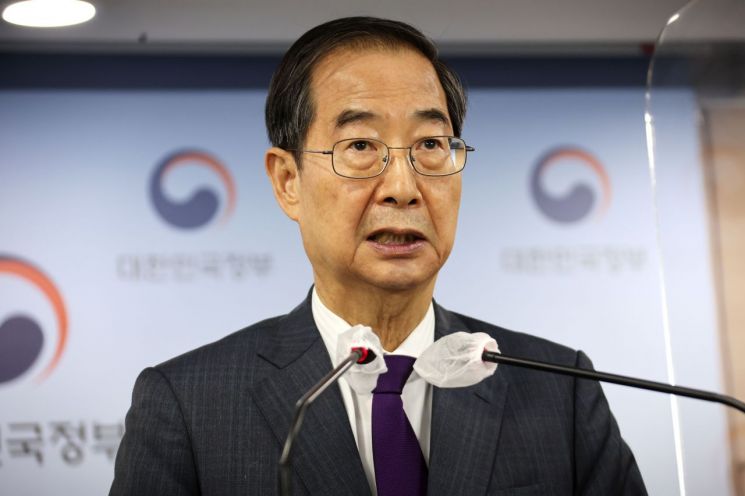 Prime Minister Han Duck-soo is announcing the government's position on the Cargo Solidarity Headquarters strike scheduled for the 24th at the briefing room of the Government Seoul Office Building on the 22nd. [Image source=Yonhap News]
The ruling party and government have signaled a tough response, emphasizing strict punishment for illegal acts over dialogue. On the previous day at the Government Seoul Office, Prime Minister Han Duck-soo stated, "This is a time when we must devote all efforts to reviving the economy. In this serious situation, the Cargo Solidarity Headquarters' refusal to transport will cause irreversible damage to the national economy beyond logistics paralysis," adding, "We will respond firmly to illegal acts according to law and principles." The People Power Party also released an official statement saying, "We are fed up with KCTU's arrogant threats to the public. This is a ruthless behavior for their own interests," and "They can be recognized as a genuine union only when they operate within the bounds of the law."
Attention is also focused on whether public authority will be deployed. Since the beginning of the current administration, it has declared it will actively respond to illegal acts by unions. During the general strike of the Daewoo Shipbuilding & Marine Engineering subcontractor branch last July, which served as a gauge, the police hinted at the possibility of using public authority by preparing to deploy a special police unit. Continuing this stance, Minister of Employment and Labor Lee Jeong-sik said on the 21st, "Regardless of labor or management, we will establish a close cooperation system with the National Police Agency and the Ministry of Land, Infrastructure and Transport to respond strictly to illegal acts." However, deploying public authority requires overriding the 'Police Special Forces Operation Regulations' revised in 2019, which stipulate that police special forces will not be deployed at assembly and protest sites.
© The Asia Business Daily(www.asiae.co.kr). All rights reserved.


















