Claims Below $20 in Ukraine and Poland
EU Proposes Gas Price Cap at 275 Euros... Diverging Opinions Emerge
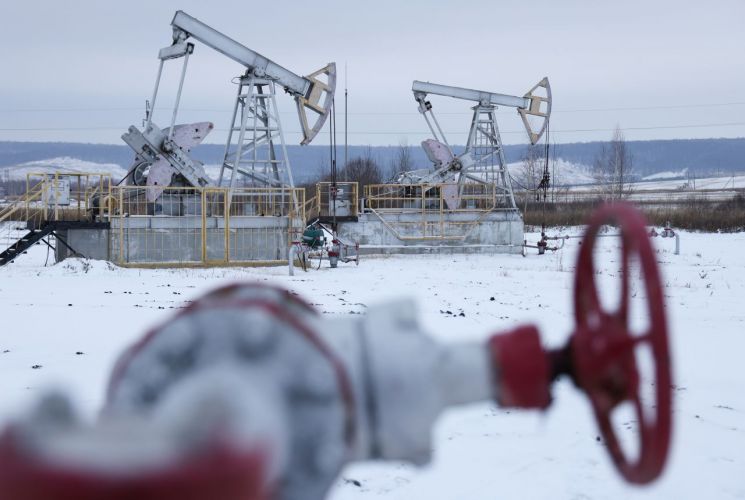
[Asia Economy Reporter Hyunwoo Lee] The Group of Seven (G7) major countries, including the United States, and the European Union (EU) are reportedly considering a price cap on Russian crude oil at around $60 per barrel (approximately 80,000 KRW). This is the first time a specific cap figure has been mentioned. While the EU is also discussing concrete measures for a gas price cap, differing interests among member countries are expected to prolong the time needed to reach an agreement.
On the 23rd (local time), the Wall Street Journal (WSJ), citing EU officials, exclusively reported, "On the 23rd, EU member state ambassadors will meet to reconcile differences regarding the Russian crude oil price cap," adding, "The most likely figure being discussed is around $60 per barrel." This is the first time a specific cap figure has been raised.
WSJ reported that although the G7 is not directly involved in deciding the cap amount, it will participate by importing according to the cap set by the EU, and Australia also plans to follow the EU's decision. Previously, the G7 and EU agreed to implement the price cap on Russian crude oil starting from the 5th of next month.
EU member states generally support the implementation of the price cap, but disagreements over the cap level are emerging. Eastern European countries bordering Russia, such as Poland and Lithuania, have taken a hardline stance, proposing to lower the cap below Russia's crude oil production cost of around $20 per barrel.
The Ukrainian government also argues that a $60 cap would not inflict direct damage on Russia and insists the cap should be set lower. Oleg Ustenko, economic advisor to the Ukrainian president, told WSJ in an interview, "If the price cap is introduced at around $60, it would be reasonably acceptable from the perspective of most European countries," but added, "From our perspective, we want to see the minimum possible value close to the marginal production cost."
However, countries centered on shipping industries where tanker transport plays a significant economic role, such as Greece, Malta, and Cyprus, oppose a cap set too low, sparking controversy. If the price cap is set, tankers from G7 and EU countries transporting Russian crude oil exceeding the cap will not be able to receive insurance coverage. If the cap is set too low, insurance for tankers transporting Russian crude oil will be blocked, which is expected to deal a significant blow to shipping companies.
Meanwhile, the EU is also reviewing a gas price cap. According to CNN, the EU Commission officially proposed a gas price cap of 275 euros (approximately 380,000 KRW) per megawatt-hour (MWh) to member states on the same day. It is reported that the implementation will be discussed at a special meeting of the EU Energy Council scheduled for the 24th.
However, many countries are opposing the gas price cap, arguing that it is too high compared to the current price range of 110 to 120 euros, so prolonged difficulties are expected before an actual agreement is reached.
Russia reiterated its previous stance of halting exports to countries implementing the price cap and threatened to further reduce gas supplies to neighboring Moldova. According to Bloomberg News, Russian state-owned gas company Gazprom warned that it may further cut gas volumes transported to Moldova via Ukraine starting from the 28th.
© The Asia Business Daily(www.asiae.co.kr). All rights reserved.

















