[Asia Economy Sejong=Reporter Kim Hyewon] The Organisation for Economic Co-operation and Development (OECD) has lowered South Korea's economic growth forecast for next year to the high 1% range. The consumer price inflation forecast for next year remains unchanged at 3.9%.
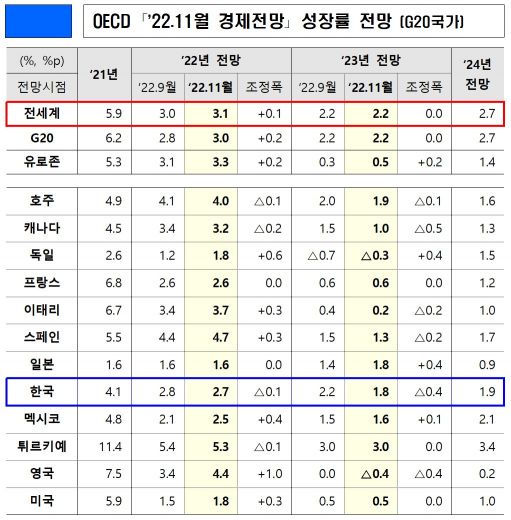
According to the Ministry of Economy and Finance, the OECD revised down South Korea's economic growth forecast for next year by 0.4 percentage points from 2.2% to 1.8% in its economic outlook released on the 22nd.
The OECD's growth forecast for next year is lower than those of the Asian Development Bank (2.3%), the International Monetary Fund (2.0%), and Fitch (1.9%). It is 0.7 percentage points below the South Korean government's forecast of 2.5%. It matches the Korea Development Institute (KDI) forecast.
Thus, the OECD has lowered South Korea's economic growth forecast for next year twice in a row, following its midterm economic outlook in September.
This year's economic growth forecast was revised down by 0.1 percentage points from 2.8% to 2.7%. The economic growth forecast for 2024, the year after next, was presented at 1.9%.
The OECD predicted, "South Korea's economic growth rate is expected to slow to just below 2% during 2023-2024." It added, "Private consumption has shown a steady recovery so far, but the slowdown in disposable income growth due to high inflation may constrain private consumption going forward," and assessed, "Exports will be affected in the short term by the semiconductor market downturn and global demand uncertainties."
The global economic growth rate is expected to slow to 2.2% next year and then gradually recover to 2.7% in 2024. This year's global economic growth rate was projected at 3.1%.
The OECD diagnosed that the Russia-Ukraine war has triggered the highest level of energy crisis since the 1970s, causing worldwide high inflation and low growth.
The OECD emphasized, "While Asia will lead the global recovery through 2024, economic recovery in Europe, North America, and South America will be quite sluggish," adding, "Due to soaring prices, real wages are falling and real purchasing power is shrinking in most countries, making inflation control the top policy priority at this time."
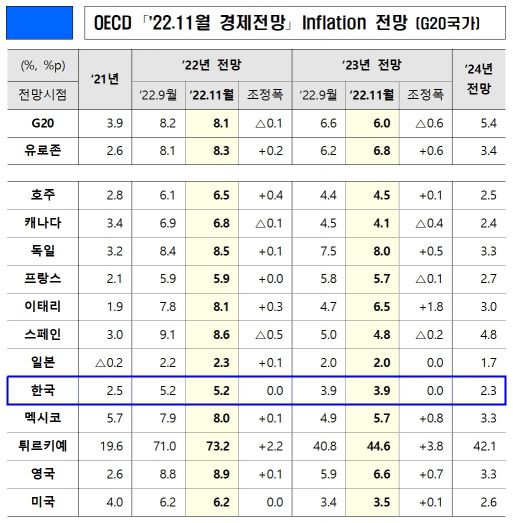
The consumer price inflation forecast for the Group of Twenty (G20) is 8.1% this year, 6.0% next year, and 5.4% the year after next.
For South Korea, the consumer price inflation rate is forecast at 5.2% this year, 3.9% next year, and 2.3% the year after next. The OECD predicted, "Prices will remain high for a while, mainly in services and public utilities, but will gradually decline thereafter."
Regarding the South Korean economy, the OECD said, "The adjustment in housing prices and corporate insolvency risks due to increased repayment burdens on households and businesses could act as downside factors for consumption and investment," and "The easing of geopolitical tensions, China's shift away from zero-COVID policy, and early recovery of face-to-face services could act as upside factors." It also recommended maintaining a tight monetary policy for the time being to ensure stable formation of inflation expectations. Additionally, it called for efforts to restore fiscal soundness, alleviate inflationary pressures, and proposed that the National Assembly adopt fiscal rules to prepare for rapid population aging.
© The Asia Business Daily(www.asiae.co.kr). All rights reserved.


















