"Concerns Over Export and Economic Damage"
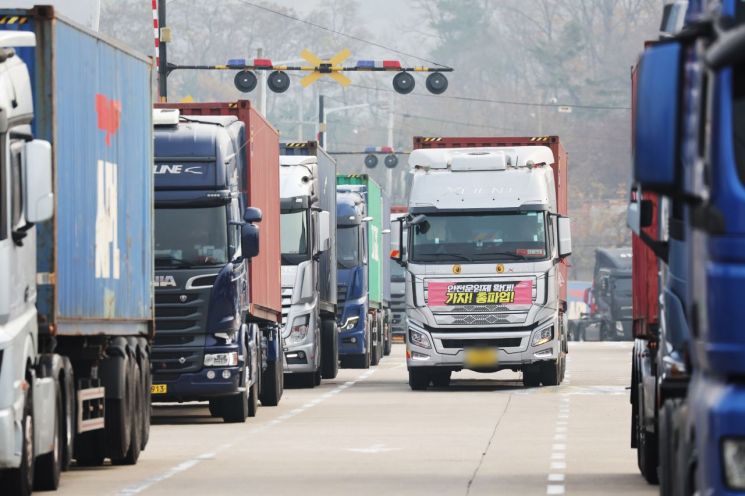 On the morning of the 22nd, two days before the Cargo Solidarity general strike, cargo trucks were moving in and out of the Inland Container Depot (ICD) in Uiwang-si, Gyeonggi-do. [Image source=Yonhap News]
[Asia Economy Reporter Jeong Dong-hoon] Six economic organizations expressed concern over the Cargo Solidarity's refusal to transport strike and demanded the withdrawal of the strike.
On the 22nd, six economic organizations including the Federation of Korean Industries, Korea Employers Federation, Korea Chamber of Commerce and Industry, Korea International Trade Association, Korea Federation of Small and Medium Business, and Korea Federation of Medium-sized Enterprises urged the Cargo Solidarity Headquarters of the Public Transport Union under the Korean Confederation of Trade Unions (KCTU) to "immediately withdraw the refusal to transport (general strike) and promote win-win cooperation among truck owners, transport companies, and cargo owners."
In a joint statement, the six economic organizations said, "We are concerned about the serious damage that the Cargo Solidarity's indefinite collective refusal to transport will cause to exports and the economy."
The Cargo Solidarity has announced a general strike starting on the 24th, demanding the continuation and expansion of the 'Safe Freight Rate System,' which is scheduled to expire at the end of this year.
The six economic organizations diagnosed that Korean companies are facing an unprecedented crisis due to trade deficits, soaring raw material prices, and rising interest rates. They also pointed out that the collective refusal to transport carried out by Cargo Solidarity in June paralyzed key national industries such as automobiles, steel, and petrochemicals for over a week, and some small and medium-sized enterprises even faced the ordeal of having export contracts canceled because they could not transport their products.
The six economic organizations stated, "Another collective action by Cargo Solidarity will cause significant damage not only to our export companies but also to the national economy, and public criticism of Cargo Solidarity's collective selfishness, which does not consider exports and the public, will intensify."
They added, "The Safe Freight Rate System demands unilateral sacrifices from cargo owners by causing a sharp rise in logistics costs and is ultimately an unreasonable system that can reduce the workload of truck owners and transport companies. We urge the immediate abolition of the Safe Freight Rate System as planned and actively seek alternatives that allow truck owners, transport companies, and cargo owners to achieve a win-win-win situation."
Regarding this, the six economic organizations demanded ▲ immediate abolition of the Safe Freight Rate System ▲ cessation of attempts to expand the scope of items subject to the Safe Freight Rate System ▲ promotion of safety assurance efforts based on scientific and empirical methods ▲ balanced composition of the Safe Freight Rate Committee between truck owners and cargo owners. They also appealed to the government and the National Assembly, saying, "Many cargo owners, including small export companies, are waiting for a system that allows mutual coexistence. Please do not be unilaterally overwhelmed by collective power and work on reasonable alternatives."
© The Asia Business Daily(www.asiae.co.kr). All rights reserved.

















