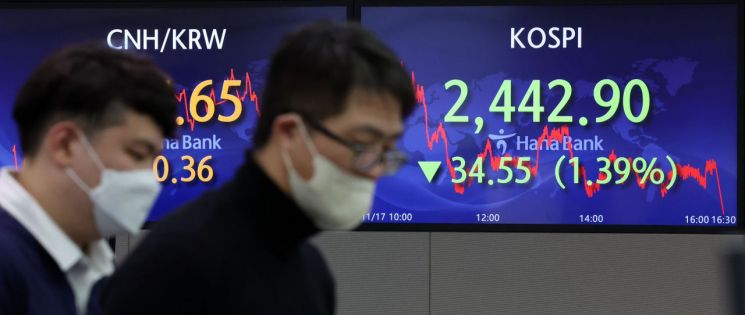
[Asia Economy Reporter Ji Yeon-jin] The domestic stock market collectively declined slightly on the 22nd. Investor sentiment was dampened by the previous day's weak U.S. stock market due to China's renewed COVID-19 lockdowns and concerns over an economic recession following the drop in international oil prices.
The KOSPI index closed at 2405.27, down 14.23 points (0.59%) from the previous day. The index started with a slight decline and attempted a rebound during the session but turned downward as foreign and institutional investors increased their selling pressure. Foreign investors sold up to 100 billion KRW during the session and ended with a net sale of about 35.8 billion KRW. Institutions also recorded a net sale of 4.1 billion KRW. Individual investors alone net sold about 28.2 billion KRW.
On the previous day in the U.S. stock market, news of Foxconn halting hiring led to significant declines in Apple (-2.17%), parts stocks, and semiconductor sectors. Additionally, Tesla fell sharply due to recalls and the plunge in international oil prices, dragging down electric vehicle-related stocks as well.
In the Korea Exchange, the non-metallic minerals sector, which includes secondary battery-related stocks, fell sharply by 1.58%, and the electrical and electronics sector dropped 1.15%. The service sector, including gaming stocks, was the weakest, declining 2%.
Meritz Financial Group closed at the upper limit after announcing the full acquisition of Meritz Fire & Marine Insurance and Meritz Securities, highlighting the rise in securities stocks (4.53%) and financial stocks (3.60%).
Among the top market capitalization stocks, electronics and secondary battery-related stocks such as Samsung Electronics (-1.30%), SK Hynix (-1.27%), Samsung SDI (-2.02%), and LG Energy Solution (-0.35%) fell significantly. Hyundai Motor also declined 1.49%, and Celltrion recorded a slight decrease of 0.28%. LG Chem, which surged during the session due to increased U.S. investment, closed up 0.73%.
Kim Seok-hwan, a researcher at Mirae Asset Securities, stated, "The decline in major tech stocks like Apple and Tesla in the U.S. stock market, along with the sharp drop in international oil prices, synchronized to dampen investor sentiment," adding, "This was reflected in concerns over strengthened lockdowns due to the resurgence of COVID-19 in China."
The KOSDAQ index also fell 6.31 points (0.88%) to 712.26. Foreign and institutional investors led the decline with net sales of approximately 76.5 billion KRW and 74.4 billion KRW, respectively, while individual investors supported the downside by net buying about 159.3 billion KRW.
Among the top market capitalization stocks, most recorded weakness except for Celltrion Healthcare (0.46%) and HLB (2.26%). L&F plunged 5.74%, and secondary battery parts stocks such as EcoPro BM (-2.75%), EcoPro (-3.07%), and Cheonbo (-3.49%) were the weakest. Gaming stocks like Pearl Abyss (-3.07%) and Kakao Games (-2.95%) also closed lower.
Han Ji-young, a researcher at Kiwoom Securities, said, "Since mid-last week, major markets including Korea and the U.S. are in a phase where previous upward momentum factors such as the decline in U.S. Consumer Price Index (CPI), the Federal Reserve's pace adjustment, earnings season, and exchange rate declines are being exhausted," adding, "As the market has become accustomed to both positive and negative factors, the current phase is more of a box range rather than directional betting."
© The Asia Business Daily(www.asiae.co.kr). All rights reserved.

















