Fines Totaling 7.5 Billion KRW Imposed... Measures Include Prosecution, Business Suspension, and Corrective Orders
[Asia Economy Reporter Lim Cheol-young] The Ministry of the Interior and Safety announced that it detected approximately 1.43 million safety vulnerabilities after conducting a joint inspection with related agencies around more than 6,000 elementary schools nationwide to prevent safety accidents involving children during the new school term.
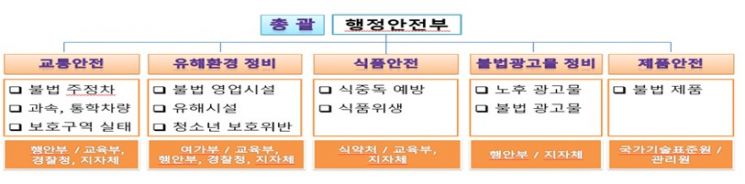
This new school term inspection involved 720 organizations, including central government ministries, local governments, and private organizations, with 35,808 participants. They conducted focused inspections on 6,163 elementary school protection zones nationwide in five major areas: traffic safety, harmful environments, food safety, illegal advertisements, and product safety.
As a result of the inspection, a total of 1,432,710 dangerous or illegal cases were detected. Minor issues were corrected on-site, while violations were subject to administrative measures such as fines and business suspensions. Serious cases were reported to judicial authorities.
In the traffic safety sector, 47,614 cases of traffic safety risks were identified, including old or damaged traffic safety facilities around schools, illegal parking, and speeding violations within child protection zones. Fines and penalties totaling 4.7 billion KRW were imposed. In particular, to prevent child safety accidents caused by construction sites, 272 construction sites around elementary schools nationwide were inspected, detecting 91 risk factors such as missing safety fences and inadequate falling object prevention nets, which were ordered to be corrected.
In the harmful environment sector, 16,319 youth-harmful businesses around elementary, middle, and high schools nationwide were inspected, detecting 1,426 violations such as sales of harmful substances to youth, unauthorized youth entry, and employment violations. Measures including guidance, prosecution, criminal charges, and business suspensions were taken against violating businesses. In the food safety sector, 33,678 food suppliers, school stores, and snack shops around schools were inspected, detecting 5 cases such as displaying or storing expired products, resulting in fines and other measures. Additionally, promotional materials were distributed to encourage proper use of the rapidly increasing number of unmanned stores for children, and cautionary labels were attached to display shelves to reduce children's high caffeine intake, alongside active promotional activities.
In the product safety sector, consumer organizations such as the Korea Life Safety Federation participated in inspections of 1,042 child products in manned and unmanned stores frequently visited by children. As a result, 102 suspected illegal products were detected in 37 stores, with on-site corrections made and follow-up actions such as sales suspension and fines imposed for non-compliance. In the illegal advertisement sector, private organizations including the Outdoor Advertising Association participated in inspections and maintenance of 11,297 locations around kindergartens, elementary, middle, and high schools nationwide. They inspected 1,383,563 cases of hazardous old or defective signs and illegal banners, imposing fines of 2.7 billion KRW and enforcement fees of 91 million KRW.
Furthermore, joint campaigns with private organizations such as the Green Mothers' Association and the Korea Life Safety Federation were actively conducted, along with promotional activities using electronic billboards and websites to create a safe school environment. This second semester inspection was conducted on a large scale due to the easing of COVID-19 social distancing and the resumption of face-to-face classes in elementary schools. Compared to the first semester inspection, the number of detected risks and violations increased by 48.2%, and the number of promotional activities increased by 112.5%.
Cho Sang-myung, Director of the Safety Policy Office, emphasized, “Creating an environment for children’s safe daily routines, such as commuting to and from school, is of utmost importance.” He added, “Government ministries, local governments, and private organizations will continue to do their best to proactively identify and promptly resolve safety vulnerabilities around schools so that children can attend school with peace of mind.”
© The Asia Business Daily(www.asiae.co.kr). All rights reserved.
![User Who Sold Erroneously Deposited Bitcoins to Repay Debt and Fund Entertainment... What Did the Supreme Court Decide in 2021? [Legal Issue Check]](https://cwcontent.asiae.co.kr/asiaresize/183/2026020910431234020_1770601391.png)
















