[Asia Economy Honam Reporting Headquarters, Reporter Yoon Jamin] Kang Gijeong, Mayor of Gwangju Metropolitan City, stated that he will "prepare various policies to improve the quality of individual lives" to address the issues of population outflow and low birth rates.
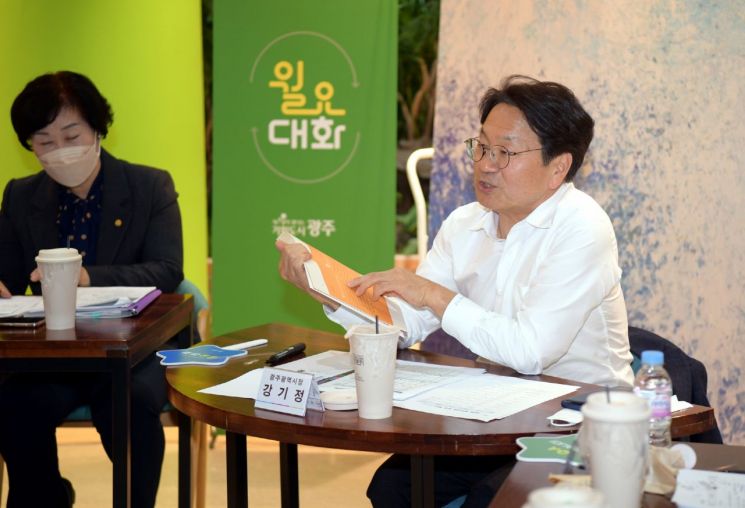
On the afternoon of the 21st, Mayor Kang held a discussion at City Hall with members of ‘Top-us,’ a university student group concerned about population issues, focusing on responses to population changes. He said, “To solve population problems, we start by expanding cultural facilities prioritized by young people, creating quality jobs, and establishing stable housing environments.”
The university students openly shared their thoughts on ▲ Gwangju’s proud features and shortcomings ▲ current status and causes of youth (population) outflow ▲ improvements needed to solve low birthrate population issues.
The students viewed the core of solving population outflow and low birthrate problems as changing ‘my life.’ They explained that the lack of cultural infrastructure and jobs in the region not only drives young people to the metropolitan area but also leads to a vicious cycle of giving up dating, marriage, and childbirth.
First, Seo Jangwon (Donggang University) said, “Gwangju has many proud legacies such as the May 18 Democratic Movement, the beautiful four seasons of Mudeungsan National Park, and the Asia Culture Center, but it still feels 2% lacking. I have lived in Gwangju for 20 years, but there are no proper places to go or hang out, and there are no jobs, so many friends are leaving for the metropolitan area.”
He continued, “If Gwangju had attractions and entertainment like complex shopping malls, amusement parks, and 5-star hotels, it could transform from a no-fun (No-Jam) city to a fun (U-Jam) city. If that happens, people will gather in the region, jobs will be created, and naturally, population problems can be solved,” he emphasized.
Park Nayoung (Donggang University) said, “Along with improving the quality of individual lives such as stable housing environments, childbirth and childcare policies also need to change. Based on opinions from friends around me, policies supporting even one child rather than two or more, and workplace environment improvements like parental leave that can be taken without hesitation are necessary.”
Finally, Mayor Kang said, “Young people want social environments such as cultural facilities, housing stability, quality jobs, and workplace awareness improvements to change first. Since policy decision-makers are mostly over their 50s, the voices of 2030 youth are sometimes not properly heard or deprioritized. Based on big data, we will properly listen to young people’s voices and create a new, vibrant Gwangju.”
The ‘Top-us’ campaign titled ‘Our Pledge! Adding and Subtracting’ was also held. For responding to population issues, participants wrote cards about efforts needed for ‘shared childcare’ and ‘work-life balance’ and took certification photos.
Attendees included Mayor Kang, students Kang Haeun, Park Yuna, Kim Jungseo, and Kim Dabin from Gwangju University; students Kang Heemin, Kim Jinhui, Park Nayoung, and Seo Jangwon from Donggang University; Lee Kyungmi, Manager of the Gwangju-Jeonnam Branch of the Population Health and Welfare Association; Lim Seonju, Team Leader of the Working Mom Support Team at the Gwangju Work-Family Balance Support Center; and Kim Sunok, Director of the Women and Family Education Bureau of the city.
‘Monday Dialogue’ is a forum hosted by the mayor to discuss major issues in eight fields including education, youth, economy, and startups with people from various sectors, aiming to realize ‘Gwangju, a city of shining opportunities for my☆future.’
Meanwhile, Gwangju City is advancing the step-by-step enhancement of the Gwangju Aikiwoom Platform’s care map by December to establish a ‘thorough all-day care system from birth to growth.’ It will provide integrated care information within 10 minutes of one’s neighborhood (care facilities, communities, services, etc.) by age and residence of children.
© The Asia Business Daily(www.asiae.co.kr). All rights reserved.

















