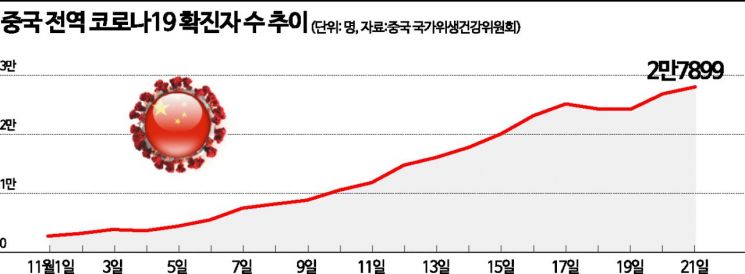
27,899 Cases Confirmed on 21st... Record High Approaching
John Lee, Hong Kong Chief Executive, Tests Positive Next to Xi at APEC
Conversation Without Masks... Classified as Close Contact Under Regulations
[Asia Economy Beijing=Special Correspondent Kim Hyunjung] The number of new COVID-19 cases across China has exceeded 20,000 for seven consecutive days, putting the health authorities on high alert. Regions that had been attempting to normalize economic activities under the banner of "precision epidemic control" have responded by increasing lockdown measures again. Amid this situation, Hong Kong Chief Executive John Lee, who had sat and conversed with Chinese President Xi Jinping without masks, tested positive for COVID-19, making even the head of state a close contact.
According to the National Health Commission of China on the 22nd, the number of new COVID-19 cases nationwide reached 27,899 the previous day, approaching the record high of 28,973 on April 13. Until early this month, the daily new cases were around 2,000, but they increased to over 10,000 on the 10th and jumped to over 20,000 on the 15th. After exceeding 20,000 for seven consecutive days until the previous day, the number is now close to 30,000.
In the capital Beijing, where the number of confirmed cases has risen to the 1,000s (1,438 as of the 21st), tension is mounting as deaths have occurred. Following an 87-year-old man on the 19th, a 91-year-old woman and an 88-year-old man died after testing positive on the 20th. Beijing has mandated three nucleic acid tests over three consecutive days for all arrivals, switched school classes to online, and recommended residents to refrain from going out and closed restaurants. Businesses such as banks that must operate are only allowing the minimum necessary staff to attend work.
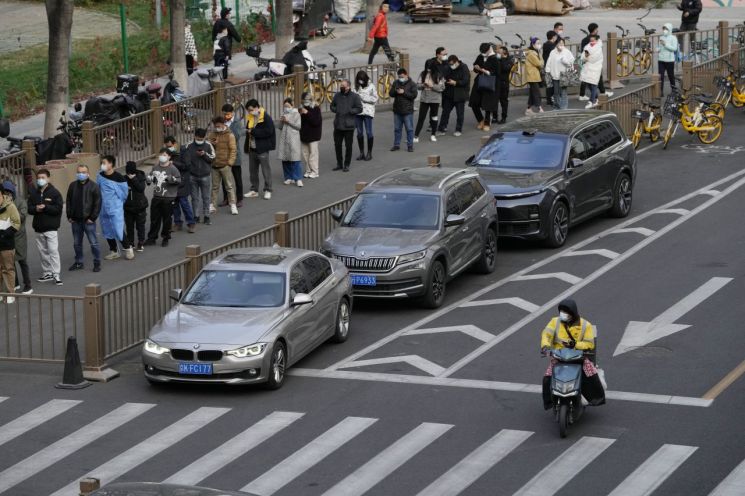
According to local media, Shijiazhuang, the capital of Hebei Province adjacent to Beijing, has effectively imposed lockdown measures on six urban districts including Chang'an District for five days until the 25th of this month. Residents in high-risk areas are prohibited from leaving their homes, and residents in medium- and low-risk areas are also expected to stay home as a principle. In locked-down households, one person must present a negative PCR test certificate every 24 hours, and going out for limited purposes such as purchasing daily necessities is allowed for two hours. Wuhan, the capital of Hubei Province, also locked down five urban subdistricts during the same period, closing shopping malls and restaurants. Additionally, partial lockdowns, business suspensions, and online classes have been implemented in Guangzhou, Tianhe, Huangpu, and Zhengcheng in Guangdong Province.
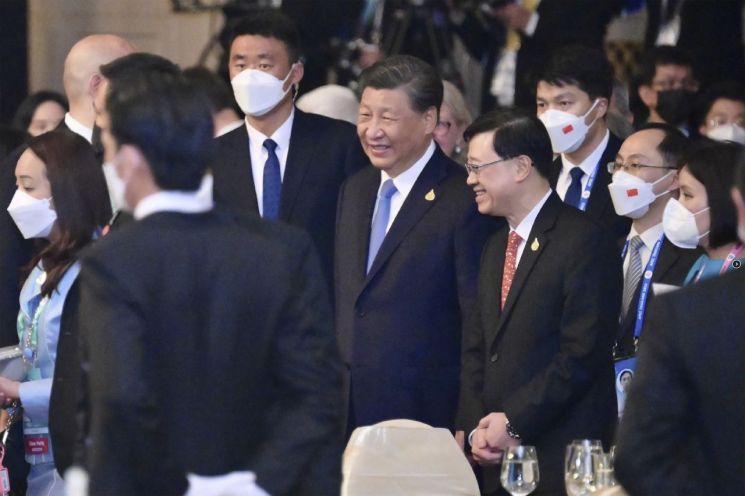
In this situation, even President Xi Jinping has become a close contact, making isolation unavoidable. The Hong Kong government announced in a statement the previous day that "Chief Executive Lee tested positive in a PCR test conducted at Hong Kong International Airport upon returning on the night of the 20th" and is "currently in isolation." According to photos distributed by the Hong Kong government, President Xi stood right next to Chief Executive Lee at the APEC summit dinner on the 17th and sat side by side during the summit on the 18th and 19th. Neither of them wore masks. Lee is also reported to have conversed without masks with several Chinese government officials, including Wang Yi, China's Foreign Minister.
According to local regulations, close contacts of COVID-19 confirmed cases must quarantine for eight days (five days in a facility plus three days self-isolation). In this case, even if President Xi tests negative in nucleic acid tests, he cannot engage in outside activities for at least 28 days. Of course, as the head of state and with Cuban President Miguel D?az-Canel's scheduled visit to China on the 24th, exceptions may apply, but so far there has been no special announcement from the Chinese government. At a regular briefing the previous day, Chinese Foreign Ministry spokesperson Mao Ning responded to questions about President Xi's health by saying, "Chinese delegations visiting foreign countries are following COVID-19 prevention regulations," and the Ministry posted the briefing content on its website excluding related questions and answers, which is unusual.
Some view the spread of COVID-19 as an inevitable development following the earlier announced "20 measures" policy shift. Lu Mengji, a virus researcher at the University of Duisburg-Essen in Germany, told Bloomberg News, "The spread was inevitable after the adoption of the measures specified in the new policy," and predicted "it will trigger larger-scale controls." He added, "We need to observe how it affects vulnerable populations in 6 to 7 weeks," explaining that "(the results) will indicate either confidence or frustration with the new policy."
© The Asia Business Daily(www.asiae.co.kr). All rights reserved.



















