Osstem and Dentium Show Strong 3Q Sales
Osstem Expected to Join 1 Trillion Won Annual Sales Club
Domestic Implant Industry Highly Dependent on China
Will Next Year's VBP Implementation Be a Boon or a Bane?
[Asia Economy Reporter Lee Chun-hee] The domestic implant industry continues its growth trend. In particular, while massive exports to China form the foundation of this growth, there is a prevailing outlook that the Chinese government's market regulation policies will actually be beneficial for domestic implant companies.
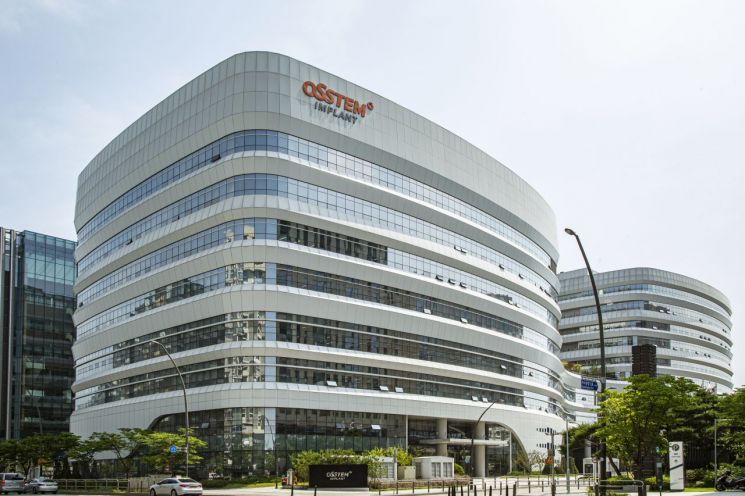
According to the industry on the 22nd, most domestic implant companies recorded strong performances in the third quarter. Osstem Implant, which holds an overwhelming 45% market share domestically last year, posted consolidated sales of 279.55929 billion KRW and operating profit of 56.0544 billion KRW in the third quarter. This represents growth of 31.1% and 59.3% respectively compared to the same period last year. Especially, with cumulative third-quarter sales reaching 779.1 billion KRW, a positive signal has been lit for achieving annual sales of 1 trillion KRW this year. Financial information firm FnGuide analyzed that Osstem Implant's annual sales this year will reach 1.0616 trillion KRW.
Following that, Dentium, which holds the second-largest market share at 11%, also showed growth with consolidated third-quarter sales of 90.65814 billion KRW and operating profit of 33.72236 billion KRW, up 27.4% and 123.3% respectively compared to last year. On the other hand, Dio recorded sales of 38.15271 billion KRW and operating profit of 1.07054 billion KRW, showing declines of -2.3% and -89.3% respectively.
The difference in performance is analyzed to be influenced by the Chinese market. For domestic implant companies, the proportion of sales from China exceeds 50% for some companies, highlighting the importance of the Chinese market. According to provisional export figures from the Korea Customs Service and Korea Trade-Investment Promotion Agency for the period from the 1st to the 20th of this month, of the total implant export value of 40.04 million USD (approximately 56.6 billion KRW), China accounted for 18.31 million USD, about 45%.
The recent consecutive quarterly sales declines for Dio compared to the same period last year are also attributed to its smaller influence and sales organization scale in China compared to other companies, making it difficult to overcome regional lockdowns caused by COVID-19. In contrast, Osstem Implant and Dentium, whose sales to China have continued to increase as local hospitals stockpiled inventory fearing shortages, show the opposite trend.

The high dependence on China is also considered the biggest variable affecting the performance of domestic implant companies due to the Chinese government's centralized volume-based procurement (VBP) policy scheduled to be implemented next year. VBP is a policy where the government directly purchases large quantities of pharmaceuticals and standardizes prices. If implants are included in the VBP target, it will inevitably lead to a decrease in supply prices.
However, many in the domestic industry view the VBP policy as a positive factor. A company official said, "Most exports of implants to China focus on mid- to low-priced products," adding, "Even if prices fall, there is a high possibility of quantitative growth that exceeds this, so it will rather be an opportunity to increase sales."
As latent demand is revealed through price reductions and the implant market expands, high-priced implant companies such as Straumann and Dentsply may find it difficult to respond to prices under VBP. Currently, with Osstem Implant at 33% and Dentium at 25%, the two domestic companies already hold more than half of the Chinese market share, presenting an opportunity to increase their market share further.
Domestic companies are also focusing on expanding production capacity. Osstem Implant has secured land near its Busan factory to build a second plant. It plans to have an annual production capacity of 13 million sets, and combined with the existing production headquarters volume, it will have the capability to produce 30 million implant sets annually. The Philadelphia production plant in the United States, which manufactures the high-priced implant 'Hiossen,' has also begun facility expansion to increase production by 58% compared to its current scale.
© The Asia Business Daily(www.asiae.co.kr). All rights reserved.


















