Establishing the Concept of 'Bold Initiative'... Yoon Officializes North Korea Policy
Moon Shifts from 'Dialogue Emphasis' to 'Strong Deterrence'
Easing Reciprocal Measures on Denuclearization Compared to MB Era
"Factors to Elicit North Korea's Response... Need for Specification and Detailing"
[Asia Economy Reporter Jang Hee-jun] The Yoon Seok-yeol administration plans to support the normalization of U.S.-North Korea relations, establish a peace regime, and promote arms control between the South and North, following the "Bold Initiative" roadmap for denuclearization. Denuclearization negotiations with North Korea are divided into three stages: initial measures, substantial denuclearization, and complete denuclearization, with the intention to implement corresponding measures simultaneously at each stage.
The Bold Initiative is evaluated as being based on strong deterrence against North Korea's nuclear and missile threats, presenting somewhat tougher principles such as "zero tolerance for any military provocations" compared to the Moon Jae-in administration's North Korea policy, which emphasized "peace." However, there are also critiques that more detailed and specific provisions are needed to leave room for North Korea's positive response.
A Denuclearized, Peaceful, and Prosperous Korean Peninsula... Officializing the 'Bold Initiative'
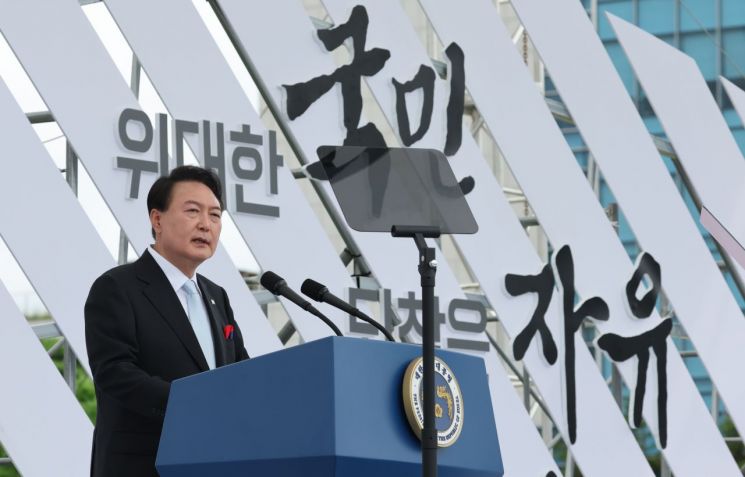
On the 21st, the Ministry of Unification published materials on the Yoon Seok-yeol administration's unification and North Korea policies aimed at a denuclearized, peaceful, and prosperous Korean Peninsula, officially announcing the denuclearization implementation plan under the Bold Initiative. The implementation of the Bold Initiative is divided into three stages: initial measures, substantial denuclearization, and complete denuclearization. Along with the publication, a general framework for economic, political, and military corresponding measures by stage was systematized.
Initial measures are implemented the moment North Korea approaches negotiations with "sincerity toward denuclearization." Explicitly, the condition is expected to be North Korea's return to denuclearization talks. Previously, President Yoon stated in the budget address on the 25th of last month, "If North Korea makes a decision on denuclearization and comes to the dialogue table (omitted), we will fully provide political and economic support through the Bold Initiative."
However, lifting sanctions on North Korea is an issue that must be addressed to provide support corresponding to the initial measures. Regarding this, a Ministry of Unification official explained, "One characteristic of the Bold Initiative is that we secure a central role while closely cooperating with the international community," adding, "There is already much understanding with the U.S. regarding the Bold Initiative."
Once a comprehensive agreement defining and setting goals for denuclearization is reached at the initial measures stage, economic cooperation and political-military measures will be actively implemented simultaneously from the substantial denuclearization stage. In the economic cooperation sector, the launch of the South-North Joint Economic Development Committee and modernization projects for ports and airports will be promoted, while in the political and military sectors, discussions on improving U.S.-North Korea relations, establishing a peace regime, and implementing military tension reduction measures will take place.
At the final complete denuclearization stage, full-scale South-North economic cooperation will be promoted through expanded investment and trade, and the full implementation of the South-North Joint Economic Development Plan will proceed. Politically and militarily, plans include normalizing U.S.-North Korea relations, concluding a peace agreement to establish a substantive peace regime, and enhancing military trust through the full-scale implementation of arms control measures.
Moon: Peace and Coexistence → Yoon Administration: "Zero Tolerance for Any Military Provocation"
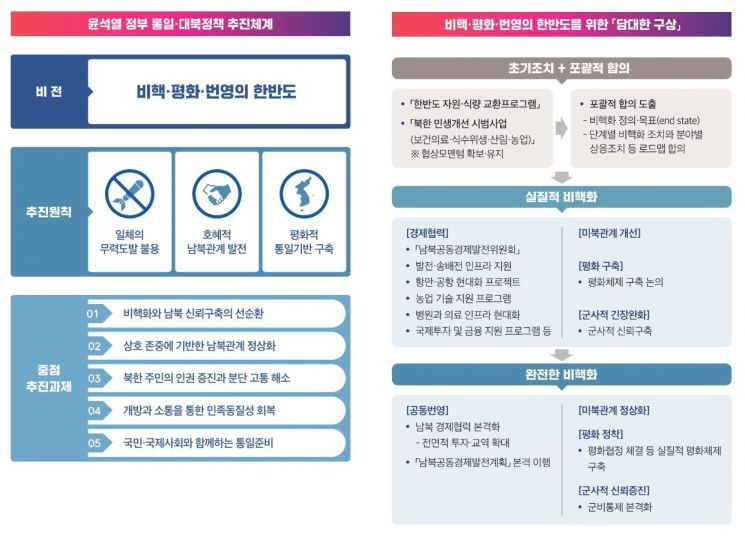 Yoon Suk-yeol Administration's Unification and North Korea Policy Briefing Materials
 Photo by Ministry of Unification
The Yoon Seok-yeol administration presented three main principles to implement its North Korea policy. The first is "zero tolerance for any military provocations." This means no tolerance for any military provocations by North Korea and opposition to unilateral changes to the status quo. Other principles include "mutually beneficial South-North relations development" and "building a foundation for peaceful unification," which were also presented by previous administrations.
The Bold Initiative clearly differs from the so-called "Korean Peninsula Peace Process" North Korea policy under the Moon Jae-in administration. Although five principles such as "our leadership," "strong security," and "mutual respect" were presented at that time, there was no expression as strong and definitive as the zero tolerance for military provocations.
Both administrations share the premise of striving for "mutually beneficial relations" and not pursuing "absorption unification." However, while the Moon administration's North Korea policy concluded with "peace" or "coexistence" as its goal, the Bold Initiative is based on North Korea's willingness to denuclearize and discusses support measures accordingly. It is also notable that the term "Korean Peninsula denuclearization" has been explicitly specified as "North Korea's denuclearization" under the current administration.
The government plans to improve, develop, and inherit the mistakes of previous administrations' North Korea policies. However, it intends to maintain consistency in respecting all agreements made between the South and North, such as the Panmunjom Declaration and the June 15 South-North Joint Declaration. This aligns with the government's approach of "Satongpaldal" (discussions on unification from all directions, passing the baton in all directions).
The Bold Initiative is also evaluated as similar to the "Denuclearization, Openness, 3000" policy during the Lee Myung-bak administration because it conditions support on North Korea's denuclearization. However, unlike Denuclearization, Openness, 3000, which planned to implement corresponding measures only after denuclearization was completed, the Bold Initiative provides support measures as soon as North Korea shows willingness and returns to negotiations.
A Ministry of Unification official explained, "The Bold Initiative is a more flexible and practical plan that pushes denuclearization negotiations with bold and preemptive measures from the initial stage as long as North Korea shows firm willingness toward denuclearization," adding, "Especially, unlike Denuclearization, Openness, 3000, it is a comprehensive plan that includes not only economic support but also political and military measures that can effectively lead North Korea."
Experts: "Lack of Room for North Korea's Positive Response... Need for Detailed Stage Breakdown"
Experts praised the Bold Initiative for clearly stating the will for denuclearization. However, some analyses suggest that the room for North Korea to respond positively is ambiguous. Since North Korea regards nuclear weapons as its last stronghold, it is necessary to establish detailed response stages such as "cessation of military provocations" or "implementation of South-North agreements" rather than directly moving to denuclearization.
Moon Sung-mook, head of the Unification Strategy Center at the Korea Institute for National Strategy, evaluated, "Our will for denuclearization must be stronger than North Korea's nuclear possession will, and in this regard, the Bold Initiative seems clearer than previous administrations' North Korea policies."
He added, "Although Kim Yo-jong, the vice department head of the Workers' Party, rejected and criticized the government's Bold Initiative, in reality, North Korea is the one who desperately wants South Korea's support measures. As time passes, the economic crisis worsens in North Korea, so we must consistently maintain denuclearization (willingness to return to negotiations) as a precondition based on international consensus and support."
Yang Moo-jin, president of the Graduate School of North Korean Studies, argued, "In the implementation of phased and simultaneous measures following North Korea's denuclearization, there should be a 'security versus security' perspective that allows North Korea to respond, rather than a 'security versus economic support' framework," adding, "For example, if North Korea suspends ballistic missile provocations or intercontinental ballistic missile (ICBM) launches, corresponding measures in the same field, such as reducing or suspending South Korea-U.S. joint military exercises, should be proposed."
He continued, "The plan should be improved to leave room for North Korea to respond positively, and the sooner such complementary measures are implemented, the more effective they will be."
Meanwhile, the Ministry of Unification plans to continuously supplement its North Korea policy by gathering opinions from various experts, including at the first public seminar held from 2 p.m. on the same day.
A Ministry of Unification official said, "It is difficult to disclose detailed implementation measures by stage at this point," adding, "Once a comprehensive agreement on denuclearization is reached, detailed measures will likely be coordinated with North Korea." The official further stated, "We will strengthen deterrence against North Korea to make it abandon its nuclear possession will and come to the negotiation table," and "We plan to enrich and specify the plan by closely cooperating with related ministries and incorporating opinions from experts and various sectors."
© The Asia Business Daily(www.asiae.co.kr). All rights reserved.



















