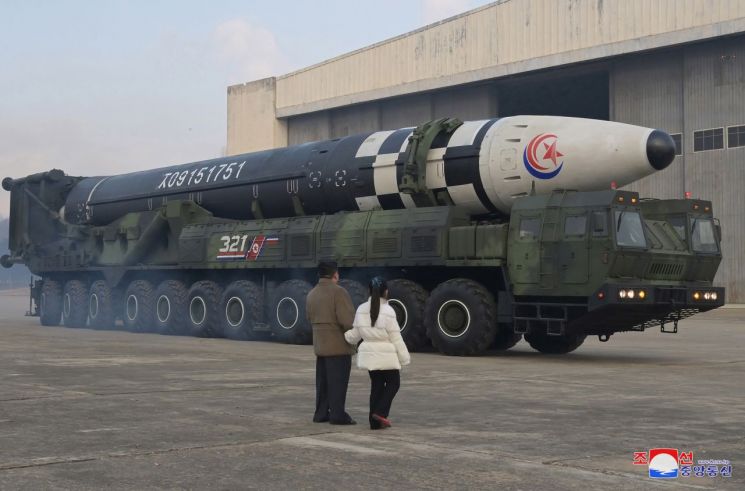
[Asia Economy Yang Nak-gyu, Military Specialist Reporter] The military authorities stated on the 21st that there is no information indicating that North Korea's intercontinental ballistic missile (ICBM) Hwasong-17 has been deployed in actual combat.
Kim Jun-rak, spokesperson for the Joint Chiefs of Staff, responded at a regular briefing on the same day to a question regarding North Korea's mention of the "Intercontinental Ballistic Missile Unit," saying, "The ICBM launched by North Korea on November 18 is assessed to be the Hwasong-17 as claimed by North Korea, but we do not have information related to its actual deployment."
On the 19th, North Korea's state media reported that the Hwasong-17 was test-fired under the observation of Chairman Kim Jong-un and mentioned the "Intercontinental Ballistic Missile Units" for the first time. This led to speculation that North Korea might have established an ICBM unit and interpretations that they intend to deploy the Hwasong-17 in actual combat.
In particular, North Korean Chairman Kim Jong-un took his young daughter to the ICBM launch site, promoting the message that the Hwasong-17 has achieved stability as a strategic weapon.
However, experts evaluate that North Korea still has "a long way to go" to complete its ICBM capabilities.
North Korea stated that the Hwasong-17 test launch was conducted "with the purpose of inspecting the reliability and operational confidence of the weapon system." In the context of weapon system operation, "inspection" refers to testing the performance of an already developed weapon, and North Korea's designation of this launch as an "inspection" also implies a demonstration of "mass production."
For North Korea to succeed in developing the ICBM Hwasong-17, it must first possess atmospheric re-entry technology. Atmospheric re-entry technology refers to the capability of the warhead to withstand extreme heat of approximately 6000 to 7000℃ when re-entering the atmosphere.
However, North Korea conducted a high-angle test launch this time. To verify atmospheric re-entry, the missile must be launched at a normal angle and travel a long distance, and verification is limited with a high-angle launch. Due to North Korea's geographical characteristics, the space to launch an ICBM at a normal angle would be over the Pacific Ocean.
The warhead launched at a high angle falls almost vertically upon re-entry. A warhead launched at a normal angle enters the atmosphere obliquely, flying for a longer time and receiving much more heat, so the conditions are fundamentally different, making atmospheric re-entry verification by high-angle launch largely meaningless.
Moreover, to complete atmospheric re-entry verification, the warhead must be recovered at the impact site to inspect how much load it endured, how much heat it absorbed, and whether the warhead's tip was uniformly abraded. North Korea has no way to recover warheads that fell into Japan's Exclusive Economic Zone (EEZ).
Lee Chun-geun, Honorary Research Fellow at the Science and Technology Policy Institute, also said, "Since this was a high-angle launch, the re-entry situation was probably not clearly visible," and added, "They need to continue launching multiple times to secure reliability before deployment," mentioning the possibility of additional launches.
It appears that North Korea has not secured the Post Boost Vehicle (PBV) technology, which is essential for developing multiple independently targetable reentry vehicle (MIRV) ICBMs. After launch, the ICBM separates the PBV containing the warheads in outer space, and the rocket attached to the PBV ignites to control and carry the warheads over the target area.
In the past, PBVs were identified on the warhead section of the Hwasong-17, but this has never been properly verified due to North Korea's geographical constraints. It is necessary to confirm how individual warheads are deployed by the PBV after long-distance flight, but such flights have not been conducted.
There is also an observation that it is somewhat early to operate a small number of ICBMs divided among various units or bases while maintaining a launch-ready status. Furthermore, North Korea conducts ICBM test launches only from Pyongyang Sunan because it is difficult to move ICBMs far from the assembly facilities near Sunan, leading to analysis that deploying ICBMs to other units is still a distant prospect.
A military official stated, "The key is not simply whether there is a unit or a launch base prepared, but whether the ICBM has actually been deployed," adding, "This is still an uncertain matter."
© The Asia Business Daily(www.asiae.co.kr). All rights reserved.

















