Expanding Battery Territory Through Industry-Academia-Research Collaboration: Workforce Training, R&D, and Securing IP Capabilities
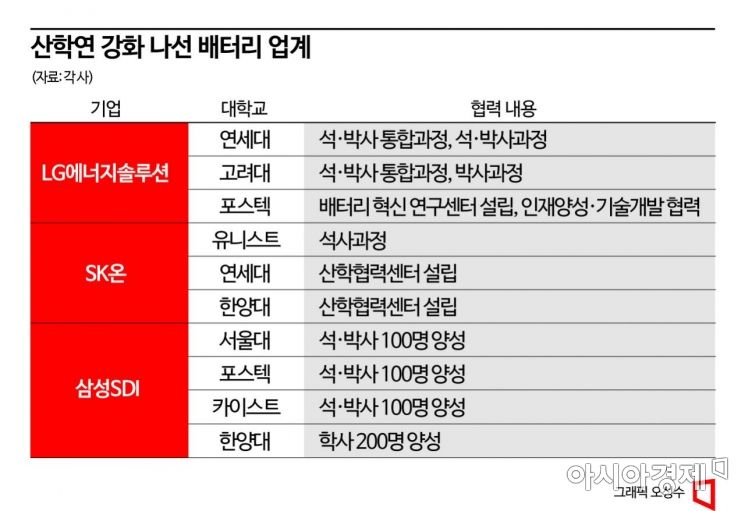
Battery companies are strengthening their industry-academia-research cooperation with universities. With factories being built in dozens of locations worldwide and the need to stay ahead in next-generation battery technology development against competitors, collaboration with universities and research institutions has become even more crucial.
According to the industry on the 26th, the three major battery companies have begun to enhance their cooperation with leading domestic engineering universities such as Seoul National University, Yonsei University, Korea University, POSTECH, and KAIST. While focusing on nurturing master's and doctoral students majoring in batteries through graduate programs at each university, they are also establishing joint research centers with companies and conducting R&D for next-generation batteries such as all-solid-state batteries.
SK On recently signed business agreements to establish industry-academia cooperation centers with Hanyang University and Yonsei University, respectively. Both universities hold numerous papers and patents related to all-solid-state batteries, and professors and master's and doctoral researchers in the next-generation battery field will participate in the newly established cooperation centers. Under this agreement, SK On and the two universities plan to jointly research innovative next-generation battery technologies such as lithium protective layer materials. LG Energy Solution is also collaborating with POSTECH by actively utilizing POSTECH's research achievements in materials, precise analysis technologies, and capabilities related to battery R&D and intellectual property (IP) such as patents.
Currently, the battery industry is widely regarded as being in a "saturated state" when considering the domestic talent pool, research infrastructure, and overseas expansion status. Since the battery industry is still in its infancy and the production process is complex, there is a high demand for master's and doctoral-level excellent personnel to optimize these processes and develop materials and component technologies that can determine electric vehicle performance such as driving range, charging speed, and output. In particular, domestic companies are already building or planning dozens of factories worldwide, so there is an evaluation that even optimizing and operating local facilities is facing a shortage of personnel.
Battery companies are actively securing talent by guaranteeing employment to students who complete battery-related degrees and even paying salaries during their educational programs. According to the Korea Battery Industry Association, the domestic battery industry lacks 1,810 bachelor's-level process personnel and 1,013 master's and doctoral-level research and design personnel.
The Ministry of Trade, Industry and Energy also announced last year a plan to train more than 1,100 personnel annually at various levels according to industry demand. However, there are criticisms that Korea is late since other countries have already been investing in research personnel and infrastructure for several years.
In Europe, efforts to reduce reliance on external sources for the battery industry are critical, such as launching the European Battery Alliance (EBA) in 2017. In particular, in May 2018, the European Commission released the "Battery Industry Development Strategy Implementation Plan" and began establishing a roadmap for workforce training. Europe plans to invest 500 million euros annually over the next decade to train 1,000 research and production personnel each year in fields such as materials engineering, smelting technology, electrical systems, battery pack structure and design, battery safety, and digitalization, while actively attracting overseas experts.
In the case of China, the "National Power Battery Innovation Center," which oversees battery research, was established in 2016, and its battery research infrastructure is known to be world-class. It is operated by a coalition of more than 170 universities, companies, and institutions inside and outside China, providing full support for next-generation technology development such as all-solid-state batteries and workforce training.
Professor Park Cheol-wan of the Automotive Department at Seojeong University said, "What should be noted here is that the United States and Europe are beginning to recognize the importance of batteries and are starting to nurture talent," adding, "like the Semiconductor Special Committee, a Battery Special Committee composed of the government, National Assembly, companies, and experts should be promptly formed to rebuild all areas including workforce training, technology development, industrial structure reorganization, and reshoring (return of manufacturing to the home country)."
© The Asia Business Daily(www.asiae.co.kr). All rights reserved.

![A Woman with 50 Million Won Debt Clutches a Stolen Dior Bag and Jumps... A Monster Is Born [Slate]](https://cwcontent.asiae.co.kr/asiaresize/183/2026021902243444107_1771435474.jpg)















