[Asia Economy Yeongnam Reporting Headquarters Reporter Hwang Dooyul] A study has found that the order of interviews influences evaluations in various ways.
Professor Oh-Sang Kwon and researcher Jong-Min Moon from the Department of Biomedical Engineering at UNIST measured the "influence of the immediately preceding evaluation on the current evaluation when assessing sequentially presented visual stimuli."
The results showed that the current evaluation simultaneously operates in a "similar direction" to the immediately preceding evaluation and in a "direction moving away" from the immediately preceding stimulus.
The research team proposed a mathematical model explaining the computational process that generates these contradictory cognitive biases.
In everyday life, such as shopping or meetings, various evaluations occur sequentially. People use the previous item as a reference to evaluate the current one, and contradictory directions appear simultaneously.
After seeing an excellent interviewee or product, the next one may appear relatively worse, or positive perceptions may continue, making the next seem better.
This study experimentally demonstrated that these two opposing cognitive biases operate simultaneously.
Professor Kwon Oh-Sang said, "Almost all objects we experience have temporal continuity," adding, "Since states change slowly, it is reasonable to assume that the immediately preceding and current states are similar, and to detect changes in the object, maximizing differences is effective, so the brain utilizes both directions."
For example, if there was a heatwave advisory today, no one would suddenly expect a heavy snowfall tomorrow. Since the environment changes slowly, it is reasonable to consider the current state similar to the immediately preceding one.
On the other hand, if yesterday's weather was scorching hot, even if today's temperature is high, it feels relatively cooler compared to yesterday. Maximizing differences is effective for detecting changes in this case.
This study experimentally revealed how these two opposing biases interact.
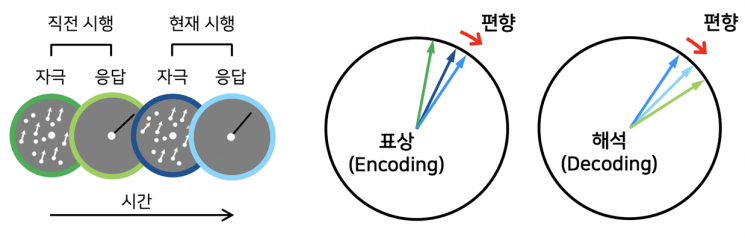
Participants in the experiment viewed dots moving in the same direction and performed a task reporting that direction.
In multiple trials, participants' responses were biased by the results of the immediately preceding trial.
The participants' responses were in a direction moving away from the "direction in which the dots moved in the immediately preceding trial (actual objective stimulus)" and similar to the "direction they responded to in the immediately preceding trial (subjective judgment)."
The research team explained that these cognitive biases arise because the brain's cognitive processing is divided into two stages: "representation" of the object's state and "interpretation" of that representation.
Representation is the encoding process of inputting information about the object into the brain, and interpretation is the decoding process of extracting meaning from the input information.
In cognitive processing, representation and interpretation are separated, and contradictory cognitive biases appear simultaneously as each process is handled efficiently.
According to the mathematical model developed by the research team, when the brain represents the state of an object, it efficiently allocates limited information-processing resources to detect changes from the immediately preceding state.
Next, when interpreting the representation, the brain integrates what was obtained from the immediately preceding object and the expected current state with the newly acquired representation to make mathematically optimized inferences.
Professor Kwon Oh-Sang said, "Evaluations of the current object changing depending on the immediately preceding object may seem irrational at first glance, but in fact, it is the result of efficiently processing information and making mathematically optimized decisions," adding, "This study shows that our biased evaluations paradoxically stem from our rationality."
He continued, "Cognitive biases can also be causes of various conflicts and polarization in our society," and added, "We hope this study, which elucidates the order effects appearing in brain cognitive processing, will provide clues to finding solutions to social problems."
This study was conducted with support from the SSK project of the National Research Foundation of Korea, and the research results were published in "BMC Biology," a leading journal in the life sciences field.
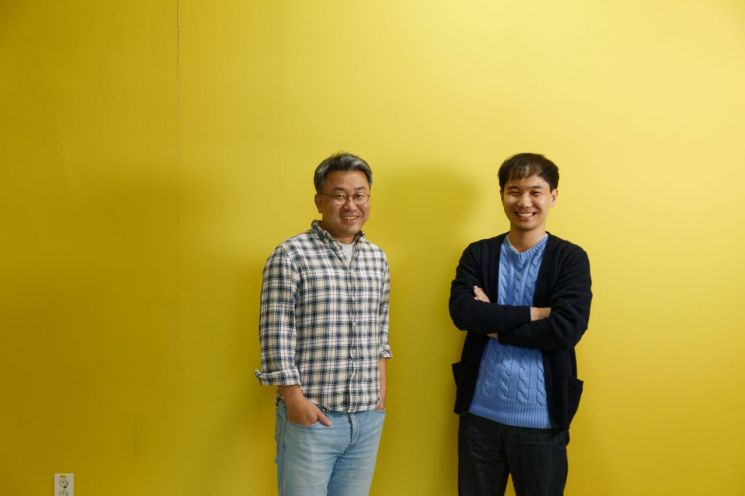 Professor Oh-Sang Kwon (left) and researcher Jong-Min Moon from the Department of Biomedical Engineering at UNIST are taking a commemorative photo.
© The Asia Business Daily(www.asiae.co.kr). All rights reserved.


















