[Asia Economy Reporter Myunghwan Lee] Domestic telecom companies are facing an unprecedented crisis. The Ministry of Science and ICT has taken a bold step by abruptly canceling the allocation of the 28 GHz frequency band for 5G services that had been assigned to KT and LG Uplus. Securities firms have assessed that the financial impact on telecom companies will be minimal in the short term, but they warned that the growth momentum of the telecom industry could weaken.
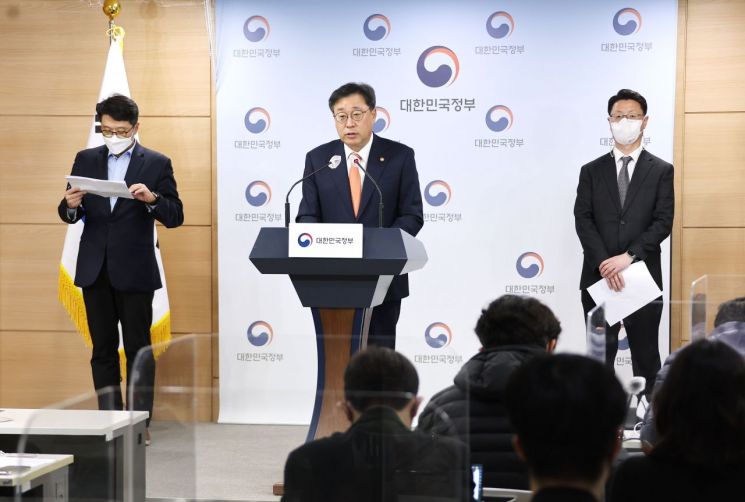
According to the industry on the 21st, the Ministry of Science and ICT announced the results of the compliance inspection procedure for the conditions imposed during the 2018 5G frequency allocation on the 18th, deciding to cancel the allocation. This was due to the installation rate of base stations in the 28 GHz band failing to meet the required standard score. Even SK Telecom, the only company that exceeded the standard, was ordered to shorten its usage period by six months.
Following the Ministry of Science and ICT's decision, if the final decision is made during the hearing procedure next month, KT and LG Uplus will have to terminate their 28 GHz services. This will be an unprecedented situation where telecom companies will have their actively used frequencies reclaimed.
5G mobile communication services operate on two bands: 3.5 GHz and 28 GHz. The service speed of the 3.5 GHz band is faster than the existing 4G LTE technology but falls short of the 28 GHz band, earning it the stigma of being "half 5G." On the other hand, the 28 GHz band has been expected to be widely utilized in areas such as the metaverse (extended virtual world) and AR (augmented reality) due to its ultra-high speed, ultra-low latency, and ultra-connectivity characteristics.
However, despite the Ministry of Science and ICT's announcement of frequency reclamation, domestic telecom stocks showed little change. On the day of the cancellation notice, the 18th, KT (0.83%) and LG Uplus (0.84%) closed higher. Only SK Telecom, which retained its frequency allocation, fell by 0.60%. As of 10:30 AM that day, telecom stocks including SK Telecom (-0.61%), KT (-1.37%), and LG Uplus (-2.49%) were all showing weakness.
Securities firms have diagnosed that the financial impact of this frequency allocation cancellation on telecom companies will be limited. This is because all three major telecom companies have already written off the usage rights for the 28 GHz band early. According to KB Securities, the three telecom companies each recorded early impairment of intangible assets related to the 28 GHz band in the late 100 billion KRW range in the fourth quarter of last year. Researcher Ilhyuk Kim of KB Securities stated, "Even if impairment losses on tangible assets for 28 GHz equipment are recognized, the scale is expected to be small," adding, "There are no telecom modules or terminals that can utilize the 28 GHz band, so the revenue generated from this band is also minimal."
However, concerns have also been raised that the growth momentum for next-generation communication technologies such as 6G could weaken. This is because next-generation communication technologies are expected to utilize ultra-high frequency bands like 28 GHz. Researcher Kim analyzed, "6G is known to utilize the extremely high-frequency band," and "difficulties in advancing business using ultra-high frequency bands could dampen expectations."
© The Asia Business Daily(www.asiae.co.kr). All rights reserved.

















