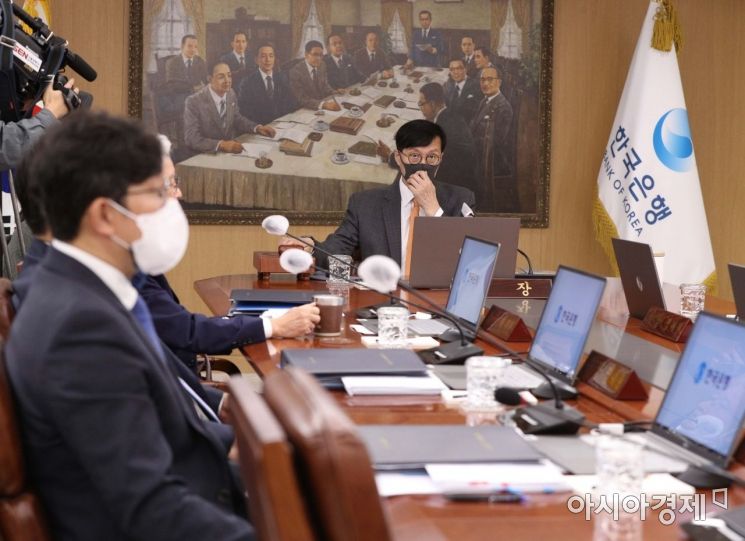
 Lee Chang-yong, Governor of the Bank of Korea, is presiding over the regular Monetary Policy Committee meeting held on the 12th at the Bank of Korea in Jung-gu, Seoul. Photo by Joint Press Corps
[Asia Economy Reporter Junho Hwang] With the Bank of Korea's final Monetary Policy Committee meeting of the year scheduled for the 24th, the securities industry on the 21st largely expects the BOK to raise the base interest rate by 25bp (0.25%P). Although there was a prevailing forecast that a big step (0.50%P) would be taken immediately after the October MPC, most opinions now see that the subdued inflation trend and concerns about economic recession will be reflected in this MPC. Attention is focused on whether the market will breathe easier depending on the pace adjustment of the base interest rate.
Base Interest Rate Hike Pace Expected to Slow Down
The securities industry judged that the need for a rapid base interest rate hike by the BOK has decreased. At the Federal Reserve (Fed), which determines U.S. monetary policy, there was mention of the need to slow the pace of rate hikes at the November Federal Open Market Committee (FOMC). Looking at last month's U.S. Consumer Price Index (CPI) and Producer Price Index (PPI), it was confirmed that the inflation trend is also slowing down. The probability of a 50bp hike at the December FOMC, as reflected in the federal funds futures market, has risen to 80.6%. This means the likelihood of the U.S. taking a fifth giant step (0.75%P hike) at the next FOMC this year has diminished. Jaegyun Lim, a researcher at KB Securities, analyzed, "The reason for deciding on a big step at the October MPC was to respond to the won's weakness due to the strong dollar, so the justification for an additional 50bp hike by the BOK has decreased."
The fact that South Korea's export economy is slowing down is also a burden. In the economic outlook announced by the BOK last August, next year's CPI and Gross Domestic Product (GDP) forecasts were 3.7% and 2.1%, respectively. For CPI, the peak was confirmed relatively early at 6.3% in July. Since there is a growing forecast that the growth rate will also decline, considering this, the CPI forecast for next year is also likely to be revised downward. Jiman Kim, a researcher at Samsung Securities, stated, "Given the high possibility that the BOK's GDP and CPI forecasts will be lower than before, it seems difficult for the message at this MPC to be hawkish."
Although recent liquidity tightening has emerged, there is also analysis that additional rate hikes will be inevitable as the peak and decline speed of domestic inflation have not been confirmed. Given that financial authorities have introduced support measures in response to concerns about liquidity tightening in the bond market, it is observed that MPC members will agree on the need to maintain the rate hike stance, even if an additional big step is burdensome.
Need to Watch Rather Than Expect
However, it is expected that it is necessary to watch rather than expect. Fundamentally, the BOK is expected to fulfill its role as the "inflation firefighter."
Researcher Jaegyun Lim forecasted, "The possibility of an electricity rate hike by Korea Electric Power Corporation (KEPCO) increases the downward rigidity of inflation, and with oil prices rebounding, expected inflation is also rising. In particular, the BOK will strive not to repeat the mistake the Fed made in the 1970s (cutting rates due to recession concerns despite rising inflation)." Accordingly, even if the MPC raises rates by 25bp, the BOK governor's remarks at the press conference are expected to be hawkish.
Researcher Jiman Kim advised, "Even though inflation concerns have eased, inflation at the 5% level is still not a level to be reassured about, and expected inflation, which rose to the 4% range after July, has not come down. If expectations are excessive, mentions of inflation could act hawkishly, so rather than chasing rate cuts, a more relaxed response is needed at this time."
© The Asia Business Daily(www.asiae.co.kr). All rights reserved.
![Clutching a Stolen Dior Bag, Saying "I Hate Being Poor but Real"... The Grotesque Con of a "Human Knockoff" [Slate]](https://cwcontent.asiae.co.kr/asiaresize/183/2026021902243444107_1771435474.jpg)
















