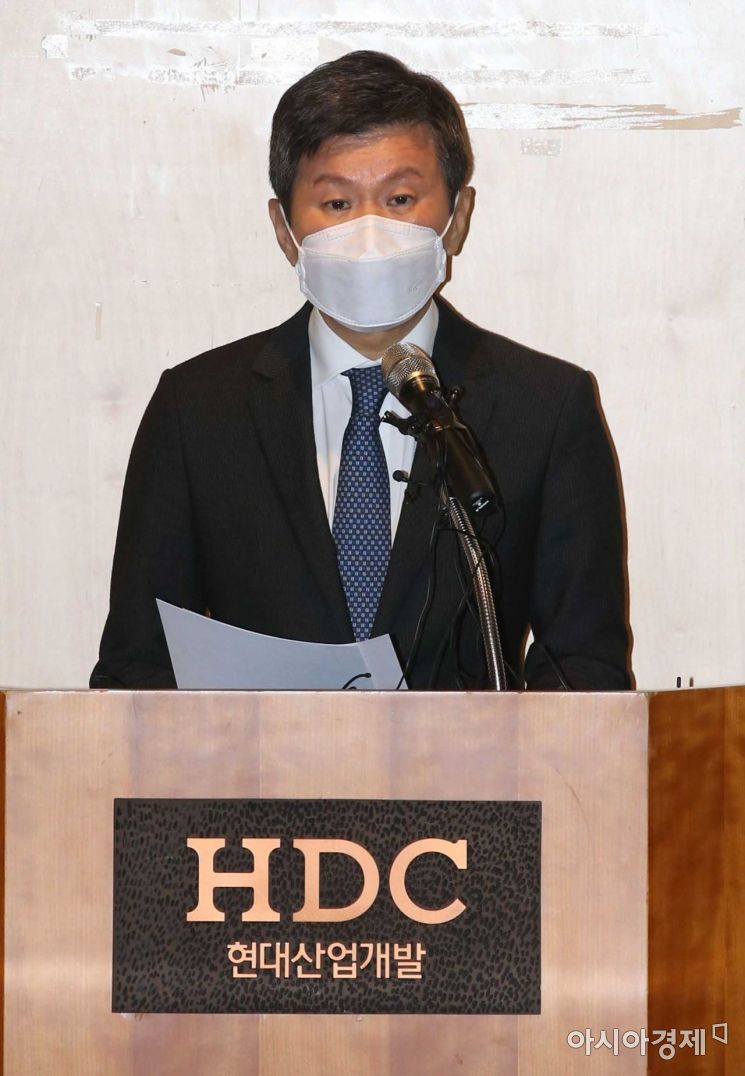
 Jung Mong-gyu, chairman of HDC Group, who has faced public backlash for a series of major collapse accidents in Gwangju, is making a public apology and announcing his position regarding his future at the HDC Hyundai Development Company Yongsan headquarters in Seoul concerning the exterior wall collapse accident at Hwajeong I-Park in Seo-gu, Gwangju. Photo by Kang Jin-hyung aymsdream@
[Asia Economy Reporter Kim Hyung-min] Will 2022 end as a 'nightmare year' for Chung Mong-gyu, Chairman of HDC Group, or will he make a comeback?
The 2022 Qatar World Cup, which opened on the 21st, is expected to decide this. For Chairman Chung, who is holding onto the position of President of the Korea Football Association, the World Cup is like the 'last bastion' to revitalize the atmosphere. If our national football team achieves a good result by advancing to the round of 16 or beyond, Chairman Chung can also be spotlighted as a key figure and rise again. However, if the opposite happens, his position as chairman could become so precarious that he might have to step down. It is known that Chairman Chung will soon fly to Doha, Qatar, to encourage our national team. Then, he will watch the team's matches cautiously. The Bentu team's challenge to surprise the world is also Chairman Chung's do-or-die battle.
◆ Ten months of financial burden and image decline, Chung Mong-gyu's crisis
Recently, HDC Hyundai Development Company (hereafter HDC Hyundai) is reported to be struggling with significant financial burdens. The costs related to a series of major accidents at several construction sites were substantial, and along with the group's image deterioration, other construction projects have not been smoothly carried out, leading to an increase in debt scale.
In June last year, a five-story building being demolished for redevelopment in Hakdong, Gwangju, collapsed onto the roadside, and in January last year, at the Hwajeong-dong I-Park new construction site in Gwangju, the apartment structure and exterior wall collapsed, resulting in six deaths. The aftermath of these incidents seems to be ongoing. Chairman Chung stepped down from his position in January following the Gwangju incident, but voices holding him accountable remain.
In particular, the legal risks are not small. According to the legal community, HDC Hyundai and its affiliates are involved in dozens of lawsuits. If they lose these lawsuits, the compensation costs will add to the financial burden. The most recent case was on the 17th, where HDC Hyundai lost a legal battle concerning the failed merger and acquisition (M&A) of Asiana Airlines against Kumho Construction and Asiana Airlines. The Seoul Central District Court, which handled the first trial, ruled in favor of the plaintiffs, Kumho Construction and Asiana Airlines, in the lawsuit against HDC Hyundai and Mirae Asset Daewoo for notification of pledge extinction and damages claims. The court ordered HDC Hyundai to pay 1 billion KRW to Asiana and 500 million KRW to Kumho Construction jointly with Mirae Asset. HDC Hyundai said it would appeal, but it cannot be certain that this ruling will be overturned in the second trial. On the 25th, the trial will begin in earnest for the lawsuit requesting the cancellation of Seoul City's business suspension order. Earlier, Seoul City imposed a business suspension of 1 year and 4 months on HDC Hyundai, holding it responsible for the Hakdong collapse accident. However, HDC Hyundai partially replaced this by paying a fine of 400 million KRW and filed an injunction and cancellation lawsuit against the remaining 8 months of business suspension, delaying the enforcement. The lawsuit's outcome could greatly influence HDC Hyundai's future.
As the situation worsened, various indicators showed that HDC Hyundai reached a level where it felt a sense of crisis. Last month, NICE Credit Rating downgraded HDC Hyundai's credit rating from A+ to A and assigned a 'Negative' outlook. This is the first downgrade of Hyundai's credit rating in over eight years since 2018.
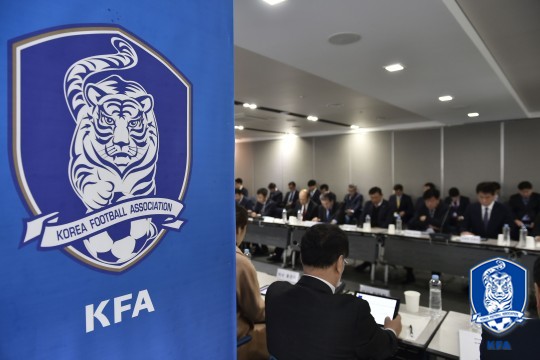 Korea Football Association
 Photo by Korea Football Association
◆ Poor administration throughout the Football Association, calls for accountability
As the chairman's company is shaken, the Korea Football Association, led by Chairman Chung, is also reported to have encountered various problems. There are controversies over 'poor administration' due to mishandling important matters. In particular, the football national team's management in preparation for the 2022 Qatar World Cup was criticized for discord. Our national team almost missed participating in the East Asian Football Federation (EAFF) E-1 Championship (East Asian Cup) held in Japan from July 20 to 27 due to the association's sloppy administration. Association officials applied for Japanese visas late just before the tournament, almost preventing players from entering Japan, let alone participating in the competition. Fortunately, the visas were issued just before the tournament, allowing the team to participate. However, the association faced criticism for having an organizational structure that mixed marketing promotion and team support, which caused such problems.
The association was also criticized for tightening its belt sharply over the past two years due to the COVID-19 pandemic's impact on revenue. After the Asian qualifiers for the Qatar World Cup ended, the association arranged for all friendly matches to be held domestically. Except for the three matches at the East Asian Cup in Japan in July, seven matches were held domestically. This contrasts sharply with the away matches played by World Cup opponents in Middle Eastern countries like Qatar or Europe. Especially, the final evaluation match against Iceland held on the 11th in Hwaseong, Gyeonggi Province, was heavily criticized as "pointless." This raised concerns that our national team's competitiveness for the World Cup might have declined. Football experience and atmosphere differ greatly between playing home matches domestically and away matches abroad. Since the team must play World Cup matches in Qatar, more away evaluation matches were needed, but the association ignored this.
There are also indications that the association significantly cut costs in domestic football competitions. According to domestic coaches, some elementary league matches played with eight players had only one referee, and the medical staff had to accept player substitution requests and manage substitutions, creating a bizarre scene. According to association regulations, two referees must be assigned for eight-player matches. However, this problem reportedly arose because the association recently decided to reduce referee labor costs. Additionally, earlier this month, there was controversy over the P-level (professional) license, the highest qualification that domestic football coaches can obtain. Sudden changes in regulations and quotas led to football commentator Ahn Jung-hwan and others being included among the 25 P-level license students, sparking allegations of favoritism in the football community.
Many also attribute the failure to host the Asian Cup to Chairman Chung's poor diplomatic skills. The association challenged to host the AFC Asian Cup next year but lost to Qatar. Chairman Chung flew to Malaysia with association executives to promote the bid but was evaluated as failing to properly appeal the justification for hosting the tournament.
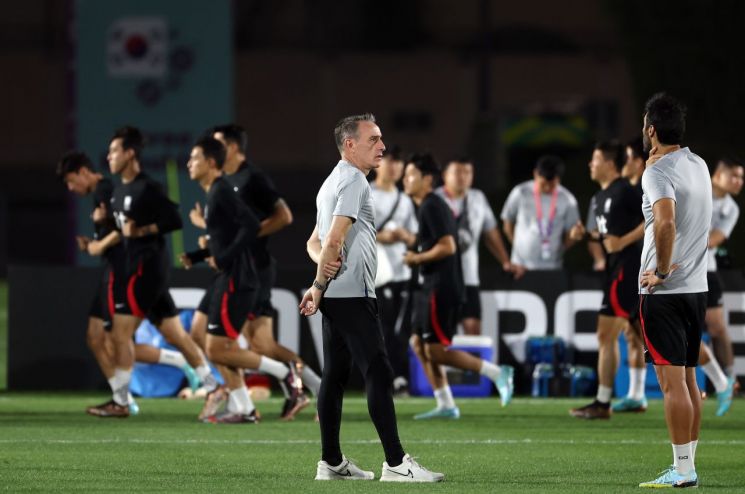 Paulo Bento, the head coach leading the South Korean national football team at the 2022 Qatar World Cup, is watching the players at the Al Egla training ground in Doha, Qatar, on the afternoon of the 19th (local time).
 [Image source=Yonhap News]
◆ Challenge to revitalize atmosphere in Qatar, fate of Hyundai family's 'football dynasty' also at stake
If the national team achieves good results at the World Cup, Chairman Chung can succeed in 'revitalizing the atmosphere.' His initiatives during his term, such as the 'K League mandatory participation rule for players under 22,' will also shine and earn public praise. However, if the opposite occurs, he could face fierce criticism and his position as association president could become precarious. Chairman Chung's term lasts until January 2025, leaving only about two years of effective time to serve. He has been re-elected three times and cannot be re-elected again. The Korea Football Association president's term is limited to three terms.
Whether he steps down early or at the end of his term amid criticism, this could also direct criticism toward the Hyundai family, which has been a major figure in Korean football. This could lead to the end of Hyundai's football dynasty. Since 1993, when Chung Mong-joon, chairman of the Asan Foundation, took office as president, Hyundai has been at the pinnacle of Korean football. Even during the brief tenure of President Cho Joong-yeon from 2009 to 2013, key Hyundai figures remained influential in the association. Due to their long-standing presence, criticism of Hyundai in the football community has increased significantly. If the national team's performance at the Qatar World Cup is poor, these criticisms will gain momentum and spread, greatly narrowing the influence of Chairman Chung and other Hyundai Group-related figures in the football world.
Even if Hyundai wants to keep the presidency, there is reportedly no suitable figure to succeed Chairman Chung. Initially, Kwon Oh-gap, Chairman of Hyundai Heavy Industries Group, emerged as a strong candidate, but he could not register as a candidate on election day because the association's bylaws allow only those under 70 years old to run for president. Chairman Kwon is 71 this year. However, there is a possibility that the association might urgently hold a general meeting to amend the bylaws to allow Chairman Kwon to run. Besides Chairman Kwon, many expect Vice President Lee Yong-soo of the Korea Football Association to be the next presidential candidate.
© The Asia Business Daily(www.asiae.co.kr). All rights reserved.