3 out of 4 Golf Courses Under Construction Are in Provinces
Distinctive Landscapes and Dynamic Courses for Differentiation
"Reasonable as Initial Investment Costs Can Be Saved"
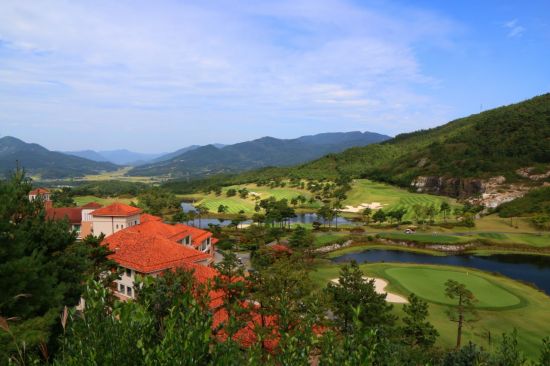
[Asia Economy Reporter Lee Seo-hee] The construction of golf courses, which had been concentrated in the metropolitan area, is spreading to provincial regions. This is due to the high land prices and difficulties in securing large-scale sites. Additionally, with the increase in golf population and continuous improvements in transportation networks, companies are turning their attention to areas outside the metropolitan region.
These newly established provincial golf courses plan to attract customers by offering relatively affordable fees and differentiated courses to secure competitiveness.
77% of Public Golf Courses Under Construction Early This Year Are Outside the Metropolitan Area
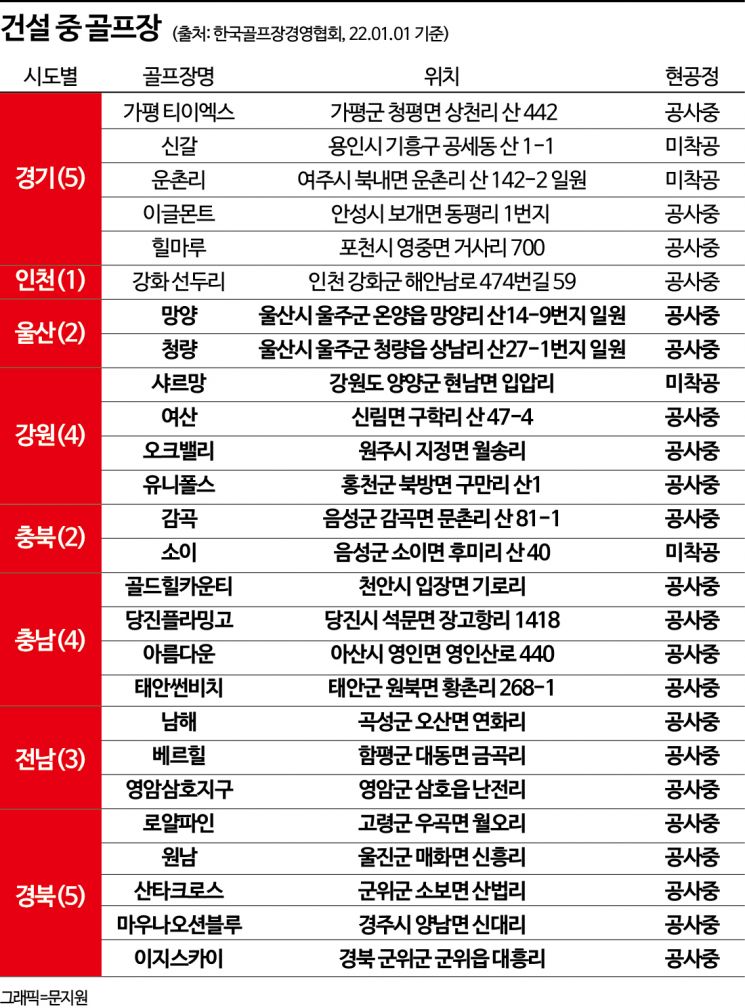
According to the Korea Golf Course Management Association on the 21st, as of January this year, there are a total of 26 public golf courses under construction or planned, of which 20 are located in provincial areas. This means that 77% of the four newly planned golf courses are outside the metropolitan area.
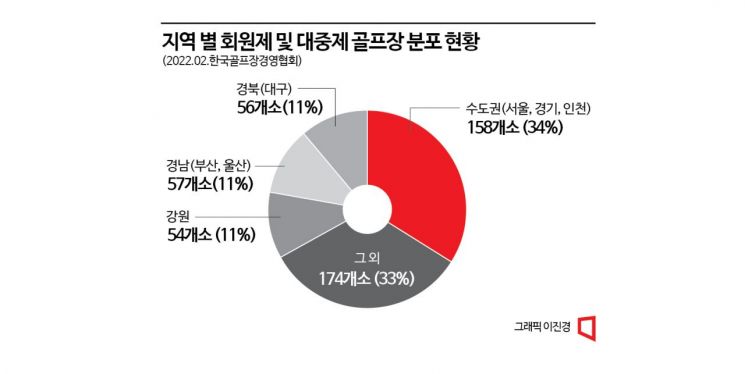
The top priority for existing golf course locations was accessibility to Seoul. According to data released by the Korea Golf Course Management Association in February this year, out of 499 domestic golf courses (including public and membership courses), 158 are in the metropolitan area, accounting for 34% of the total. Since half of the total population is concentrated in the metropolitan area, golf courses have also clustered there.
However, recently, provincial golf courses competing with affordable green fees and differentiated facilities and courses have been emerging one after another. The Ulsan 'Gangdong Basetars CC,' which opened in April this year, involved world-renowned course designer David Dale in its design. A key feature is the scenic view of the Ulsan sea from every hole. The golf course’s 'signature hole,' the 4th hole, offers a panoramic view of Dangsa Hang in Buk-gu, Ulsan.
Some places emphasize premium services. 'Seongmunan CC' in Wonju, Gangwon Province, which opened in July this year, operates with a daily limit of 60 teams and 10-minute interval tee-offs, principles that are realistically difficult to implement in metropolitan golf courses. Additionally, the fairways are made of bentgrass, a cool-season grass, to provide golfers with the best shot experience.
“Lower Investment Costs to Enhance Price Competitiveness”
As the golf population increases, the number of visitors to provincial golf courses continues to rise. More golfers are traveling to provincial areas due to severe reservation difficulties. According to data from the Korea Golf Course Management Association on the number of users per hole by region, golf courses in the Gyeongbuk region saw the largest increase, rising 15% from 5,305 users in 2019 to 6,131 in 2021.
In contrast, the metropolitan area is reaching saturation in terms of visitor capacity, causing the growth rate of users to slow down. The number of users per hole in the Gyeonggi area increased only 8.3% over three years, from 4,604 in 2019 to 4,946 in 2020 and 5,023 in 2021.
Experts cite the significant reduction in initial investment costs as an advantage of provincial golf courses. Seo Cheon-beom, director of the Korea Leisure Industry Research Institute, said, “Provincial golf courses have the advantage of saving on initial construction costs such as land acquisition compared to metropolitan golf courses. Instead, they actively invest in courses and facilities or attract new golfers by charging lower green fees than metropolitan golf courses.”
© The Asia Business Daily(www.asiae.co.kr). All rights reserved.



















