In the current situation, the executive branch uses a workaround to request bill proposals
However, concerns about 'infringement on legislative autonomy' arise within the National Assembly
[Asia Economy Reporter Kum Boryeong] A bill to establish an organization dedicated to regulatory impact assessment of member-proposed bills in the National Assembly is set to be introduced. Although there have been calls to conduct regulatory assessments on member-proposed bills, it is unusual that a member of the National Assembly is proposing a 'self-regulation review.' Unlike government-proposed bills, member-proposed bills do not undergo regulatory assessments, leading to criticism that they generate excessive regulations, while claims of infringement on legislative autonomy are also significant.
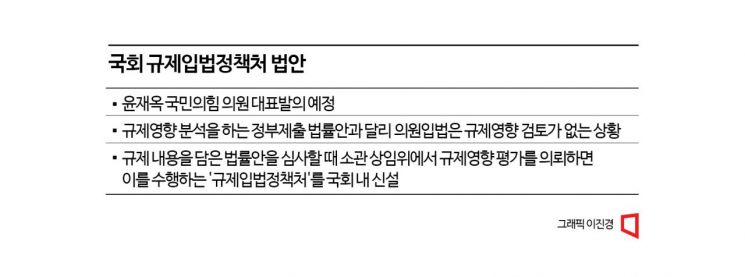
According to the National Assembly on the 21st, Yoon Jae-ok, a member of the People Power Party, plans to introduce this month the "National Assembly Regulatory Legislative Policy Office Act," which proposes establishing a Regulatory Legislative Policy Office within the National Assembly.
The core of the bill is to establish a Regulatory Legislative Policy Office in the National Assembly to evaluate the regulatory impact of bills. The Regulatory Legislative Policy Office will conduct impact assessments when requested by each standing committee of the National Assembly during the bill review process.
Yoon conceived the Regulatory Legislative Policy Office because, while the proportion of member-proposed legislation is increasing day by day, there are no proper means to control regulations. According to the Legislative Information System, from January 1 to the 17th of this year, a total of 3,879 bills were submitted, of which 3,630 were proposed by members, overwhelmingly dominant. The government submitted only 121 bills.
Government bills must undergo a rigorous process including regulatory impact analysis and review by the Regulatory Reform Committee before submission, whereas member-proposed bills lack such institutional mechanisms. There is inevitably a loophole where the executive branch asks members to propose bills to avoid various review and amendment procedures, including regulatory impact analysis. Yoon said, "The biggest problem is the mass production of regulatory bills," and explained, "I judged that institutional measures are necessary to prevent this."
The absence of a regulatory review system for member-proposed bills is a chronic problem in our legislative system. The National Assembly Research Service pointed out in a report over ten years ago that "there is no system to evaluate member-proposed legislation, raising concerns about the low quality of regulations," and noted that "the lack of a regulatory impact analysis system imposes serious costs and burdens on the economy and society and may lead to the mass production of low-quality regulatory proposals based solely on political considerations."
Experts have responded positively to the establishment of the Regulatory Legislative Policy Office. Gil Hong-geun, Executive Director of the Korea Regulatory Society, said, "The absence of regulatory impact assessments leads to hasty legislation like real estate laws," and added, "If a legislative impact analysis office is created, materials analyzed by experts could become the standard for review."
It is also effective for training professional personnel, as there is currently a shortage of regulatory impact analysis experts. Establishing a specialized institution would allow for appointing external personnel or forming a pool through training. Yoon’s office also stated, "Professional personnel are needed to conduct regulatory legislative analysis, but since the government finds it difficult to perform this internally, it is realistic to entrust it to external organizations."
Within the party, opinions supporting the need for regulatory review of member-proposed legislation have already been raised. Hong Seok-jun, head of the People Power Party’s Regulatory Reform Promotion Team, recently pointed out at the National Assembly’s Steering Committee audit, "The number of bills passed annually in the National Assembly is 1,743, which is three times that of the United States, 15 times that of Germany, and 51 times that of the United Kingdom, with about 6,000 member-proposed bills overwhelmingly exceeding others," and criticized, "There are side effects such as poor bill review reports and the excessive enactment of regulatory legislation." He also urged the introduction of pre-regulatory impact analysis and post-impact evaluation systems.
However, since many members who are the main proponents of member-proposed legislation oppose it, the path to even submitting the bill for discussion after its introduction is expected to be thorny. The biggest reason for opposition is the concern over "infringement on legislative autonomy." A policy aide to a member emphasized, "Bills are quickly proposed on issues deemed necessary after gathering opinions through various channels such as forums and meetings," and stressed, "Creating a Regulatory Legislative Policy Office might itself be seen as regulation."
A member of the People Power Party also pointed out, "Bills are discussed in standing committees, reviewed by expert members, and pass through the Legislation and Judiciary Committee, so adding another process is unnecessary."
There are also concerns about the 'another form of power concentration' in the newly established Regulatory Legislative Policy Office. As it decides which and how many regulatory bills to filter based on certain criteria, members may inevitably feel pressured.
Executive Director Gil said, "Institutional measures to ensure quality in the legislative bill proposal process are absolutely necessary," and added, "In the end, it might be like 'putting a bell on a cat’s neck.'"
© The Asia Business Daily(www.asiae.co.kr). All rights reserved.
![Clutching a Stolen Dior Bag, Saying "I Hate Being Poor but Real"... The Grotesque Con of a "Human Knockoff" [Slate]](https://cwcontent.asiae.co.kr/asiaresize/183/2026021902243444107_1771435474.jpg)
















