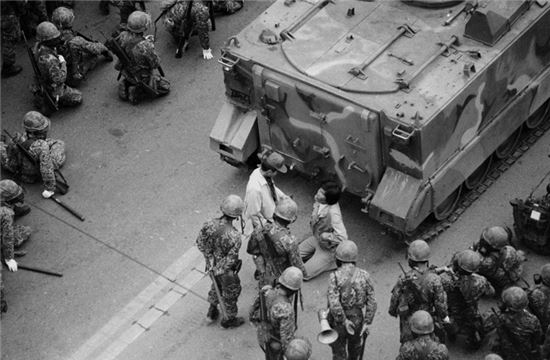
 Martial law troops deployed to Geumnam-ro during the May 18, 1980 incident [Image source=Yonhap News]
"Martial law troops are entering Jinju without negotiating with the Student Recovery Committee. (Omitted) Let us show the united power of Gwangju citizens." (May 27, 1980, 9:00 AM)
A court ruling has ordered the state to pay approximately 65 million KRW in damages to Ms. Park (64, female), who made the last broadcast at the final stronghold of the citizen army during the May 18 Democratic Movement and suffered wrongful imprisonment.
According to the court on the 18th, the Seoul High Court Civil Division 1 (Presiding Judge Jeon Ji-won) recently ruled in the appeal trial of Ms. Park, a May 18 merit recipient, who filed a damages claim against the state, that "the defendant must pay the plaintiff approximately 64.95 million KRW in damages."
Previously, Ms. Park, a 21-year-old university student at the time, broadcasted to citizens about the situation while moving around Jeonnam Provincial Office and downtown Gwangju for three days starting May 24, 1980, ahead of the final suppression operation by the May 18 martial law troops.
Until 2:30 AM on May 27 of that year, before the martial law troops stormed the Jeonnam Provincial Office where the citizen army was stationed, she tearfully urged citizens to join, saying, "We must not shoot before the martial law troops open fire. Let us all fight the martial law troops to the end and protect the lives of citizens." This was reflected in the role of "Park Sin-ae," played by actress Lee Yo-won in the film May 18.
Ms. Park was arrested without a warrant by the martial law troops and was beaten with fists and wooden sticks. Based on unjust statements extracted through harsh treatment, she was prosecuted and sentenced to one year in prison on charges of inciting rebellion. It was only in June 2015, 35 years later, that she was acquitted after a retrial.
Subsequently, Ms. Park filed a damages claim lawsuit against the state. The appellate court distinguished the consolation money she received under the former Gwangju Democratization Movement Compensation Act from the damages and assessed the damages at 100 million KRW. However, it ruled that the approximately 35 million KRW criminal compensation paid after her acquittal in the retrial should be deducted. As a result, compared to the 15 million KRW recognized by the first trial in October last year, which stated that consolation money should be deducted when calculating damages, about 49 million KRW was additionally granted.
The appellate court explained, "It is evident from experience that the plaintiff must have suffered extreme physical and mental pain. She was expelled from university during her studies due to 'student activities' while being illegally detained, and after release, she lived for over 30 years in another region with the stigma of a criminal record. She also faced great difficulties in social and economic activities, using a different name instead of her real name during external activities."
It added, "Considering the plaintiff's age at the time of the state's illegal acts, the historical context, and her life after the illegal acts, the mental suffering experienced by her and her family must have been considerable. Given the long delay in compensation since the illegal acts occurred, it is necessary to appropriately increase the principal amount of damages. Furthermore, since serious human rights violations were systematically and intentionally committed by public officials, there is a need to suppress and prevent recurrence of similar incidents."
Meanwhile, in September, the Supreme Court First Division (Presiding Justice Park Jeong-hwa) affirmed a ruling in another May 18 merit recipient's state compensation lawsuit that recognized damages and consolation money separately, thereby broadening the state's liability for compensation. Previously, courts often confused or failed to distinguish between the two, resulting in significant discrepancies in the scope of damages recognized related to democratization movements.
© The Asia Business Daily(www.asiae.co.kr). All rights reserved.
![Clutching a Stolen Dior Bag, Saying "I Hate Being Poor but Real"... The Grotesque Con of a "Human Knockoff" [Slate]](https://cwcontent.asiae.co.kr/asiaresize/183/2026021902243444107_1771435474.jpg)















