Economic Hardship Deepens Amid Prolonged Sanctions
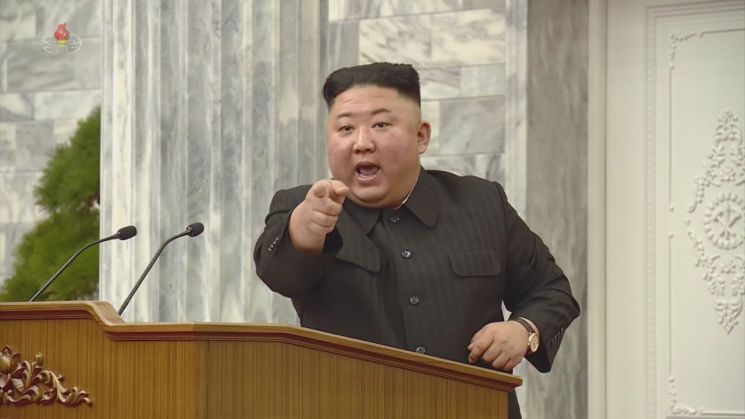
[Asia Economy Reporter Jang Hee-jun] North Korea has urged its officials to maintain integrity and purity, strictly monitoring even their immediate family members and relatives, while calling on residents to practice a lifestyle of frugality. This is interpreted as North Korea’s desperate struggle to overcome the worst economic crisis in its history, compounded by prolonged sanctions and the impact of COVID-19.
The Workers' Party organ, Rodong Sinmun, on the 17th published an article titled "The Noble Character of Humans ? Integrity and Purity," stating, "Even if one eats plain rice dipped in soybean paste, as long as one carries out the revolution under the Party’s trust, that is enough. One must hold a firm belief and conduct work and life with integrity and purity without any qualms of conscience," emphasizing, "If revolutionaries become blinded by selfish desires, they will betray their group, comrades, loyalty, and conscience, and eventually commit the terrible sin of betraying the revolution for a few coins."
It continued, "Those who seek special privileges and favors like free handouts become immersed in empty formalities and decadent lifestyles, knowing nothing but complacency and indulgence," and criticized, "The nepotism and bureaucratic corruption that follow special privileges like shadows are toxic consequences that harm our revolutionary work."
In particular, the newspaper urged, "Officials must not only be personally honest and pure but also properly carry out family revolutionization, educating their wives, children, and siblings to live conscientiously and purely."
This appears to be a warning against high-ranking officials with authority, as well as their families, taking bribes from residents and exploiting them. Trace International, a US-based international anti-bribery NGO, recently pointed out in its "2022 Bribery Risk Index" report that North Korea’s level of corruption is the worst.
Additionally, North Korea called on ordinary residents to adopt a "lifestyle of frugality."
Rodong Sinmun, in an article titled "A Model to Uphold in Today’s Era," argued, "In today’s harsh reality where the enemy’s vile and brutal provocations are intensifying, the wrongful phenomenon of wasting resources without any awareness to save everything to the utmost can only be described as a criminal act that infringes upon the people’s interests."
It also stated, "As the saying goes, even rivers run dry if overused. No matter how vigorously we fight to increase production, without frugality, accumulation is impossible. Without increasing accumulation, it is impossible to overcome the reality of scarcity and expand and develop the country’s economic power," urging to "save even one watt (W) of electricity, one drop of water, one gram (g) of coal, and one grain of rice."
North Korea’s demands for integrity from officials and frugality from residents are interpreted as efforts to overcome the deepening economic crisis caused by prolonged sanctions, the COVID-19 pandemic, droughts, floods, and other natural disasters. According to the "2021 North Korean Economic Growth Rate Estimate" released by the Bank of Korea in July, North Korea’s real GDP last year was 31.41 trillion won, a 0.1% decrease from the previous year (2020). Although the decline narrowed compared to 2020 (-4.5%), it marks two consecutive years of economic contraction.
© The Asia Business Daily(www.asiae.co.kr). All rights reserved.
![Clutching a Stolen Dior Bag, Saying "I Hate Being Poor but Real"... The Grotesque Con of a "Human Knockoff" [Slate]](https://cwcontent.asiae.co.kr/asiaresize/183/2026021902243444107_1771435474.jpg)
















