Financial Supervisory Service Announces 'Preliminary Domestic Bank Operating Results'
Bank Interest Income Soars from 33.7 Trillion to 40.6 Trillion
Loan-Deposit Interest Rate Spread Rises from 1.78% to 1.81% to 2.13%
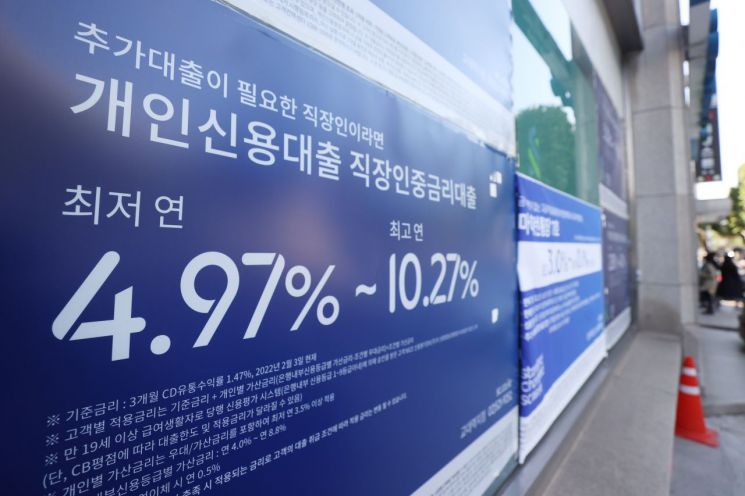
[Asia Economy Reporter Song Seungseop] Following the base interest rate hike, the loan-deposit interest rate spread at domestic banks is rapidly soaring. Although the overall net income of the banking sector has decreased due to a decline in non-interest income and an increase in loan loss provisions, commercial banks are recording high profits based on massive interest income.
According to the Financial Supervisory Service on the 17th, the net income of domestic banks was tentatively estimated at 15 trillion won, down 800 billion won from a year ago. However, the situation differs when looking at individual banks. Large commercial banks, which hold a significant market share, saw their net income increase from 9.3 trillion won to 10.5 trillion won. Regional banks also experienced a slight increase from 1.2 trillion won to 1.3 trillion won. Internet banks decreased from 180 billion won to 100 billion won, and special banks fell from 6.5 trillion won to 4.5 trillion won.
The growth of commercial banks is largely due to a significant increase in interest income. In the third quarter of this year, banks earned 40.6 trillion won in interest income, up 6.9 trillion won (20.3%) from 33.7 trillion won last year. This was influenced by an approximately 10.5% increase (293.5 trillion won) in operating assets such as loan receivables. Interest-earning assets expanded from 2,784.5 trillion won in the third quarter of last year to 3,078 trillion won. Thanks to the interest rate hike, the net interest margin (NIM) improved by 0.15 percentage points to 1.59%.
In particular, the loan-deposit interest rate spread is rapidly increasing. During a base rate hike period, the interest rates on variable products, which account for 70% of the loan market, rise immediately, but the rates on demand deposits and current accounts, which make up half of deposits, increase slowly. The loan-deposit interest rate spread surged from 1.78% in 2020 and 1.81% last year to 2.13% currently. The interest yield stands at 3.57%, which is more than 1 percentage point higher compared to 2.54% in the third quarter of last year.
The profitability ratios show a similar trend. The return on assets (ROA) of domestic banks was 0.58%, down 0.10 percentage points from 0.68% in the same period last year, but this decline was due to special banks dropping from 0.78% to 0.49%. General banks maintained the same ROA at 0.62%. The return on equity (ROE) for all domestic banks decreased from 8.76% to 8.10%, but general banks recorded growth from 8.80% to 9.56%.
However, non-interest income dropped sharply by 72.9% (4.5 trillion won) from 6.1 trillion won last year to 1.7 trillion won. Securities-related income decreased by 2.1 trillion won, and fee income fell by 300 billion won.
Loan loss provisions expanded by 1.7 trillion won (71.8%) from 2.4 trillion won last year to 4.1 trillion won. This was a result of changes in the loan loss provision calculation method in the second quarter. In June, the financial authorities improved the method of calculating ‘forward-looking information’ used in estimating loan loss provisions through a banking sector task force (TF). Consequently, the amount of new loan loss provisions increased significantly compared to last year.
Operating and administrative expenses of domestic banks rose by 600 billion won (3.5%) from 17.5 trillion won last year to 18.1 trillion won. While personnel expenses remained similar to last year, material costs increased by 600 billion won.
Non-operating income and expenses shrank by 99.7%, from 1 trillion won last year to 3.1 billion won.
The Financial Supervisory Service stated, “In preparation for the possibility of expanding credit losses centered on vulnerable borrowers due to worsening domestic and external economic conditions, we will encourage banks to strengthen their loss absorption capacity.” It added, “We will monitor the status of banks’ loan loss provisions quarterly and guide banks with weak capital ratios to strengthen capital management.”
© The Asia Business Daily(www.asiae.co.kr). All rights reserved.
!["I'd Rather Live as a Glamorous Fake Than as a Poor Real Me"...A Grotesque Success Story Shaking the Korean Psyche [Slate]](https://cwcontent.asiae.co.kr/asiaresize/183/2026021902243444107_1771435474.jpg)
















