Cargo Solidarity "Cargo Truck Owners' Survival Rights Issue, Ministry of Land Only Represents Shippers' Position"
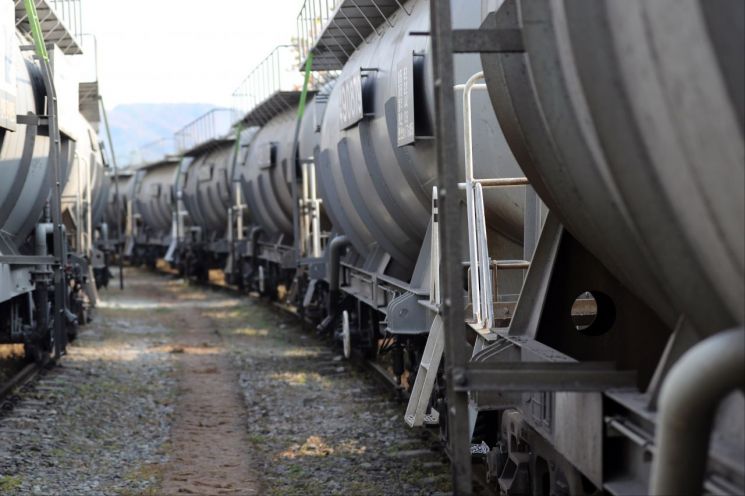 Cement transport trains are stopped on the tracks at Obong Station in Uiwang-si, Gyeonggi-do.
 [Photo by Yonhap News]
[Asia Economy Reporter Kim Jong-hwa] With the nationwide general strike (transport refusal) by the Cargo Solidarity Headquarters of the Public Transport Union of the Korean Confederation of Trade Unions (Cargo Solidarity) scheduled for the 24th and the nationwide railway union strike on the 23rd, a crisis has arisen in cement supply. The cement industry is also sighing over consecutive setbacks, including the 8-day Cargo Solidarity strike in June and the suspension of train operations due to a fatal accident at Obong Station in Uiwang City, Gyeonggi Province on the 5th.
According to the cement industry on the 17th, there are an estimated total of about 3,000 Bulk Cement Trailers (BCT) transporting cement, of which about one-third, approximately 1,000, are transport owners affiliated with Cargo Solidarity. Cargo Solidarity demands the extension of the safety freight rate system, which is set to expire on the 31st of next month, and the expansion of the applicable vehicle types and items limited to container and cement transport vehicles to include steel products, etc. They plan to launch an indefinite general strike, with the railway union also joining in.
When Cargo Solidarity goes on strike, they have obstructed the operation of non-Cargo Solidarity transport owners and blocked the front and rear gates of cement factories, paralyzing cement transportation. Cement is transported by BCT, rail, and ships, but ships are used only for exports. If Cargo Solidarity blocks BCT operations and the railway union halts train operations, virtually all logistics movement is cut off.
A cement industry official expressed concern, saying, "If the strike materializes, cement transportation supplying ready-mixed concrete plants and construction sites nationwide will effectively come to a complete halt." Lee Bong-ju, chairman of Cargo Solidarity, also clearly stated on the 14th when announcing the general strike, "This strike will be an unprecedentedly powerful general strike that will stop all industries at once."
The suspension of train operations at Obong Station, responsible for supplying cement to the southern metropolitan area, has added another blow to the already insufficient cement supply in the metropolitan area. Obong Station is a shipping base where seven cement companies, including Ssangyong C&E, Hanil Cement, Hyundai Cement, Sungshin Cement, Sampyo Cement, Asia Cement, and Halla Cement, gather. About 57,000 tons of cement are shipped weekly, accounting for 40% of the metropolitan area's cement consumption.
The problem is that from September to early December each year is the peak season when cement sales are roughly 20% higher than usual shipments. Transport refusal during this period, which determines annual performance, is fatal to the cement industry. A cement industry official said, "The 8-day Cargo Solidarity strike in June alone caused sales losses of 106.1 billion won, and this will inflict irreparable damage on the cement industry," adding, "The cement industry is expected to record the worst business performance in history."
Unlike Cargo Solidarity, which demands the extension and expansion of the safety freight rate system, the cement industry is advocating for its abolition. They claim that operating the safety freight rate system over the past three years has increased logistics costs by about 120 billion won. Although land logistics costs have risen by about 40%, the shortage of BCT and frequent strikes have disrupted timely cement supply, increasing the burden on shippers (the cement industry).
A representative of the Korea Cement Association emphasized, "Since the effects of introducing the safety freight rate system appear to be minimal, it is appropriate to end it as scheduled," and added, "Large-scale damage is expected across all industries. The strike must be withdrawn."
In response, Lee Eung-joo, Director of Education and Publicity at Cargo Solidarity, said, "The Ministry of Land, Infrastructure and Transport is taking steps to deny and discard the agreement made in June with Cargo Solidarity to maintain the safety freight rate system," adding, "This is a matter of survival for truck owners, but the ministry is unilaterally representing the interests of shippers. The strike will proceed as planned."
© The Asia Business Daily(www.asiae.co.kr). All rights reserved.
![Clutching a Stolen Dior Bag, Saying "I Hate Being Poor but Real"... The Grotesque Con of a "Human Knockoff" [Slate]](https://cwcontent.asiae.co.kr/asiaresize/183/2026021902243444107_1771435474.jpg)
















