[Seoul District News] Mapo-gu Proposes Legal Amendments to Ministry of Environment to Enhance Recycling System for Transparent PET Bottles & Park Gang-su, Mayor of Mapo-gu, States “We Will Improve Laws and Policies to Increase Recycling Effectiveness”
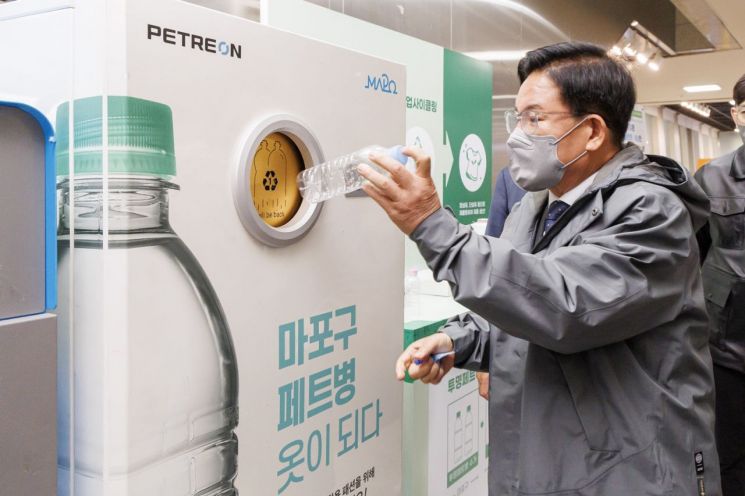 Park Kang-su, Mayor of Mapo-gu, demonstrating the transparent PET bottle recycling process at the transparent PET bottle upcycling experience space inside the Mapo-gu Office building
[Asia Economy Reporter Jongil Park] Mapo-gu (Mayor Park Gang-su) has rolled up its sleeves to reduce plastic, the main culprit of environmental pollution, and to advance the recycling system for transparent PET bottles.
The district judged that stronger policy support is necessary to realize the emerging solution to waste problems, ‘Bottle to Bottle’ (recycling plastic bottles repeatedly into plastic bottles), and formally proposed an amendment to the 'Act on the Promotion of Saving and Recycling of Resources' to the Ministry of Environment.
First, it proposed legislating that all containers produced by manufacturers be made of colorless ‘transparent PET bottle’ material. Transparent PET bottles belong to the ‘best’ grade in terms of packaging recyclability as defined by the Ministry of Environment. Currently, the Ministry of Environment encourages manufacturers to change production materials and structures indirectly by increasing the share of fees through the ‘Extended Producer Responsibility (EPR)’ system.
In response, the district explains that legislating all containers to be made of colorless transparent PET bottles is a much more direct and effective way to activate recycling.
Additionally, it proposed mandating the installation of ‘transparent PET bottle exclusive sorting facilities’ within private sorting centers for efficient recycling of transparent PET bottles. For ‘Bottle to Bottle’ recycling to be practically realized, dedicated sorting facilities for transparent PET bottles within sorting centers are essential, but currently, facility installation is induced by differentially supporting subsidies under the EPR system.
The district says that a strong regulation is needed, such as providing sufficient grace periods for private sorting centers to equip these facilities and restricting the types of recyclables handled by sorting centers if facilities are not installed afterward.
It also proposed expanding the resource circulation deposit system, currently implemented only for empty bottles and disposable cups, to include transparent PET bottles. In Germany, the deposit system operates including PET bottles in multi-use containers, and according to the German Packaging Market Research Association, the recycling rate of PET bottles collected in 2019 reached 97.4%.
The district requested improvements to expand the resource circulation deposit system to transparent PET bottles, enabling both producers and consumers to actively participate in separate collection, as in the German case.
Park Gang-su, Mayor of Mapo-gu, said, “Governmental legislative amendments are essential to establish a system that can infinitely recycle transparent PET bottles,” adding, “We will continue to strive for policy improvements that promote resource circulation throughout the entire lifecycle of plastic production, use, and disposal, reduce plastic waste generation, and enhance the effectiveness of recycling.”
© The Asia Business Daily(www.asiae.co.kr). All rights reserved.

















