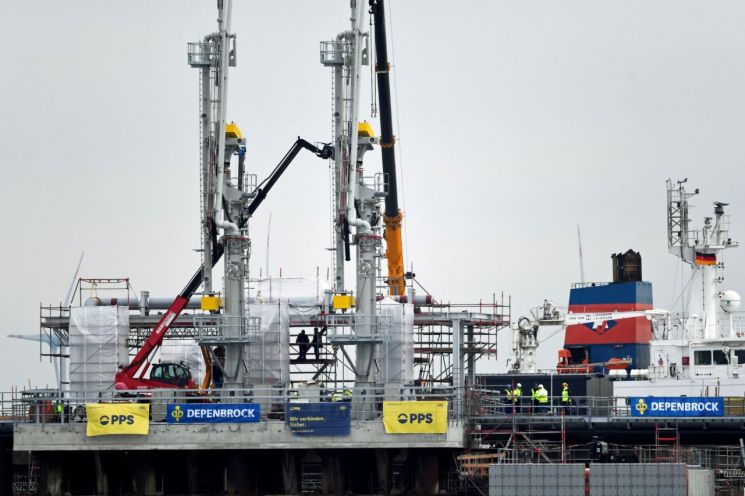
[Asia Economy Reporter Park Byung-hee] Major foreign media reported on the 15th (local time) that Germany has completed construction of its first liquefied natural gas (LNG) import terminal. The foreign media stated that the LNG terminal will be an important turning point for Germany in breaking its dependence on Russian energy, and analyses suggest that the possibility of Germany getting through this winter without an energy crisis has increased.
Germany's first LNG import terminal has been completed in Wilhelmshaven on the North Sea. Since Russia's invasion of Ukraine, Germany has been preparing new gas import infrastructure to cope with the reduction in Russian gas supply.
Germany plans to start importing gas from January next year using a floating LNG storage and regasification unit (FSRU) at the new terminal.
The German government already granted permits for five FSRUs earlier this year, and one of them will be used at the Wilhelmshaven terminal. By the end of this year, another FSRU will be installed in Brunsb?ttel, and together with Wilhelmshaven, gas supply will begin from two FSRUs starting January next year.
Robert Habeck, Germany's Minister for Economic Affairs, emphasized that the Wilhelmshaven terminal was completed in a short period of about 200 days, calling it an important achievement.
Minister Habeck stated that the other three FSRUs will also be installed within a few months. He added that another FSRU will be added to the Wilhelmshaven terminal in the fourth quarter of next year.
Habeck explained that the total annual LNG import capacity using FSRUs will be 29.5 billion cubic meters. Considering that Germany's gas demand last year was 90.5 billion cubic meters, this means that one-third of the demand can be met with LNG using FSRUs.
Initially, concerns that Germany would suffer a severe energy supply shortage this winter due to the cutoff of Russian gas supply have also diminished.
This is because gas consumption has decreased thanks to warmer-than-average weather early this winter. It was confirmed that gas usage in Germany's industrial sector dropped by 27% in October. As gas consumption decreased, Germany's gas storage facilities are currently filled to 100% capacity.
Over the past few weeks, gas imports from the Netherlands, Belgium, and Norway have increased, and France also began transporting gas to Germany from mid-last month.
Germany's largest bank, Deutsche Bank, stated in a report, "Germany's gas supply outlook has significantly improved over the past few weeks," and analyzed that "Germany is highly likely to get through this winter without gas supply restrictions."
However, the German government remains cautious. It explained that global LNG demand is increasing, so uncertainties remain high. Also, even though gas storage is at 100% capacity, this only amounts to about two months of usage.
In the long term, Germany aims to replace natural gas with hydrogen energy. On this day, at the 27th United Nations Climate Change Conference of the Parties (COP27) held in Egypt, Germany announced it will provide 550 million euros to the green hydrogen sector through two new funds.
One of the two funds will be used to lend money for hydrogen development projects in developing and emerging countries, while the other fund will be used to accelerate the growth of the global hydrogen market, including infrastructure. It was also explained that the scale of funds managed by the two funds will be the same.
© The Asia Business Daily(www.asiae.co.kr). All rights reserved.
![Clutching a Stolen Dior Bag, Saying "I Hate Being Poor but Real"... The Grotesque Con of a "Human Knockoff" [Slate]](https://cwcontent.asiae.co.kr/asiaresize/183/2026021902243444107_1771435474.jpg)
















