Korean Air, Asiana, T'way, Jeju Air Foreign Exchange Losses Total 1.3986 Trillion Won
Paid in Dollars...Higher Losses Signal Trouble for Airlines
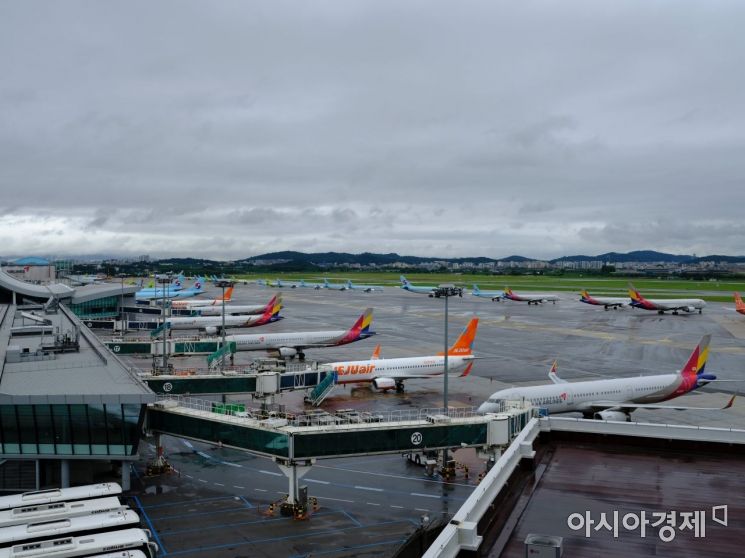
[Asia Economy Reporter Yoo Hyun-seok] In the third quarter of this year, airlines' foreign currency translation losses surged significantly. The sharp rise in the KRW-USD exchange rate is cited as the main cause, increasing aircraft purchase and lease costs.
According to the aviation industry on the 17th, the foreign currency translation losses of Korean Air, Asiana Airlines, T'way Air, and Jeju Air in the third quarter, on a separate basis, totaled 1.3986 trillion KRW. This represents a 112.1% surge compared to the same period last year. When including subsidiaries of Korean Air and Asiana Airlines such as Jin Air and Air Busan, the loss scale is expected to be even larger.
By scale, Asiana Airlines recorded the largest loss at 766.9 billion KRW, a 148.1% increase from the same period last year. Korean Air's loss rose by 70.1% to 509.5 billion KRW, while T'way Air and Jeju Air saw increases of 192% and 88.6%, recording 66.8 billion KRW and 29.8 billion KRW respectively.
The reason for the significant increase in airlines' foreign currency translation losses is that most of their payment standards are in US dollars. Since airlines incur foreign currency liabilities when leasing or purchasing aircraft, profits and losses vary depending on exchange rates. The KRW-USD exchange rate, which averaged 1,205 KRW in the first quarter, rose to an average of 1,261 KRW in the second quarter and further increased to 1,338 KRW in the third quarter. Due to the sharp rise in exchange rates and high jet fuel prices, all airlines except Korean Air recorded net losses for the period. Asiana Airlines posted a net loss of 172.3 billion KRW, Jeju Air 66.8 billion KRW, and T'way Air 57.6 billion KRW.
The exchange rate burden is expected to persist into the fourth quarter. Although the KRW-USD exchange rate briefly dipped to the low 1,300 KRW range recently, it mostly hovered above 1,400 KRW throughout October, indicating continued pressure.
However, the revival of international flights offers some consolation to airlines. Air travel demand is rapidly increasing due to the resumption of travel to Japan and other factors. According to NH Investment & Securities, the number of passengers traveling to Japan in January was only 10,731. But with the resumption of visa-free entry in October, the number of passengers to Japan reached 416,132 in October, a 2,649.8% increase compared to 15,133 in the same month last year.
As travel to Japan recovers, international passenger numbers are also rapidly increasing. In October, international and domestic passengers numbered 2.54 million and 3.4 million respectively, totaling 5.9 million, a 63.8% increase compared to the same month last year. Notably, international passengers surged by 709.9%. Park Soo-young, a researcher at Hanwha Investment & Securities, explained, "Passenger numbers showed a strong recovery thanks to the full resumption of Japan routes starting October 11."
Due to the increase in air passenger demand, airlines' performance improvements are expected to accelerate. Total passenger demand in the third quarter of this year was 15,159,572, a 65.6% increase compared to the same period last year. As a result, Korean Air and Asiana Airlines saw their sales increase by 64.73% and 47.2% respectively compared to the same period last year. During the same period, Jeju Air and T'way Air also grew by 186.5% and 198.76% respectively.
© The Asia Business Daily(www.asiae.co.kr). All rights reserved.

















