Second Largest Carbon Sink Region After Amazon Rainforest
Causes Include Wildfires, Rising Temperatures, Permafrost Thaw, and Increased Pests
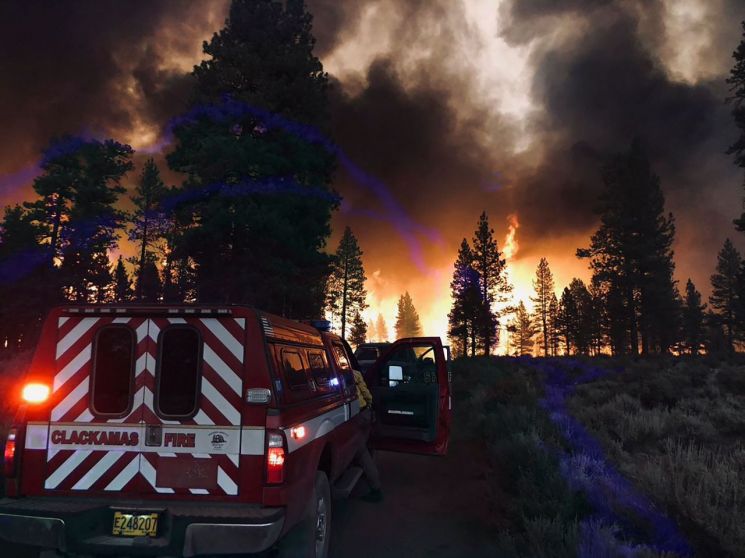
[Asia Economy Reporter Kim Junran] Following the Amazon rainforest, the vast coniferous forest around the Arctic, which has the second-largest carbon absorption capacity, is at risk of rapidly shrinking, AFP reported on the 14th.
The subarctic boreal forest located around the Arctic is a massive forest that encircles the Arctic in a ring shape. It stretches across Canada, Scandinavia, Russia, and Alaska in the United States, covering about 10% of the world's land surface area.
It spans an area of 1.2 billion hectares, equivalent to one-third of the world's forests. This coniferous forest absorbs a huge amount of carbon dioxide, helping to slow global warming, and its carbon storage capacity is estimated to be twice that of the tropical rainforest.
However, experts warn that this critically important forest area is currently facing threats from wildfires, rising temperatures due to global warming, permafrost thawing, and increased pests and diseases.
In May 2016, a massive wildfire, considered the worst natural disaster in history, occurred in Canada’s subarctic boreal forest. About 90,000 residents were evacuated, 2,500 buildings were engulfed in flames, causing property damage worth $7.4 billion (approximately 9.8 trillion KRW).
The problem is that such wildfires frequently occur in Alaska, Canada, and Siberia, threatening the forest areas. According to experts, the frequency and intensity of wildfires in this region have sharply increased to abnormal levels compared to several decades ago. Based on the affected area, wildfire destructive power has doubled compared to 10 years ago. Additionally, 70% of the wildfire-affected areas over the past 20 years have been in the subarctic boreal forest.
The warming phenomenon, which raises temperatures, also threatens the subarctic boreal forest. The frequency of extreme heatwaves has increased fivefold compared to 150 years ago, and currently, warming in the Arctic region is progressing two to three times faster than in other parts of the world. As a result, permafrost is melting, causing forest collapse, and in the southern part of the coniferous forest, shrubs and grasses are growing instead of conifers due to drought. In the north, the coniferous forest is shifting toward the tundra region.
Yan Boulanger, a researcher at Canada’s Natural Resources Department, warned, "If drought and climate change continue as they are now, the forest will fail to sustain trees and will transform into a grassland."
Along with warming, the northward movement of pests and diseases also poses a significant threat to the coniferous forest. Dr. David Pye, a coniferous forest researcher in Quebec, explained, "All the trees in the area died due to attacks by the spruce budworm." Furthermore, thousands of hectares of forests in eastern Canada and the United States have been devastated by the larvae of the gypsy moth.
Experts are analyzing whether the ecosystem is approaching a tipping point beyond which recovery is impossible, expressing concerns about how long the coniferous forest can withstand the warming phenomenon.
© The Asia Business Daily(www.asiae.co.kr). All rights reserved.

















