[Asia Economy Reporter Lee Jung-yoon] To prevent cases like the global cryptocurrency exchange FTX, which ultimately filed for bankruptcy protection due to a liquidity crisis, there is a call to establish a system to protect the deposited assets of domestic cryptocurrency exchange users.
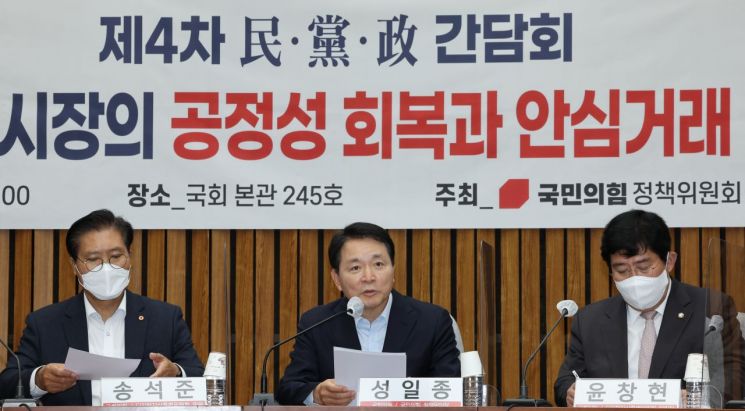
At the "4th Civil-Party-Government Meeting on Restoring Fairness in the Digital Asset Market and Creating a Safe Trading Environment," hosted by the People Power Party Policy Committee and the Special Committee on Virtual Assets on the 14th, Kim Gap-rae, a research fellow at the Korea Capital Market Institute, stated, "The safe custody of deposited assets has become significantly important due to the FTX incident."
He added, "The management of assets entrusted by users is segregated after the reporting procedure," but emphasized, "It is crucial that actual investors trust this system, and if there is suspicion, a run can occur." He explained that after the FTX incident, the global exchange Coinbase did not experience a large-scale withdrawal event because segregation of custody was already implemented and there was trust in it.
Researcher Kim asserted, "Digital asset operators must segregate and manage digital assets entrusted by users separately from their own proprietary assets under the principle of identical type and quantity," and argued, "This should be legislated."
Due to suspicions of financial instability in affiliated company Alameda Research, a liquidity crisis arose, and the world's largest global exchange Binance abandoned its acquisition, leading to a bank run at FTX. Additionally, FTX's filing for bankruptcy protection under Chapter 11 of the U.S. Bankruptcy Code increased the likelihood that investors would not be able to recover their entrusted assets. Chapter 11 of the U.S. Bankruptcy Code refers to a system that seeks rehabilitation through restructuring procedures under the supervision of the bankruptcy court.
In Korea, under the Act on Reporting and Using Specified Financial Transaction Information (Special Act on Reporting Financial Transactions), exchanges are required to manage investors' deposits separately from the proprietary assets of virtual asset operators. Moreover, major Korean won market exchanges disclose the status of customers' virtual assets held through business reports and quarterly and semi-annual reports.
Researcher Kim also said, "Among the ten bills currently pending in the National Assembly, the areas where the two major parties agree are related to investor protection and unfair trading," and requested, "Prompt progress is needed." He emphasized, "In terms of effectiveness, budget and personnel are important," adding, "Even if the law passes, if personnel and budget to enforce it are not secured, the law will be half-baked legislation."
There was also a call to further specify the Special Act on Reporting Financial Transactions, which requires exchanges to manage users' deposits separately from their own assets. Lawyer Jung Jae-wook of the law firm Juwon argued, "In the case of virtual asset exchanges, funds for virtual asset investments are deposited by users, and since trading of virtual assets occurs more frequently than deposits and withdrawals of funds, exchanges have an incentive to misuse customer funds by exploiting this time difference." He noted, "There are no separate regulations on which institution and by what method deposits and proprietary assets should be segregated, entrusted, and managed."
Voices calling for regulation of self-issued coins by exchanges also emerged. Kim So-young, Vice Chairman of the Financial Services Commission, said, "As revealed in the FTX incident, there is a need to establish user asset protection obligations for virtual asset operators and regulatory measures against unfair trading of self-issued coins." It was understood that FTX transferred its self-issued coin called FTT to Alameda Research and used it as collateral to obtain loans and expand its size. In Korea, the issuance of self-issued coins by exchanges is prohibited, but listing of self-issued coins issued by overseas exchanges is allowed.
A Financial Services Commission official explained, "We have felt the risks of self-issued coins this time, and issues such as opaque financial transactions among related parties and cross-border transaction risks have also emerged," adding, "The authorities plan to study how to respond to these matters."
© The Asia Business Daily(www.asiae.co.kr). All rights reserved.
![A Woman Who Jumps Holding a Stolen Dior Bag... The Mind-Shaking, Bizarre Con of a "Human Knockoff" [Slate]](https://cwcontent.asiae.co.kr/asiaresize/183/2026021902243444107_1771435474.jpg)
















