Clear Downtrend Starting June This Year... Entering Adjustment Phase
Korea Art Appraisal Research Center: "No Mega Collection Auctions and Limited Blue-Chip Artists"
Overseas Art Market Still Rising... Notable Advances by Ultra-Contemporary Artists
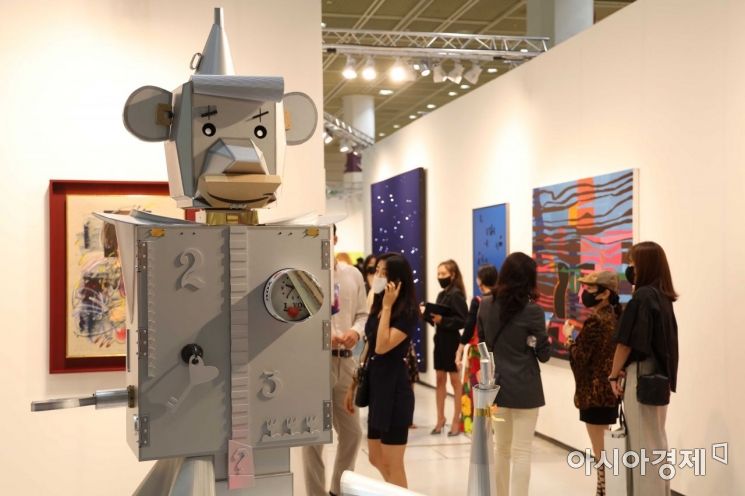 On September 2nd, at COEX C·D Hall in Gangnam-gu, Seoul, the scene of 'Frieze,' one of the world's top three art fairs. Photo by Moon Honam
[Asia Economy Culture Young Intern Reporter] An analysis has revealed that the domestic art market, which experienced significant growth last year, has entered a period of adjustment amid the economic downturn. According to the "2022 Q3 Art Market Analysis Report" published by the Korea Art Authentication Research Center on the 14th, the domestic art market turned downward starting in June this year. The total hammer price of eight art auctions held between July and October was 33.67 billion KRW, a decrease of about 62% compared to the same period last year. This represents a decline of approximately 52% compared to Q1 of this year, about 42.4% compared to Q2, and about 18% compared to 2020, marking the lowest quarterly total hammer price in the past three years.
The Korea Art Authentication Research Center analyzed the decline by stating, "There are no mega collection auctions that can withstand the recession, and the pool of blue-chip artists recognized as safe assets capable of enduring an unstable market is limited." They also explained, "This is due to distrust in the stability of the ultra-contemporary artist group (artists born after 1975), which should be the most actively traded."
They added, "Prices verified artistically, art historically, and institutionally will survive over prices created by the market," advising, "When planning investments, pay close attention to the highest-level works by stable artists evaluated within the institutional framework."
Unlike the domestic market, overseas auction markets are still on the rise. The total sales at the Christie's London auction held in October reached 6 million pounds (approximately 95 billion KRW), with 47 lots offered and a 100% sell-through rate. This marked an 11.6% increase compared to October last year. Sotheby's, another major auction house, also saw a 49.7% increase in total hammer price compared to last year.
This is interpreted as being due to the success of mega collection auctions (collections of artists and works registered in art history), which can withstand recessions. Compared to the domestic market, overseas markets have more diverse and stable portfolios and are less affected by economic downturns and stagnation due to the rarity and high demand for works. Accordingly, the Korea Art Authentication Research Center suggested that these factors should be used as criteria for future domestic art collection and investment decisions.
Meanwhile, the most notable feature of the Q3 auction market is the explosive price increase in the ultra-contemporary art market. During the previous boom, the major market entry of NFTs, street art, and female artists contributed to the current ultra-contemporary art market accounting for 18% of total art market sales. It is also observed that the youngest stars in the contemporary art market can reach prices much higher than those of great masters in a short period.
As a result, the time it takes for ultra-contemporary artists to enter the market and reach the major market is becoming faster than before. The nature of funds flowing into the art market clearly has speculative tendencies, allowing rapid growth into blue-chip status. Additionally, total sales of ultra-contemporary artworks increased by more than 700%, from 91.4 million USD in 2013 to 739.3 million USD in 2021.
© The Asia Business Daily(www.asiae.co.kr). All rights reserved.

















