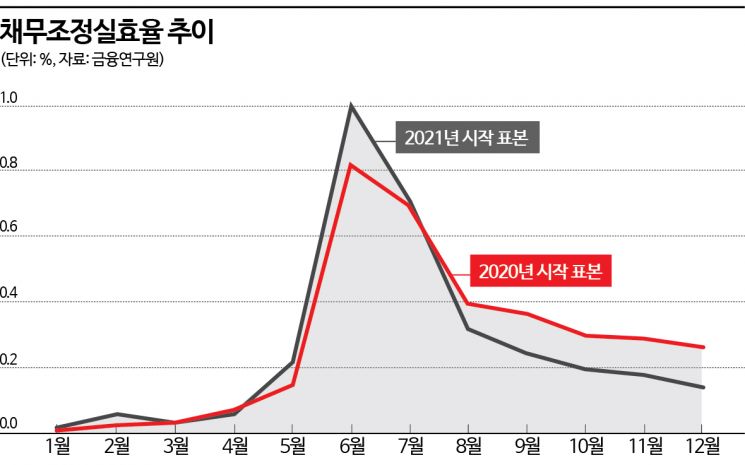
[Asia Economy Reporter Eunju Lee] It has been revealed that the "golden time" for debt adjustment is one year. Borrowers who enter the debt adjustment process but fail to implement the adjustment agreement within one year are more likely to fail to complete the repayment process. In particular, the default rate (non-payment of the repayment amount agreed upon in the debt adjustment for three months) sharply increased from the fifth month after entering the debt adjustment, indicating that initial measures need to be strengthened.
According to the Korea Institute of Finance on the 14th, most users of the debt adjustment procedure of the Credit Recovery Committee experienced the highest frequency of default (failure to implement the debt adjustment agreement as planned) within one year of contract execution. Until the fourth month after entering the debt adjustment process, the average default rate remained very low at 0-0.2%, but it surged to 0.6-0.8% from the fifth month. The debt adjustments provided by the Credit Recovery Committee include rapid debt adjustment (30 days or less), interest rate debt adjustment (31-89 days), and personal workout (90 days or more), based on the number of days overdue.
The more difficulties faced in normal repayment at the early stage of adjustment, the higher the likelihood of failing to repay the debt in the future. According to the Korea Institute of Finance, the group that defaulted within one year after signing the debt adjustment contract showed an 8.3% higher probability of default when monthly income decreased by 1 million KRW compared to the group that defaulted during the remaining period. When the principal debt increased by 1 million KRW, the probability of default was also 0.8% higher than that of the other group.
More than half of the debtors who fail debt adjustment within one year are found to have a significant debt burden. More than half of the debtors failed to pay the repayment amount at least once after the adjustment procedure. According to the Korea Institute of Finance, among personal workout users who signed contracts from 2010 to 2021, about 30.4% of those who defaulted within one year never paid any repayment amount. Those who paid only once accounted for 27.4%.
Accordingly, to enhance the effectiveness of the debt adjustment system, it is diagnosed that initial measures need to be strengthened. By strengthening the linkage with non-financial sectors in the early stages of debt adjustment to alleviate the repayment burden of debtors, the effectiveness of debtor relief systems can be improved. Hyungseok Lim, Senior Research Fellow at the Korea Institute of Finance, said, "The employment and welfare linkage programs of the Community Financial Integration Support Center should be strengthened, especially focusing on the early stage of debt adjustment to reduce the initial default rate." He added, "To this end, it is necessary to expand the Credit Recovery Committee’s pre-credit counseling function so that job counseling, employment guidance, and welfare service introductions can be provided before the debt adjustment is finalized."
© The Asia Business Daily(www.asiae.co.kr). All rights reserved.