Frozen Food Purchases Increased by 51.4% Compared to Pre-Corona... Decreased by 2.4%
Market Growth Driven by Convenience in Cooking and Storage Amid Reduced Outings and Dining Out
Most Popular Item is Mandu... CJ Leads Market Share with Bibigo
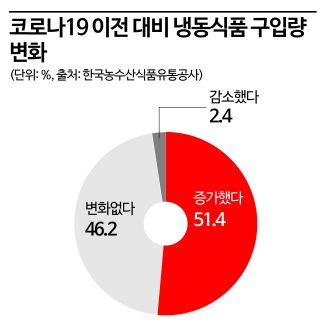
[Asia Economy Reporter Eunmo Koo] More than half of domestic consumers have increased their purchases of frozen foods since the COVID-19 pandemic. This is attributed to the increased frequency of eating at home due to the pandemic and the popularization of air fryers, which has boosted demand for convenient-to-cook frozen foods. As related demand has grown, the production value of frozen foods has also shown steady growth.
According to a consumer survey by the Korea Agro-Fisheries & Food Trade Corporation (aT) on the 14th, 51.4% of respondents answered that their purchase volume of frozen foods "increased" compared to before COVID-19, while 46.2% said there was "no change," indicating that about 98% of respondents either increased or maintained their frozen food purchases.
The reasons for increased frozen food purchases (multiple responses allowed) showed that "reduced outings and dining out" was the highest at 47.5%, followed by "ease of cooking (28.0%)," "increased frequency of eating at home (26.1%)," and "ease of storage (7.8%)." On the other hand, only 2.4% of respondents said their purchase volume "decreased," with the main reasons being "high price" at 33.3%, followed by "diet control (16.7%)," "decreased frequency of eating at home (16.7%)," and "poor quality (8.3%)."
When considering factors in purchasing frozen foods, "personal and family taste preferences" was the highest at 19.8%, followed by "affordable price (11.2%)," "familiar taste (8.0%)," "substantial contents (7.6%)," "easy cooking (7.2%)," and "domestic raw materials (7.0%)."
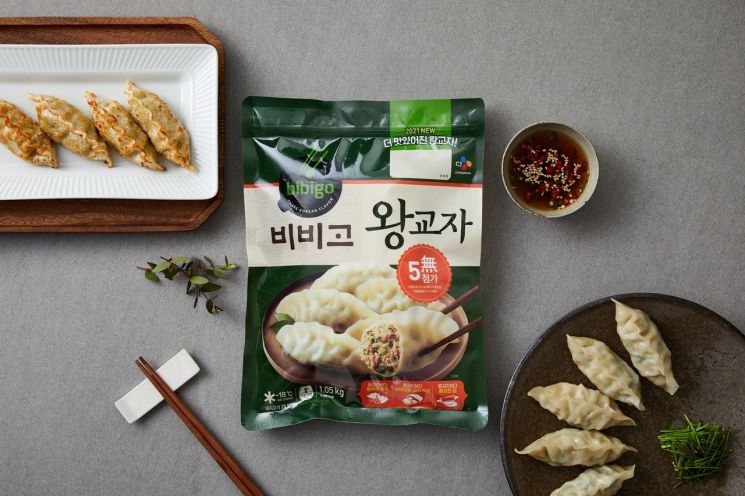
The currently most purchased frozen food item is dumplings at 56.4%, making them the most popular frozen food, followed by frozen pizza (6.4%), frozen Donggeurangttaeng (Korean-style meat patties) (4.6%), and frozen hot dogs (4.6%). As of the first half of this year, the domestic dumpling market is led by CJ CheilJedang with a 44.5% market share, spearheaded by the "Bibigo" brand, followed by Pulmuone (12.8%), Haitai (12.3%), and Dongwon F&B (8.6%).
As demand for frozen foods rises, the production scale of frozen foods has also increased annually. The domestic frozen food production value, which was about 2.2248 trillion KRW in 2017, grew to 2.3307 trillion KRW in 2018, 2.5181 trillion KRW in 2019, and 2.895 trillion KRW in 2020, marking over 30% growth in three years.
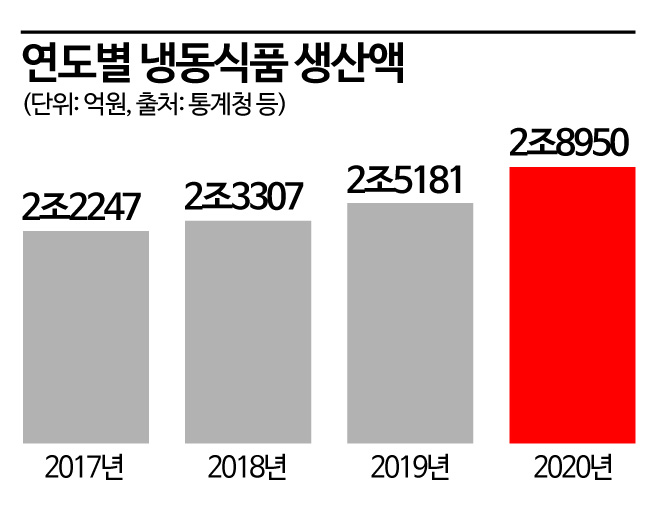
The domestic frozen food market ignited growth as dining out decreased and demand for home-cooked meals expanded during the early COVID-19 period, attracting active consumers not only in their 20s and 30s but also those aged 50 and above. Additionally, the widespread adoption of air fryers in households and the launch of various home meal replacements (HMR) expanded the market, influencing overall frozen food market growth.
In particular, with the recent rise in overall living costs, consumers' expectations to solve a cost-effective meal have increased, and they regard frozen foods as one of the cost-effective food options. Consumers are choosing frozen chicken and pizza as alternatives to relatively expensive delivery chicken and pizza, considering cost-effectiveness.
The business-to-business (B2B) market experienced a temporary sales decline due to the spread of COVID-19, remote work, and online classes, but since social distancing measures were lifted and daily life began to recover this year, it is showing signs of returning to pre-COVID-19 levels.
© The Asia Business Daily(www.asiae.co.kr). All rights reserved.
![Clutching a Stolen Dior Bag, Saying "I Hate Being Poor but Real"... The Grotesque Con of a "Human Knockoff" [Slate]](https://cwcontent.asiae.co.kr/asiaresize/183/2026021902243444107_1771435474.jpg)













