Legal Plan Revision to Restore Development and Preservation Balance Following Urban Regeneration Direction Shift
Reestablishing Basic Urban Regeneration Policies Reflecting Social Conditions and Citizen Demand...Specific Operational Standards Reorganized
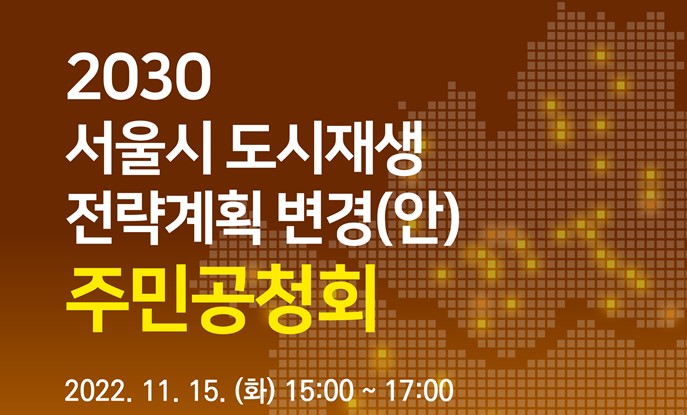
[Asia Economy Reporter Lim Cheol-young] Seoul City announced on the 14th that it will hold a public hearing on the "2030 Seoul City Urban Regeneration Strategic Plan Amendment" on the 15th at the auditorium of the Welfare Building in Seoul City Hall, with participation from general citizens, experts, and public officials. This comes as the city is promoting the "Urban Regeneration Strategic Plan Amendment" to concretely realize the direction shift to "2nd generation urban regeneration" announced in June last year.
The Seoul City Urban Regeneration Strategic Plan is the highest-level statutory plan in the urban regeneration field under Article 12 of the "Special Act on the Promotion and Support of Urban Regeneration." Since the city first established the strategic plan in 2015, urban regeneration projects have been promoted accordingly.
So far, while urban regeneration projects have achieved results in revitalizing the local economy, limitations have been pointed out, such as focusing on preservation and management rather than environmental improvement and infrastructure expansion, and implementing projects that do not meet the changed citizen demands, such as activation of living infrastructure facilities like libraries and parking lots and maintenance projects.
This strategic plan contains measures to concretely realize the 2nd generation urban regeneration announced in June last year. To systematically promote and enhance the feasibility of 2nd generation urban regeneration, the basic direction of urban regeneration has been reestablished to restore the balance between development and preservation, and new standards for operating revitalization areas have been prepared by diversifying maintenance methods.
In particular, Seoul City set a new policy direction called "Balanced Development of Declining Areas" in this strategic plan to strengthen urban competitiveness and realize balanced development policies. Specific measures include: actively supporting private sector "proactive maintenance" to respond to citizen demands; utilizing various means encompassing development, maintenance, and management to restore the balance between preservation and development; and reorganizing the public support system to promote more substantial project implementation and induce private investment.
First, Seoul City plans to shift from focusing on environmental improvement of public spaces to actively supporting private maintenance, convert key facilities that were operated as community spaces into living infrastructure facilities (SOC), and improve operational efficiency. On-site support centers within each urban regeneration project area will be reorganized into specialized support centers that assist with local needs such as development and maintenance.
Seoul City expects that urban regeneration promoted through this strategic plan amendment will enhance Seoul's urban competitiveness and establish itself as a new project model for balanced development of declining areas.
Meanwhile, this strategic plan includes five general neighborhood-type areas selected as urban regeneration activation areas from 2020 to 2021: Mangwoo Bon-dong area, Sinwol 1-dong area, Doksan 2-dong area, Hwagok Central Market area, and Yongdap Sangga Market area. The previously designated Janganpyeong area will have some changes in type and area. After the public hearing, the city plans to amend and finalize the strategic plan through opinions from the city council, consultations with related agencies, and review by the Urban Regeneration Committee, followed by official announcement.
Yeo Jang-kwon, Head of Seoul City's Balanced Development Headquarters, said, "Through the amendment of the highest-level statutory plan, the Urban Regeneration Strategic Plan, we plan to create a system that develops where development is needed and firmly supports preservation where necessary," adding, "By applying various project methods possible under the Urban Regeneration Special Act, we aim to contribute to improving citizens' quality of life through strengthening urban competitiveness and realizing balanced development policies."
© The Asia Business Daily(www.asiae.co.kr). All rights reserved.

















