Provincial Education Superintendents, Teacher Organizations, and University Presidents to Persuade National Assembly
Bill Scheduled for Submission at Education Committee on 18th
Only 3.7% of Ministry of Education Budget Allocated to Higher Education
University Financial Revenues Continue to Decline
Increase in Number of Classes and Schools Leads to Additional Operating and Personnel Costs
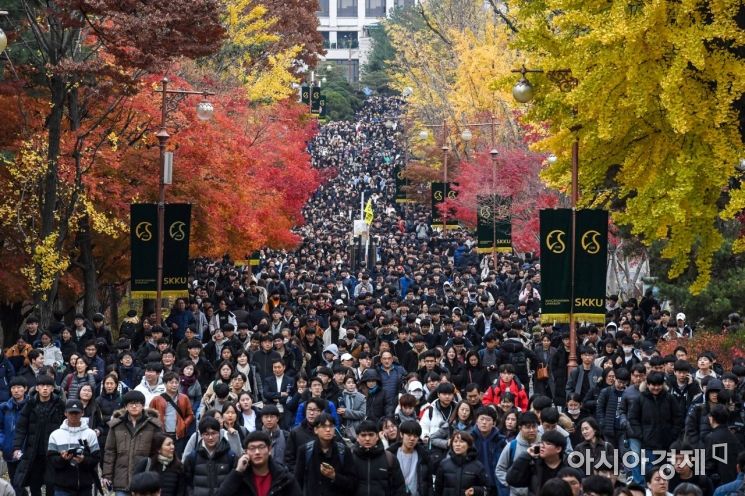 On the 17th, examinees are leaving the test site after completing the '2020 Academic Year Early Admission Essay Exam' held at Sungkyunkwan University in Jongno-gu, Seoul. Photo by Jinhyung Kang aymsdream@
As provincial education superintendents oppose the reform of the local education finance grant system, university presidents are also engaging in efforts to persuade the National Assembly, intensifying the public opinion battle.
According to the education sector on the 12th, the Local Education Finance Grant Act and the Higher and Lifelong Education Special Account Act will be submitted to the full meeting of the National Assembly's Education Committee on the 18th. The local education finance grant is funded by 20.79% of domestic taxes and a portion of the education tax. Except for the transfer to the Special Account for Early Childhood Education Support, which supports early childhood education and childcare fees from the education tax, the remainder constitutes the grant funds. The government is promoting a plan to use the education tax transfer portion of the local education finance grant for higher education accounts to resolve the financial difficulties in higher education. The education tax fund amounts to 5 trillion won annually, with 3 trillion won incorporated into the special account each year to be invested in university education. On September 9, Lee Tae-gyu, a member of the People Power Party, proposed the two bills.
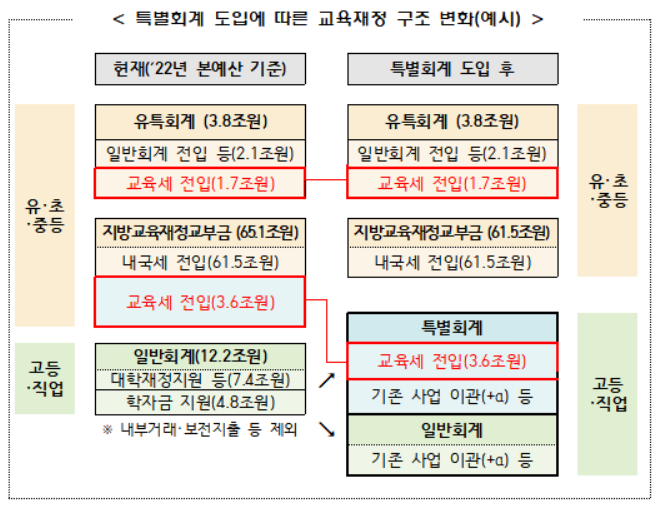
The Korean Council for University Education, a nationwide consortium of four-year universities, decided that university presidents will meet with the National Assembly's Education Committee, Budget and Accounts Committee, and the floor leaders of both ruling and opposition parties to urge the urgent expansion of higher education funding. Hong Won-hwa, chairman of the council, said, "Of the Ministry of Education's 2023 budget of 101.8 trillion won, the higher education budget is 12.1 trillion won. Excluding the national scholarship fund (4.5 trillion won) and operating expenses for national universities (3.8 trillion won), the actual higher education budget is 3.8 trillion won, which is only 3.7% of the total budget." He added, "It is urgent to increase investment to enhance university education and research competitiveness." Due to tuition freezes, university financial revenues have been continuously decreasing. According to the council, private universities' revenues have decreased by 7.7% compared to 2011, and national and public universities' revenues have decreased by 18.2% compared to 2015.
The council argues that Korea's per-student public education expenditure ranks 30th out of 38 OECD countries and that government support for higher education as a percentage of GDP must be raised to 1.1% to approach the international average. The Ministry of Education analyzed that the university admission quota will decrease from the current 475,000 to 310,000 by 2033. Given the declining school-age population, universities' survival could be at risk, so financial investment in higher education is necessary.

Provincial education superintendents and teacher organizations are opposing the reform of the local education finance grant system through one-person protests and nationwide civic movements. The Provincial Education Superintendents Council has formed a task force (TF) called the "Special Committee for Securing Local Education Finance Grants" and projected that parental burden costs will amount to 7 trillion won over the next three years. The TF's analysis of future education demand showed that while the number of students decreased by 370,000 (6.6%) from 2017 to 2021, the number of schools increased by 353 (2.2%), classes by 4,563 (1.9%), and teachers by 8,981 (2.3%). The TF noted that oversized schools and overcrowded classes have increased, and that the rise in schools, classes, and teachers will require additional operating expenses and teacher salaries, leading to an increase in fixed rigid costs.
Additionally, an analysis of the scale and trends of local education finances predicts that they will not increase excessively in the future, and the annual rates of unused and carried-over funds will steadily decrease. As the grant budget has increased proportionally with the surge in central government budgets, the amount accumulated as funds by provincial education offices due to budget carryovers and unused funds caused by insufficient project periods stands at approximately 19.2087 trillion won as of the end of this year. The primary and secondary education sector plans to invest this fund in improving educational conditions and restructuring school spaces.
The TF explained, "The modest increase in education grants after 2023 (1.0% to 3.7% year-on-year) is necessary for increases in personnel expenses and school operating costs, and the temporarily increased fund accumulation will decrease soon if invested in resources needed for future education demand."
Kim Ji-chul, Superintendent of Chungnam Provincial Office of Education, stated, "Arguing for a reduction in education finances solely based on the decrease in student numbers assumes that the current education system is optimal. Considering the accumulated deficits in education investment, reducing investment at this point would mean losing the driving force for future education."
© The Asia Business Daily(www.asiae.co.kr). All rights reserved.



















