Nickname 'Hellhound' for BQ.1.1 on Overseas SNS
Predicted to Become Dominant Strain in Europe Next Month
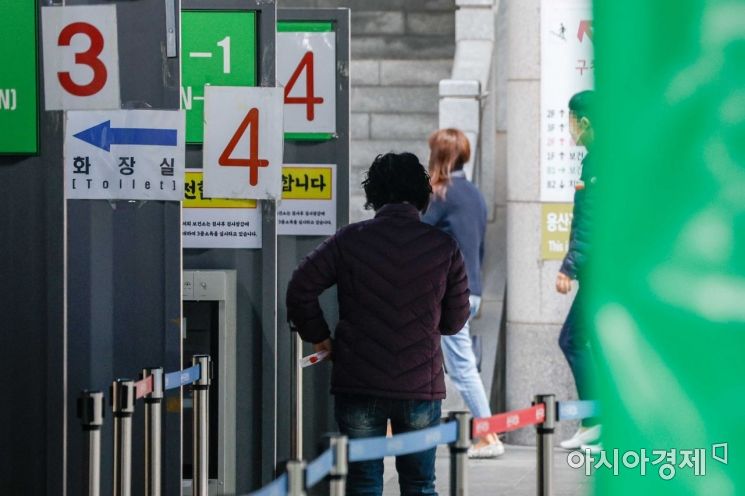 On the 10th, when 55,365 new COVID-19 cases were reported, citizens visiting the screening clinic set up at Yongsan-gu Public Health Center in Seoul were moving to get tested. Photo by Jinhyung Kang aymsdream@
[Asia Economy Reporter Kim Young-won] Following the global spread of BA.5, various new variants have emerged, attracting attention with the assignment of nicknames. There are also diverse opinions on the impact of the increasing prevalence of the nicknamed BQ.1.1 and BA.2.75 variants on the winter resurgence.
After BA.2.75, which originated in India, was nicknamed "Centaurus," overseas social networking services (SNS) have given BQ.1.1 the nickname "Hellhound." The Hellhound refers to a "dog of hell," known as a creature appearing in legends and myths.
The reason for these nicknames is that many experts and health authorities predict that BQ.1 and BQ.1.1 will account for a high proportion of COVID-19 variants this winter. Carolina Darias, Spain's Minister of Health, stated, "It is estimated that BQ.1 and BQ.1.1 will be dominant by the end of this month or early December." The European Centre for Disease Prevention and Control (ECDC) forecasts that the share of BQ lineage COVID-19 cases will exceed 80% by early next year.
In the United States, the BQ variants have already increased to levels similar to BA.5's prevalence. As of the 5th, the combined share of BQ.1.1 and BQ.1 over one week was 35.3%, while BA.5 was 39.2%. BQ.1.1 was detected at 18.8%, and BQ.1 at 16.5%. During the same period, domestically, BA.5 detection rate remains dominant at 86.0%, but BQ.1.1 was detected at 2.2%, and BA.2.75 at 5.3%, showing a growing proportion.
Although these variants are known to have immune evasion capabilities, their impact on severity has not yet been identified. In Germany and France, where the resurgence came early due to the increased prevalence of BF.7 and BQ.1.1, confirmed cases rose for six weeks starting from the fifth week of September but have recently begun to decline again. Deaths also increased for five weeks before either decreasing or stabilizing.
For this reason, some opinions suggest that the increase in Omicron subvariants will not significantly change the COVID-19 epidemic pattern. Carsten Watzl, Secretary General of the German Immunology Society, said, "Even if BQ.1.1 evades certain immunity, it cannot completely overcome immunity."
Baek Kyung-ran, Commissioner of the Korea Disease Control and Prevention Agency, regarding quarantine responses to variant inflows, said, "Although the prevalence of BQ.1, BQ.1.1, and BF.7, which are spreading in Europe and the United States, is not yet high domestically, if the inflow and transmission speed of variants increase significantly, it could affect the epidemic in our country." She added, "Moreover, since new variants continue to emerge and may affect case occurrence and severity, we will conduct thorough monitoring."
© The Asia Business Daily(www.asiae.co.kr). All rights reserved.

















