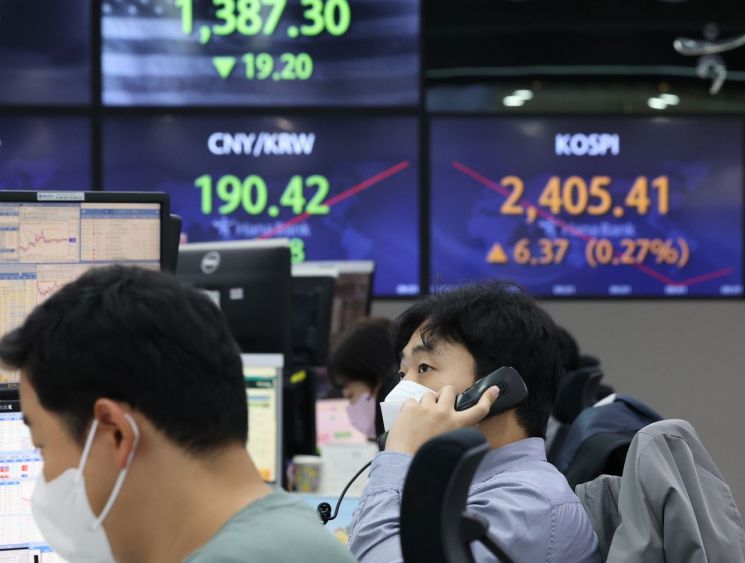
[Asia Economy Reporter Lee Seon-ae] On the 10th, the KOSPI ended its four-day rally streak and closed lower. This is interpreted as investor sentiment cooling down again due to the sharp decline in the U.S. stock market overnight. Additionally, Binance's announcement to withdraw from acquiring FTX increased volatility in the cryptocurrency market, adding to the burden. Furthermore, cautious sentiment deepened ahead of the U.S. Consumer Price Index (CPI) announcement.
On that day, the KOSPI index closed at 2402.23, down 22.18 points (0.91%) from the previous trading day. It turned negative after five trading days. The overnight New York stock market, which ended a 'three-day rally,' closed sharply lower, influencing the KOSPI. The cryptocurrency market showed signs of collapse, strengthening risk-averse sentiment and causing a significant retreat.
Kim Seok-hwan, a researcher at Mirae Asset Securities, said, "The KOSPI declined due to profit-taking mainly in large-cap stocks that had recently shown strength and the emergence of safe-haven asset preference ahead of the U.S. CPI announcement." He added, "Semiconductor and cryptocurrency-related stocks fell amid increased volatility in the cryptocurrency market, and the Democratic Party's strong performance in the U.S. midterm elections, which is negative toward crypto asset policies, also contributed to the decline in investor sentiment."
In the KOSPI market, foreigners and institutions showed net selling. Foreigners and institutions sold approximately 117.9 billion KRW and 158.3 billion KRW, respectively. Only individuals ended the day with net buying, purchasing 237.4 billion KRW.
Choi Yoon-ah, a researcher at Shinhan Investment Corp., said, "The KOSPI showed a weak trend due to cautious sentiment toward the CPI and strong dollar pressure caused by uncertainty over the U.S. midterm elections." She added, "Foreigners switched to net selling by selling semiconductor and steel sectors."
By sector in the KOSPI, the decline was prominent. Chemicals and electric/electronics fell by over 1%, while securities, electric/gas utilities, telecommunications, manufacturing, insurance, machinery, services, steel and metals, distribution, finance, transportation/warehousing, and transportation equipment fell by less than 1%. Food and beverages and non-metallic minerals fell by over 1%, while medical precision, textiles/apparel, pharmaceuticals, construction, and paper/wood rose by less than 1%.
The top market capitalization stocks also showed a strong downward trend. Samsung Electronics, which had continued its strength, fell more than 2% that day, turning negative again to 60,400 KRW. This marked a shift to weakness after five trading days. This is interpreted as influenced by the Philadelphia Semiconductor Index in the U.S. falling 78.57 points to 2424.82 the previous day.
LG Chem and Kakao also fell by around 2%, and Samsung SDI, NAVER, and Kia fell by about 1%. LG Energy Solution rose by about 1%, reaching an intraday high of 610,000 KRW, marking a 52-week high.
The KOSDAQ closed at 707.78, down 6.82 points (-0.95%) from the previous trading day. Although it briefly surpassed the 710 level during the session, it closed lower. Individuals alone bought 210.4 billion KRW, while foreigners and institutions sold 94.2 billion KRW and 110.4 billion KRW, respectively. Foreigners switched to net selling after four trading days.
By sector in the KOSDAQ, most sectors were weak. Broadcasting services and digital content fell by over 2%, while telecommunications equipment, semiconductors, other services, broadcasting services, telecommunications broadcasting services, chemicals, internet, and non-metallic sectors fell by about 1%. Machinery equipment, pharmaceuticals, manufacturing, entertainment culture, and publishing media reproduction fell by less than 1%.
All of the top 10 market capitalization stocks fell. These include Celltrion Healthcare (-1.31%), EcoPro BM (-2.02%), L&F (-1.16%), HLB (-3.23%), Kakao Games (-1.08%), EcoPro (-3.13%), Pearl Abyss (-8.30%), Celltrion Pharm (-1.47%), Cheonbo (-2.51%), and Lino Industrial (-1.96%).
Han Ji-young, a researcher at Kiwoom Securities, said, "The domestic stock market is expected to show a weak trend influenced by the adjustment in major U.S. sectors such as semiconductors, big tech, and energy due to uncertainty over the U.S. midterm elections, despite favorable foreign demand conditions, and cautious sentiment toward the October U.S. CPI (consensus 7.9%)." She added, "Although short-term market volatility may increase until the runoff vote of the U.S. midterm elections in Georgia scheduled for the 6th of next month, the overall market trajectory will depend on existing macroeconomic events such as the CPI and Federal Open Market Committee (FOMC) announcements."
In the Seoul foreign exchange market, the won-dollar exchange rate closed at 1,377.5 KRW, up 12.7 KRW from the previous trading day.
© The Asia Business Daily(www.asiae.co.kr). All rights reserved.

















